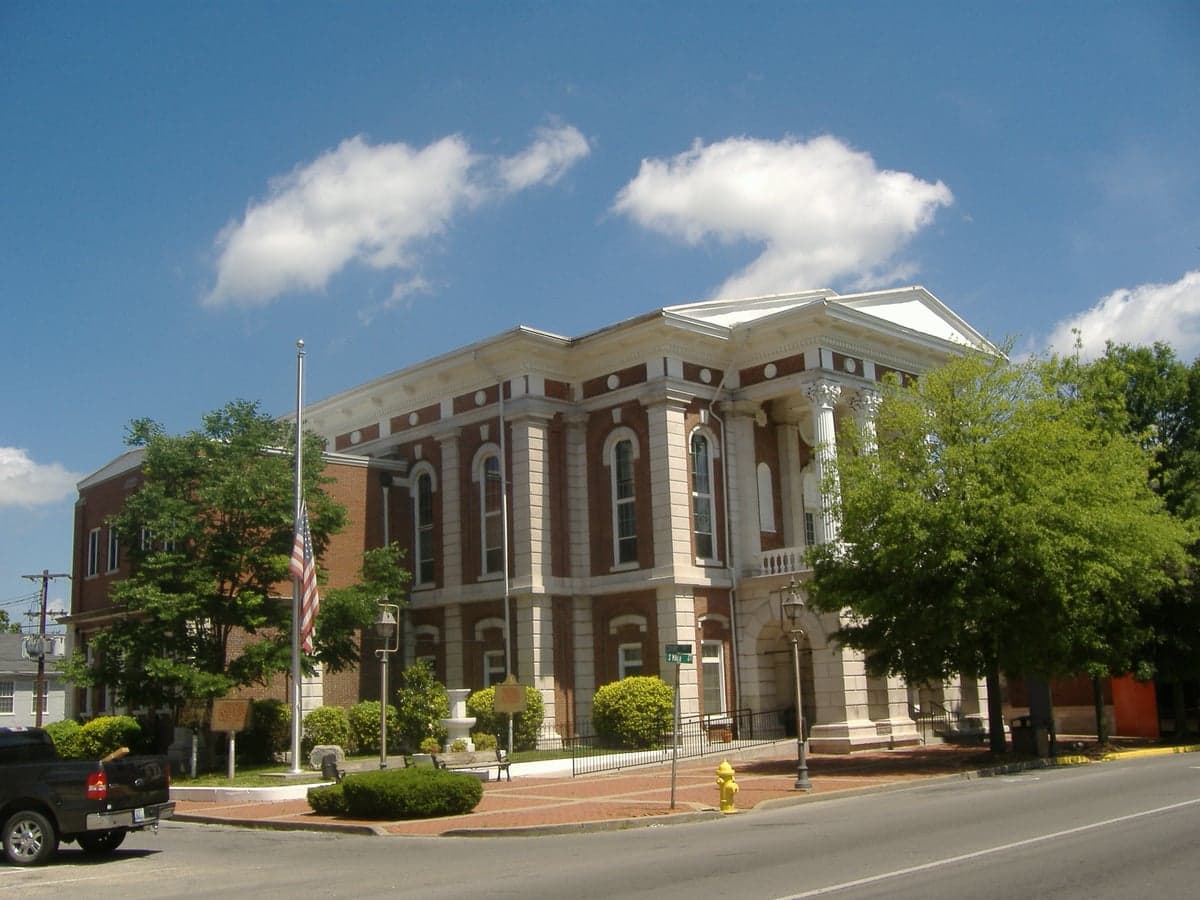
Photo: Wikipedia
Demographics of Christian County
Affluence Level in Christian County
A below-average socioeconomic profile. Incomes, home values, and educational attainment trail the U.S., with higher poverty and unemployment.
People of Christian County
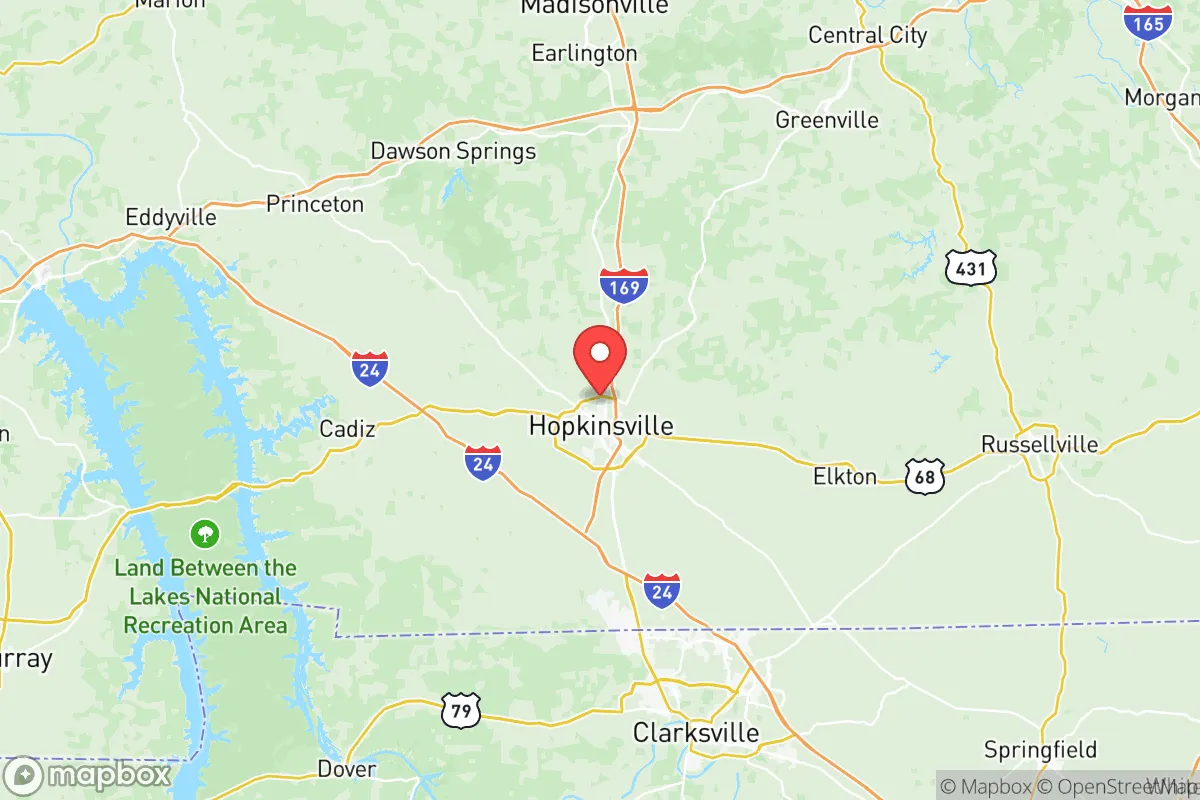
Christian County, Kentucky, is home to 72,599 residents, a population shaped overwhelmingly by its deep military roots and Southern heritage. The county’s character is defined by Fort Campbell, a sprawling U.S. Army installation that drives a transient, younger, and more racially diverse population than the surrounding region, while the county seat of Hopkinsville anchors a stable, predominantly white, and culturally conservative community. With a foreign-born population of just 1.4% and a college attainment rate of 20.0%, Christian County remains a place where local-born families and military-connected transplants coexist, creating a distinct identity that is both insular and globally connected through the base.
Settlement & growth (pre-1960)
Before European settlement, the area now known as Christian County was part of the hunting grounds of the Cherokee and Shawnee nations, who used the region’s abundant game and the Cumberland and Tennessee river corridors. No permanent Native villages existed within the county’s current boundaries, as the land was contested between tribes and largely avoided by European colonists until after the American Revolution.
Permanent settlement began in earnest after Kentucky statehood in 1792. The first wave of settlers were overwhelmingly Scots-Irish and English pioneers moving south and west from Virginia and North Carolina via the Wilderness Road. They were drawn by the promise of cheap, fertile land under the Virginia Military District land grants, which awarded acreage to veterans of the Revolutionary War. These early families established small farms and the first county seat, Hopkinsville, founded in 1796 and named after General Samuel Hopkins. The county itself was formed in 1797 from Logan County. A secondary settlement, Crofton, emerged later in the 19th century as a railroad stop along the Louisville and Nashville line, attracting a mix of farmers and small tradesmen.
Through the 19th century, the population grew slowly but steadily, dominated by native-born white families of British Isles descent. The institution of slavery was present but not as dominant as in the Deep South; by 1860, enslaved African Americans made up roughly 25% of the county’s population, working primarily on tobacco and hemp farms. After the Civil War and Emancipation, freedmen established several rural communities, most notably Pembroke, which became a center of African American life and landownership in the late 1800s. The town of LaFayette also developed as a small agricultural hamlet serving the surrounding farm population.
The 20th century brought the single most transformative event in the county’s history: the establishment of Camp Campbell (later Fort Campbell) in 1941. The U.S. Army selected the area straddling the Kentucky-Tennessee border for its rolling terrain and sparse population, displacing a handful of farming families. The base brought an immediate influx of soldiers, civilian employees, and their families from across the United States, fundamentally altering the county’s demographic and economic base. Hopkinsville grew rapidly as a service hub, and the tiny community of Oak Grove, located just outside the base’s main gate, transformed from a crossroads into a bustling bedroom community. By 1960, the county’s population had surged past 50,000, with Fort Campbell-related personnel making up a significant and growing share.
Modern era (post-1965)
The 1965 Hart-Cellar Act had a minimal direct impact on Christian County, as the area never attracted the large-scale immigrant streams that reshaped coastal and urban America. The foreign-born population remains at just 1.4%, one of the lowest rates in Kentucky. The county’s modern demographic story is instead driven by domestic migration tied to the military and, to a lesser extent, by natural growth among the existing Black and white populations.
The most significant post-1965 shift has been the growth of the Hispanic population, which now stands at 8.4%. This is largely a result of military families with Hispanic surnames being stationed at Fort Campbell, as well as a smaller number of civilian workers drawn to construction, agriculture, and service jobs in the Hopkinsville area. There is no single Hispanic enclave; instead, families are dispersed throughout Hopkinsville and Oak Grove, reflecting the military’s integrating effect. The Black population, at 19.0%, is concentrated in Hopkinsville’s historic neighborhoods and in the rural community of Pembroke, where descendants of post-Civil War settlers remain. The East/Southeast Asian population (0.8%) and Indian subcontinent population (0.4%) are almost entirely military-connected, with families living near the base in Oak Grove and the Fort Campbell housing areas.
Suburbanization has reshaped the county since the 1980s. Oak Grove has grown from a small village into the county’s second-largest population center, with new subdivisions, retail corridors, and schools catering to military families who prefer off-base housing. Hopkinsville has experienced slower growth, with its historic downtown facing challenges from suburban retail competition. The county’s white population, at 64.4%, is a mix of long-standing local families and military retirees who chose to stay after service. The college-educated share of 20.0% is below the national average, reflecting the county’s rural character and the fact that many military personnel do not hold four-year degrees.
The future
Christian County’s demographic future is tied almost entirely to the trajectory of Fort Campbell. The base is a major strategic asset for the U.S. Army, housing the 101st Airborne Division, and is unlikely to face significant downsizing in the near term. This means the county will continue to experience a steady churn of in-migration from across the country, maintaining its relatively young median age and its racial and ethnic diversity relative to surrounding rural counties. The Hispanic share is likely to grow slowly, as military families of Hispanic origin are a growing demographic within the Army, but the foreign-born percentage will remain low.
The county is not tribalizing into distinct ethnic enclaves; rather, the military’s integrating effect tends to disperse families across neighborhoods and school zones. The long-standing Black community in Pembroke and Hopkinsville is stable but aging, with younger generations often leaving for urban job markets. The white population, both local and military-connected, remains the dominant cultural force, and the county’s political and social conservatism is likely to persist. The biggest challenge is economic: the county’s low college attainment rate and reliance on the base for employment make it vulnerable to any future defense spending cuts. Growth in the small towns of Gracey and Fairview will remain minimal, as they lack the infrastructure and proximity to attract new residents.
For someone moving in now, Christian County is a place where the military presence creates a more transient and diverse community than the surrounding region, but where the underlying culture remains deeply rooted in Southern, conservative values. The population is stable in size, with slow growth likely, and the key dynamic is the constant turnover of military families rather than the arrival of new immigrant groups or domestic migrants from other regions. The county is becoming neither more homogenized nor more fragmented; it is simply continuing its role as a military town with a rural Kentucky backdrop.

* Values derived from national, state, county, city and local statistics and may differ in a specific area. Last updated: 2026-05-11T10:29:54.000Z
Narrative content on this page is AI-generated and may contain mistakes. Verify any details that matter before acting on them.
ReloMaps may earn a commission from affiliate links at no extra cost to you.

