
Photo: Wikipedia
Personal Sovereignty in Daviess County
Viable for self-reliance. Generally workable, though some barriers may limit total independence.
What does Personal Sovereignty tell us?
Personal Sovereignty measures your capacity for self-reliance and independence with minimal government friction. Higher scores mean fewer barriers between you and the way you want to live... but it assumes you have the space you need and good neighbors.
What does this tell us?
Personal Sovereignty measures your capacity for self-reliance and independence with minimal government friction. Higher scores mean fewer barriers between you and the way you want to live... but it assumes you have the space you need and good neighbors.
State Policy
Energy independence: Importer (60% of energy produced in-state)
Personal Liberty
Homesteading

Personal Liberty Analysis
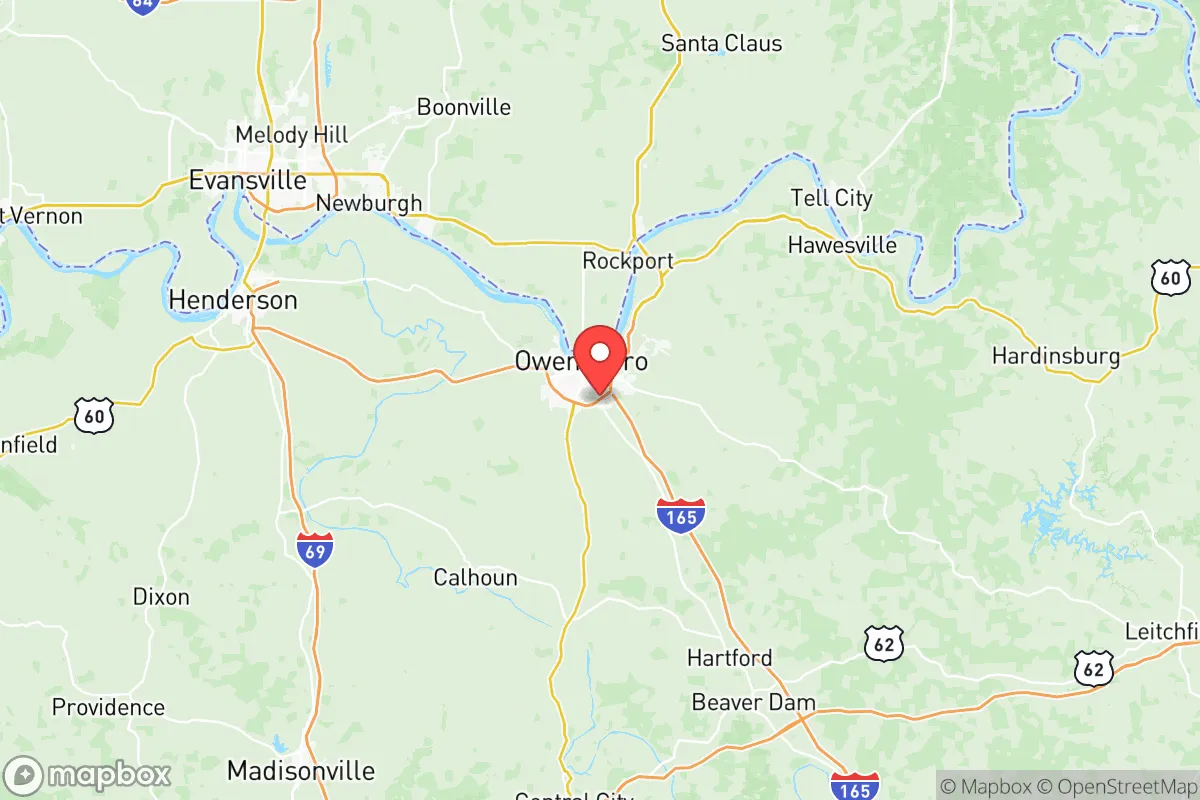
Daviess County, Kentucky, anchored by the city of Owensboro but extending into smaller communities like Whitesville, Philpot, and Utica, offers a personal sovereignty environment that leans heavily on Kentucky's broader constitutional protections and a local culture of self-reliance. The county strikes a balance between the conveniences of a regional hub and the regulatory lightness found in more rural parts of the state, making it a viable option for individuals and families who prioritize autonomy over government oversight. While not a libertarian enclave, the area's tax structure, gun laws, and land-use policies generally favor personal independence, though specific local ordinances and zoning in Owensboro create meaningful differences from the county's unincorporated areas.
Tax burden and regulatory posture in Daviess County
Kentucky's flat state income tax of 4.5% (as of 2026) and a state sales tax of 6% apply uniformly, but Daviess County's local tax burden is moderate compared to neighboring counties. The county imposes a 0.5% occupational license fee on wages and net profits, which is lower than the 1% or more seen in some urban Kentucky counties. Property taxes are assessed at a relatively low rate: the county's real property tax rate is approximately 13.5 cents per $100 of assessed value, with the city of Owensboro adding roughly 21 cents per $100 for residents within city limits. This means a homeowner with a $200,000 property in unincorporated Daviess County pays about $270 annually in county property tax, while an Owensboro resident pays closer to $690 when city and school taxes are combined. The regulatory posture is generally light-touch outside of Owensboro's municipal code. Business licensing is straightforward, and there are no county-level rent control or price control ordinances. However, building permits are required for new construction and major renovations countywide, with fees that are standard for the region. For those seeking the least regulatory friction, unincorporated areas near Philpot or Utica offer a notably lighter touch than the city limits of Owensboro.
Self-defense and gun law specifics in Daviess County
Kentucky is a constitutional carry state, meaning no permit is required to carry a concealed firearm for anyone legally allowed to possess one. Daviess County fully reflects this state law, and local law enforcement in Owensboro and the surrounding communities generally respects the right to carry without harassment. The county sheriff's office issues concealed carry permits for reciprocity purposes, but the process is administrative, not discretionary. There are no county-specific gun registration or storage laws, and the local political climate is strongly supportive of the Second Amendment. Shooting ranges are available, including the Daviess County Gun Club near Maceo, and there are no county ordinances restricting the discharge of firearms on private property in unincorporated areas, provided standard safety and nuisance laws are followed. Within Owensboro city limits, discharging a firearm is prohibited except at approved ranges or in self-defense, a common municipal restriction that does not apply in rural parts of the county like Whitesville or Yelvington. Stand-your-ground and castle doctrine laws apply statewide, giving residents broad legal protection for using force in self-defense without a duty to retreat.
Self-reliance and homesteading viability in Daviess County
Homesteading and off-grid living are feasible in Daviess County, but viability depends heavily on location. Unincorporated areas generally have minimal zoning restrictions, allowing for livestock, gardens, and alternative structures. Minimum lot sizes in agricultural zones are typically 1 to 3 acres, though some areas zoned for rural residential allow parcels as small as half an acre. In Philpot and Utica, properties with 5 to 10 acres are common and affordable, with land prices averaging $4,000 to $7,000 per acre as of 2026. Off-grid systems like solar panels, rainwater collection, and composting toilets are not prohibited by county code, but any permanent dwelling must meet state building codes and obtain a septic system permit from the Daviess County Health Department. There is no county-wide ban on tiny houses or manufactured homes, though they must comply with HUD standards. Within Owensboro city limits, zoning is more restrictive: lot sizes are smaller, livestock is generally prohibited, and accessory dwelling units require permits. For those serious about self-reliance, Whitesville and the area around Maceo offer the most permissive environment, with larger parcels, fewer neighbors, and a culture that values independence.
Personal liberties in Daviess County: parental rights, medical autonomy, speech, and property
Kentucky law provides strong protections for parental rights, including the right to direct a child's education and medical care. Daviess County has a robust homeschooling community, with the Daviess County Public Schools district offering a homeschool liaison and resources for families who choose to educate at home. There are no county-level vaccine mandates for children attending public school beyond state requirements, and medical autonomy is generally respected, though Kentucky's strict abortion laws apply statewide. Free speech is protected under the First Amendment, and there are no local ordinances restricting political expression or assembly. Property rights are well-defined, with the county following Kentucky's adverse possession and easement laws. The Daviess County Planning and Zoning Commission has authority over land use in unincorporated areas, but its regulations are primarily focused on subdivision and commercial development, not on restricting how individuals use their own land for personal purposes. Eminent domain is used sparingly, primarily for road projects and utility infrastructure. For those who value minimal government interference in personal decisions, the county's rural communities offer a notably higher degree of autonomy than the more regulated environment of Owensboro.
Overall, Daviess County ranks as a moderately high-sovereignty area within Kentucky, offering a lighter regulatory touch than urban centers like Louisville or Lexington but with more structure than the most rural eastern Kentucky counties. The key variable is location: Owensboro provides urban amenities with corresponding municipal codes, while Whitesville, Philpot, Utica, Maceo, and Yelvington offer a more permissive environment for those seeking self-reliance, homesteading, and minimal government oversight. For a conservative-leaning individual or family prioritizing personal freedom, the county's combination of low taxes, constitutional carry, and flexible land use makes it a strong contender, provided they choose the right community within its borders.

* Values derived from national, state, county, city and local statistics and may differ in a specific area. Last updated: 2026-08-09T13:37:07.000Z
Narrative content on this page is AI-generated and may contain mistakes. Verify any details that matter before acting on them.
ReloMaps may earn a commission from affiliate links at no extra cost to you.

