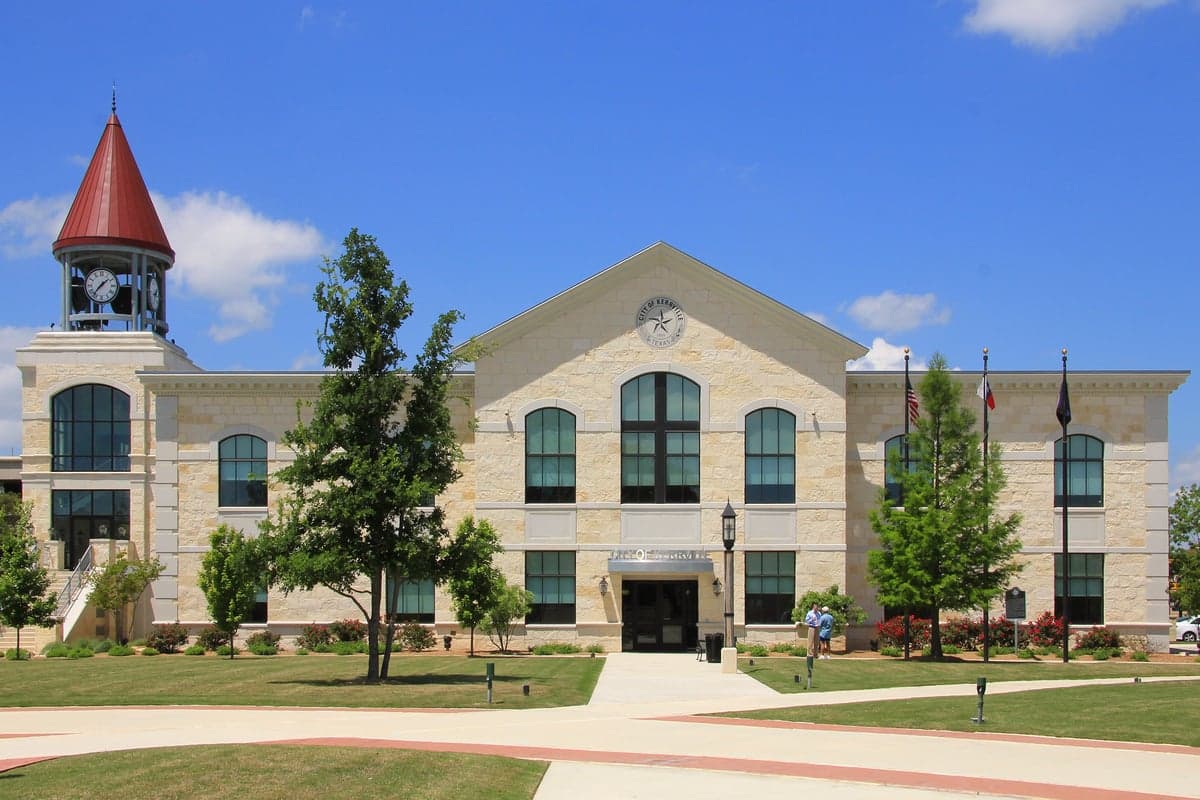
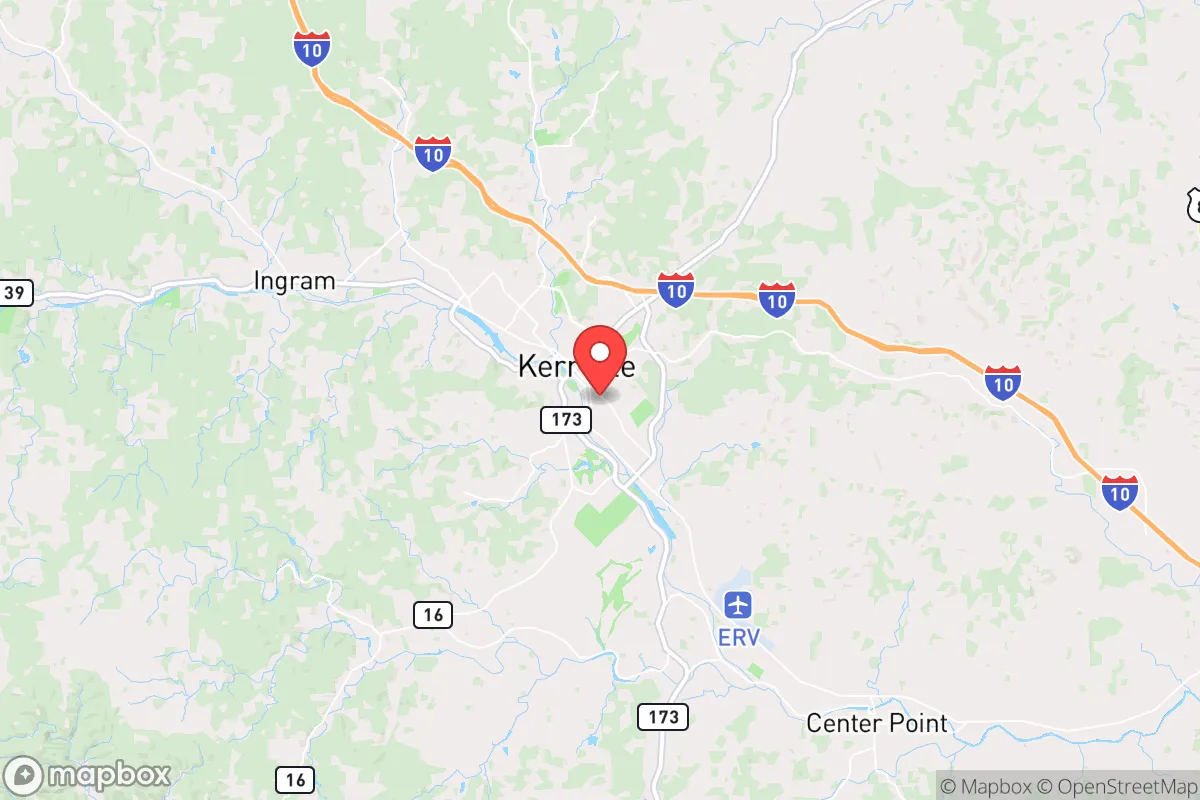
Photo: Wikipedia
Demographics of Kerrville, TX
Affluence Level in Kerrville, TX
A middle-class area roughly in line with national averages across income, home values, education, and employment.
People of Kerrville, TX
Kerrville, Texas, is a predominantly White (65.7%) and Hispanic (28.8%) city of 24,532 residents, shaped by a history of German and Anglo settlement, a mid-century tourism boom, and a recent influx of retirees and remote workers. The city’s character is defined by its Hill Country setting, a strong veteran and conservative presence, and a notably low foreign-born population of just 2.2%. With 32.4% of adults holding a college degree, Kerrville is more educated than the Texas average but remains culturally and politically homogeneous compared to larger metro areas.
How the city was settled and grew
Kerrville’s population history begins with German and Anglo settlers drawn by the Texas Hill Country’s land grants in the 1850s. The city was founded in 1856 by Joshua Brown, a Kentucky-born cattleman, but the earliest permanent residents were German immigrants who established farms and ranches along the Guadalupe River. These families built the Historic Downtown district, where stone and limestone buildings still house local businesses, and the Nimitz Addition neighborhood, named after the German-American Nimitz family who ran the Nimitz Hotel (now the National Museum of the Pacific War). By the early 1900s, Kerrville became a regional hub for wool and mohair production, attracting Anglo ranchers and a small number of Mexican laborers who worked the sheep and goat operations. The Southside neighborhood, south of the river, developed as a working-class area where these Mexican families settled, forming the foundation of today’s Hispanic community. The city’s population grew slowly but steadily, reaching about 5,000 by 1950, with the German and Anglo majority dominating civic and economic life.
Modern era (post-1965)
After the 1965 Immigration and Nationality Act, Kerrville did not experience the large-scale immigration seen in Texas cities like Houston or Dallas. Instead, its post-1965 growth came from domestic in-migration: retirees from the Midwest and Northeast seeking a mild climate and low cost of living, plus a steady stream of veterans drawn to the VA hospital and the city’s conservative culture. The Riverhill neighborhood, a master-planned community developed in the 1970s, became a magnet for affluent retirees and second-home owners, with large lots and golf course views. Meanwhile, the Hispanic population grew organically through higher birth rates and continued migration from South Texas and Mexico, concentrating in the Westside and Southside neighborhoods. The Black population, at 2.3%, remains small and is largely concentrated in the East Park area near the historic Black school and church. East/Southeast Asian communities (0.1%) and Indian-subcontinent residents (0.8%) are tiny and scattered, with no distinct ethnic enclave. The city’s foreign-born share (2.2%) is among the lowest in Texas, reflecting limited new immigration.
The future
Kerrville’s population is heading toward modest growth, driven by continued domestic in-migration of retirees and remote workers from California and the Northeast, who are attracted by the Hill Country lifestyle and lower housing costs. The Hispanic share is likely to rise slowly, from 28.8% toward 35% over the next decade, through natural increase and some migration from the Rio Grande Valley. However, the city is not tribalizing into distinct enclaves; instead, it is homogenizing around a conservative, family-oriented culture, with new subdivisions like River Ranch attracting a mix of White and Hispanic middle-class families. The Indian and East/Southeast Asian communities are expected to remain negligible, as Kerrville lacks the tech or university jobs that draw these groups to larger metros. The foreign-born share will likely stay below 5%, as the city’s economy—dominated by healthcare, tourism, and small manufacturing—does not generate the labor demand that drives immigration in other Texas cities.
For someone moving in now, Kerrville is becoming a more diverse but still overwhelmingly White and Hispanic community, with a stable, aging population and a strong conservative identity. The city offers a safe, slow-paced environment with good schools and outdoor amenities, but little ethnic or cultural variety. New residents should expect a place where the population is growing slowly, the political and social fabric is cohesive, and the demographic future looks more like a slightly browner version of the present than a dramatic transformation.

* Values derived from national, state, county, city and local statistics and may differ in a specific area. Last updated: 2026-05-10T17:53:21.000Z
Narrative content on this page is AI-generated and may contain mistakes. Verify any details that matter before acting on them.
ReloMaps may earn a commission from affiliate links at no extra cost to you.

