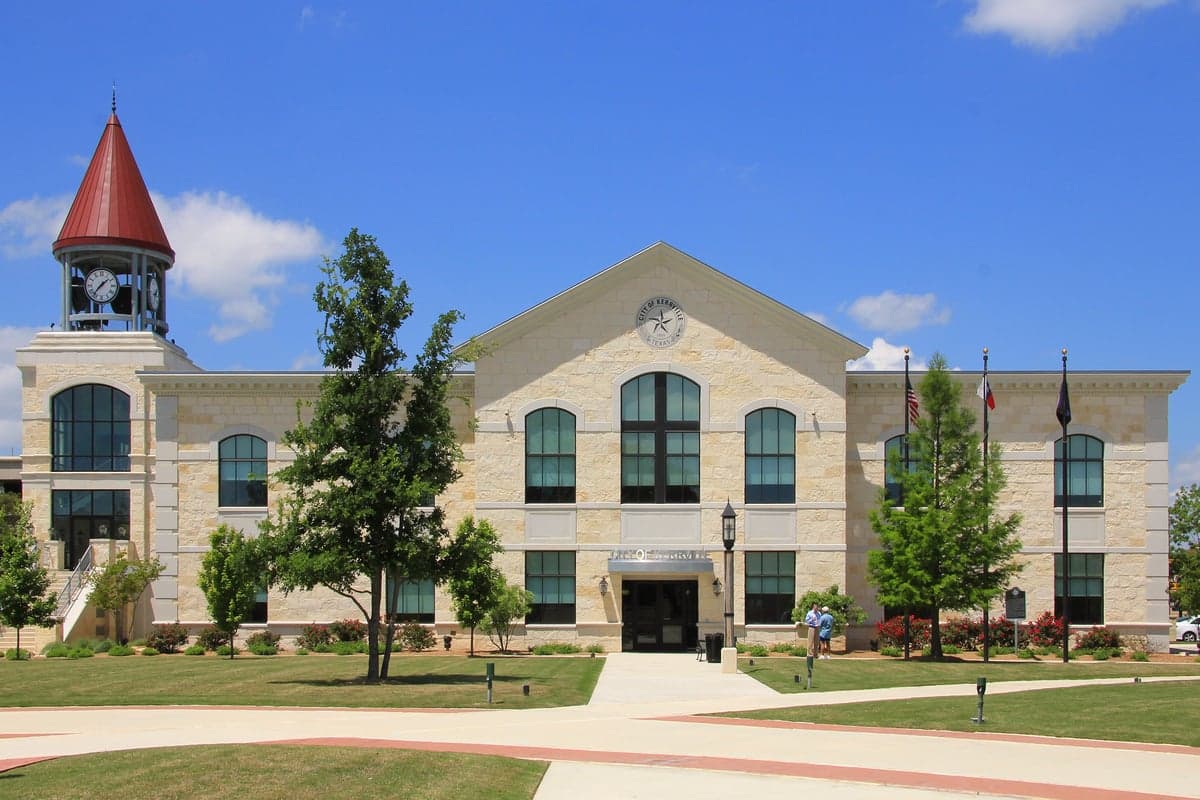
Photo: Wikipedia
Political ClimatePolitical Climate in Kerrville, TX
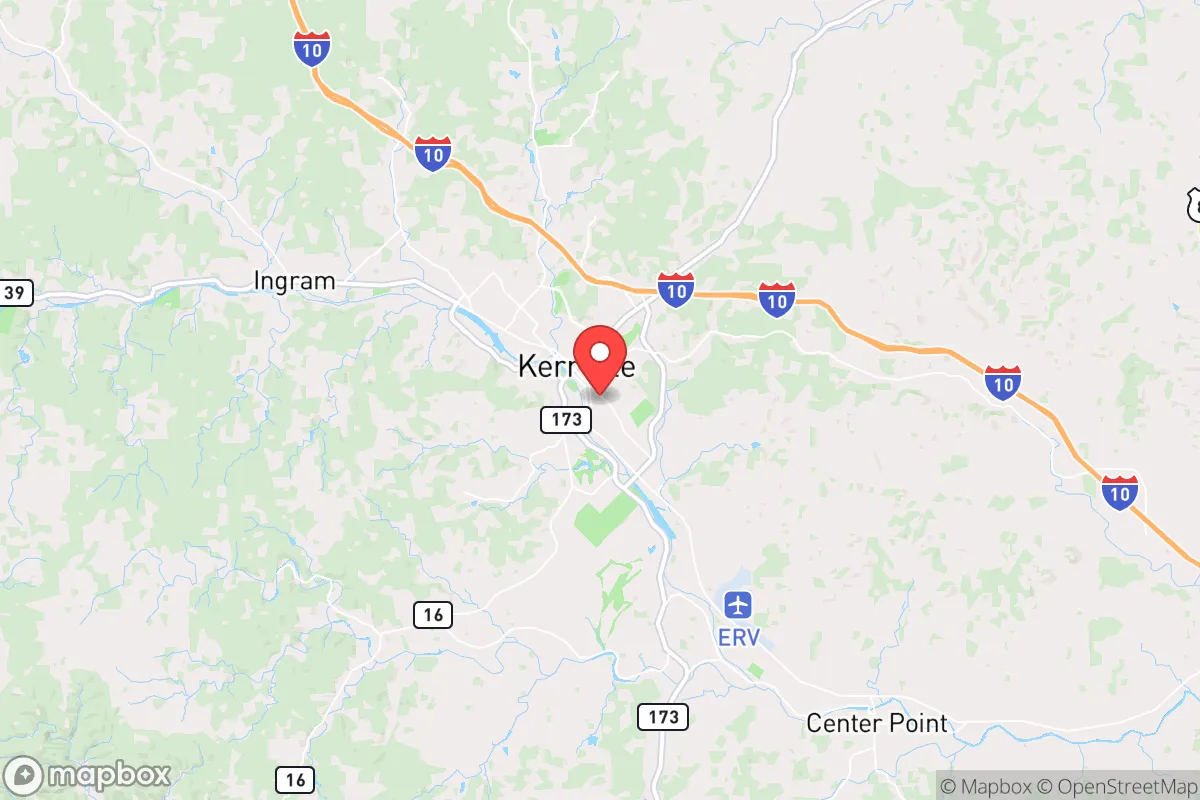
District shown is the primary district for this city’s centroid. Cities may span multiple districts.
Inherited from parent state — no local data available.
Local Political AnalysisPolitical Analysis of Kerrville, TX
Kerrville has long been a rock-ribbed conservative stronghold in the Texas Hill Country, and while the surrounding state of Texas carries a Cook PVI of R+4, this town leans significantly further right—think R+15 or more in most local races. The political climate here is rooted in a deep, generational distrust of government overreach, especially when it comes to property rights, gun ownership, and local control. You can feel it in the air at the Kerrville-Schreiner Park on a Saturday morning, where folks are more likely to debate the latest county commissioner decision than national headlines. That said, there’s been a subtle shift over the past decade, with a slow trickle of newcomers from places like Austin and San Antonio bringing more progressive ideas, and that’s got a lot of us watching the local elections a little closer than we used to.
How it compares
Compared to the rest of Texas, Kerrville is a conservative outlier even within a red state. While Texas as a whole has seen suburban districts like those around Dallas and Houston drift toward purple, Kerr County has held firm. The contrast is stark when you look at nearby towns: Fredericksburg to the south is similarly conservative but with a more libertarian streak, while Boerne to the east has seen a noticeable influx of San Antonio commuters, nudging it slightly more moderate. In Kerrville, the local Republican Party remains dominant, and you won’t find a single Democrat holding a countywide elected office. The real tension isn’t between Republicans and Democrats—it’s between traditional, limited-government conservatives and a newer wave of “country club” Republicans who are more comfortable with zoning laws and tax hikes for bike trails. That’s where the rubber meets the road for a lot of us who’ve been here since before the Schreiner University expansion changed the downtown vibe.
What this means for residents
For residents, this political climate means a daily life that’s largely free from the kind of heavy-handed regulation you see in larger Texas cities. Property taxes are still a sore spot—they’re high relative to rural counties—but there’s no city income tax, and the local government generally stays out of your business. You can build a shed on your land without a parade of permits, and the Second Amendment isn’t just respected; it’s assumed. The downside? If you’re hoping for rapid infrastructure improvements or a more diverse economy, the “slow growth” ethos can feel frustrating. The city council has resisted annexation and density increases, which keeps Kerrville small and quiet but also limits job opportunities outside of healthcare and tourism. The recent push for a “complete streets” plan raised eyebrows among locals who saw it as a backdoor to more government control over how we use our own roads.
One cultural distinction that sets Kerrville apart is its fierce independence from state-level mandates. During the COVID-19 pandemic, the county judge openly defied the governor’s orders on mask mandates, and the city never adopted a local mask ordinance. That kind of local pushback is baked into the town’s DNA. Looking ahead, the biggest concern among long-time residents is the potential for Austin-style politics to creep in as more remote workers and retirees from blue states discover the Hill Country. If the next few city council elections start favoring candidates who talk about “equity” or “sustainability” over property rights and fiscal restraint, you’ll see a real cultural clash. For now, though, Kerrville remains a place where your personal freedoms are respected, and the government’s main job is to stay out of the way—just the way most of us like it.

State Political ClimatePolitical Climate in Texas
State Political AnalysisPolitical Environment in the State
Texas has been a reliably Republican state for decades, with a Cook PVI of R+4, but the political climate is far from monolithic. The dominant coalition is a mix of rural conservatives, suburban moderates, and business-minded libertarians, though the last 10-20 years have seen a slow but steady shift toward competitive two-party politics, driven largely by explosive growth in the Dallas-Fort Worth, Houston, and Austin metros. While the state still leans right overall, the margin of victory for statewide Republicans has narrowed from double digits in the 2000s to single digits in recent cycles, a trend that has both conservatives and progressives watching closely.
Urban vs. rural divide
The political map of Texas is a stark study in contrasts. The vast rural and exurban areas—places like Lubbock, Midland, and the Panhandle—vote overwhelmingly Republican, often by margins of 70% or more. Meanwhile, the major urban centers are Democratic strongholds: Harris County (Houston) and Dallas County have flipped decisively blue, and Bexar County (San Antonio) and Travis County (Austin) are solidly progressive. The real battleground is the suburbs. Collin County (north of Dallas) and Fort Bend County (southwest of Houston) were once reliably red but have become competitive, with Collin County voting for Trump by only 6 points in 2020 after supporting Romney by 27 points in 2012. The Rio Grande Valley, historically a Democratic stronghold, has shifted rightward, with counties like Starr and Hidalgo moving double digits toward Republicans in 2020 and 2024. This urban-rural split means that state politics is a constant tug-of-war between the priorities of dense, diverse cities and the values of small-town and agricultural Texas.
Policy environment
Texas maintains a policy environment that is broadly friendly to conservative priorities, though with some notable exceptions. The state has no personal income tax, a major draw for relocating families and businesses, and property taxes are high but capped by a 2023 law (Proposition 4) that increased the homestead exemption and compressed school tax rates. The regulatory posture is light-touch, with no state-level occupational licensing for many trades and a right-to-work law that limits union power. On education, the state passed a school voucher-like program in 2023 (HB 1) that allows parents to use state funds for private or homeschool expenses, though it remains tied up in court challenges. Healthcare policy is a mixed bag: Texas did not expand Medicaid under the ACA, leaving roughly 1.5 million uninsured, but it has invested in rural hospital funding and telehealth. Election laws tightened after 2020 with SB 1, which banned drive-through voting and added ID requirements for mail ballots, a move that drew national attention but has withstood legal scrutiny. The state also passed a near-total abortion ban (SB 8, 2021) and a trigger law that took effect after Dobbs, making it one of the most restrictive states in the country on that issue.
Trajectory & freedom
On the freedom front, Texas has moved in two directions simultaneously. On the positive side for conservatives, the state expanded gun rights with permitless carry (HB 1927, 2021), allowing adults to carry handguns without a license. Parental rights were strengthened with a 2023 law banning gender-transition procedures for minors (SB 14) and requiring schools to notify parents of any changes in a child's mental or emotional health (HB 18). Property rights got a boost with the 2023 ban on foreign ownership of agricultural land near military bases (SB 147). On the concerning side, the state has seen an expansion of government overreach in the name of public health and social engineering. During COVID, Governor Abbott's executive orders on mask and vaccine mandates were heavy-handed, though later rolled back. More recently, the state has used its power to crack down on "sanctuary cities" (SB 4, 2017) and to preempt local ordinances on everything from plastic bag bans to tree preservation. The net effect is a state that is freer in many traditional conservative senses—guns, taxes, school choice—but increasingly willing to use state power to override local control, which cuts against the libertarian streak many Texans value.
Civil unrest & political movements
Texas has seen its share of political flashpoints. The 2020 Black Lives Matter protests in Austin, Dallas, and Houston were large and occasionally violent, leading to property damage and a lasting sense of unease in some downtown areas. On the right, the "Trump Train" convoy incidents on I-35 in 2020 and the January 6-related arrests of several Texans highlighted a more militant strain of activism. Immigration politics are a constant source of tension, with the state launching Operation Lone Star in 2021, deploying state troopers and National Guard to the border, busing migrants to northern cities, and passing SB 4 (2023) to make illegal entry a state crime—a law currently blocked by federal courts. The "Texit" movement, while fringe, has gained some traction online, with the Texas Nationalist Movement pushing for a secession referendum, though it has no real political power. Election integrity remains a hot-button issue, with the 2020 and 2022 cycles seeing lawsuits over ballot drop boxes and voter roll maintenance. A new resident would notice the heavy presence of political signage, especially in rural areas, and the frequency of heated local debates over school board and county commissioner races.
Projection
Over the next 5-10 years, Texas is likely to become more politically competitive, but not necessarily more progressive. The massive in-migration from California, New York, and Illinois—roughly 1,000 people per day—is often cited as a blue wave, but many of these newcomers are conservatives or libertarians fleeing high taxes and lockdowns. The real demographic shift is the growth of the Hispanic population, which is trending more Republican, especially in the Valley and among younger voters. Suburban women, however, have been drifting left, particularly on education and healthcare issues. The state's political future will hinge on whether Republicans can hold the suburbs while expanding their gains in the Valley. Expect continued fights over school vouchers, property tax reform, and energy policy (the state's grid remains a vulnerability after the 2021 winter storm). The likelihood of a Democratic statewide win in the next decade is low but not impossible—a Beto O'Rourke-style candidate could win a Senate seat if the national environment is favorable. For now, the state remains a red fortress, but the cracks are visible.
For a new resident, the bottom line is this: Texas offers a low-tax, high-freedom environment for those who value economic opportunity and traditional liberties, but you will need to navigate a state that is increasingly polarized and where local politics can vary dramatically from one county to the next. If you move to a red suburb like Keller (Tarrant County) or Frisco (Collin County), you'll find a community that shares your values. If you land in Austin or El Paso, expect a very different political culture. The key is to choose your location carefully and stay engaged in local elections, because that's where the real battles over your freedom are being fought.
* Values derived from national, state, county, city and local statistics and may differ in a specific area. Last updated: 2026-05-10T17:53:21.000Z
Narrative content on this page is AI-generated and may contain mistakes. Verify any details that matter before acting on them.
ReloMaps may earn a commission from affiliate links at no extra cost to you.

