
Photo: Wikipedia
Demographics of Key Biscayne, FL
Affluence Level in Key Biscayne, FL
A wealthy area with high-earning, well-educated households. Incomes, home values, and educational attainment meaningfully outpace national averages.
People of Key Biscayne, FL
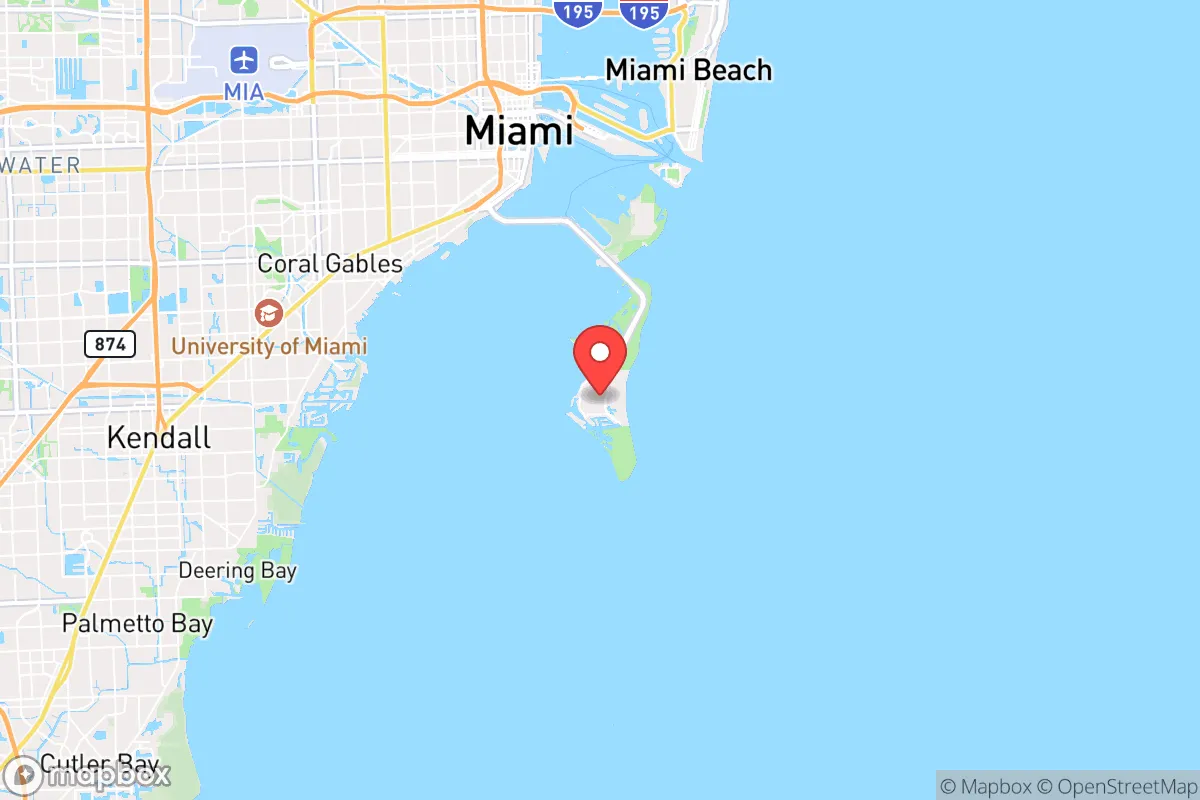
Key Biscayne, Florida, is a densely populated island city of 14,560 residents where nearly three in four people (72.8%) identify as Hispanic, making it one of the most heavily Hispanic communities in the Miami metropolitan area. The population is highly educated—74.4% hold a college degree—and 30.0% are foreign-born, a figure that understates the city’s deep cultural ties to Latin America, particularly Cuba and Venezuela. Despite its small size, Key Biscayne projects an affluent, family-oriented character, with a median household income well above the national average and a built environment dominated by high-rise condominiums and single-family homes along narrow, palm-lined streets. The city’s identity is distinctly bicultural: English is universal, but Spanish is the language of daily commerce, civic life, and the playgrounds at its two public schools.
How the city was settled and grew
Key Biscayne’s human history is almost entirely a 20th-century story. Before the 1890s, the island was sparsely inhabited by a handful of Bahamian fishermen and coconut farmers, with no permanent settlement. The first major development came in the 1910s and 1920s, when wealthy Miami businessmen—most notably William John Matheson—purchased the island and built a private estate, a coconut plantation, and a few summer homes for friends. The Matheson family’s influence gave rise to the Crandon Park area (now a county park) and the earliest residential lots along Crandon Boulevard, the island’s spine. During this era, the population was almost entirely white, non-Hispanic, and seasonal—a tiny enclave of the very wealthy.
The real settlement wave began after the Rickenbacker Causeway opened in 1947, connecting the island to mainland Miami. This bridge triggered a suburban boom: developers subdivided the island’s northern and central sections into neighborhoods like Key Colony and Harbour Green, attracting middle- and upper-middle-class white families from the mainland. These early subdivisions were marketed as quiet, safe, and exclusive—a “family island” away from the city’s bustle. By 1960, the population had grown to roughly 3,000, still overwhelmingly white and non-Hispanic, with a smattering of Jewish families who formed the nucleus of the Key Biscayne Jewish Center community.
Modern era (post-1965)
The 1965 Hart-Cellar Immigration Act and the subsequent waves of Cuban exiles transformed Key Biscayne’s population more dramatically than any other factor. In the 1970s and 1980s, affluent Cuban families—many of them professionals and business owners who had fled Castro’s regime—began buying homes in Key Colony and the newer Ocean Lane and Beach Club condominium complexes. These were not poor refugees; they were educated, capital-rich exiles who saw Key Biscayne as a safe, prestigious, and culturally familiar place to rebuild. By 1990, the Hispanic share of the population had risen to roughly 40%, and by 2000 it had crossed 60%.
The 1990s and 2000s brought a second major wave: Venezuelan immigrants fleeing political and economic instability under Hugo Chávez and his successors. These newcomers, also largely professional and upper-middle-class, concentrated in the newer high-rise towers along Westwood Lake and the Key Biscayne Beach Club area. Today, the Hispanic population is a blend of Cuban-Americans (the largest single group), Venezuelans, and smaller numbers of Colombians, Argentines, and Nicaraguans. The non-Hispanic white population has shrunk to 23.2%, and the Black population is negligible at 0.5%. East/Southeast Asian residents (0.1%) and Indian-subcontinent residents (0.1%) are present only in trace numbers, reflecting the island’s lack of the ethnic enclaves that anchor those communities elsewhere in Miami-Dade County.
The future
Key Biscayne’s population is likely to remain overwhelmingly Hispanic for the foreseeable future, but the character of that Hispanic majority is shifting. The Cuban-American cohort, which dominated for decades, is aging and slowly being joined by newer arrivals from Venezuela and Colombia. The city is not tribalizing into distinct ethnic enclaves—neighborhoods like Key Colony and Ocean Lane are mixed among Cuban, Venezuelan, and non-Hispanic white residents—but it is homogenizing in the sense that nearly all residents share a high-income, college-educated, Spanish-bilingual profile. Foreign-born share (30.0%) is plateauing, as second- and third-generation Hispanic families now make up a growing portion of the population. The next 10–20 years will likely see continued demographic stability: a wealthy, family-oriented, heavily Hispanic city with a small but stable non-Hispanic white minority. New construction is limited by geography—the island is fully built out—so population growth will be slow and driven by redevelopment of older condominiums rather than new subdivisions.
For a conservative-leaning individual or family considering relocation, Key Biscayne offers a rare combination: a safe, high-amenity island community where traditional family structures are strong, property values are high, and the dominant culture is both prosperous and deeply rooted in Latin American traditions of civic engagement and entrepreneurship. The city is not diversifying in the way mainland Miami is; it is consolidating its identity as an affluent, Hispanic-majority enclave with little racial or economic variation. Moving here means joining a community that is stable, insular, and proud of its heritage—a place where the past and future are both written in Spanish and English, and where the population is unlikely to change dramatically in the coming decades.

* Values derived from national, state, county, city and local statistics and may differ in a specific area. Last updated: 2026-04-27T14:35:59.000Z
Narrative content on this page is AI-generated and may contain mistakes. Verify any details that matter before acting on them.
ReloMaps may earn a commission from affiliate links at no extra cost to you.

