
Photo: Wikipedia
Demographics of Kingsville, TX
Affluence Level in Kingsville, TX
A below-average socioeconomic profile. Incomes, home values, and educational attainment trail the U.S., with higher poverty and unemployment.
People of Kingsville, TX
Kingsville, Texas, is a predominantly Hispanic (72.7%) city of 25,061 residents, shaped by ranching, military aviation, and higher education. Its population is notably young and family-oriented, with a median age around 30, and is characterized by a strong sense of local identity rooted in the King Ranch legacy and Texas A&M University-Kingsville. The city’s foreign-born population is low at 4.0%, and its college-educated share stands at 22.5%, reflecting a working-class, community-focused demographic that values stability and tradition.
How the city was settled and grew
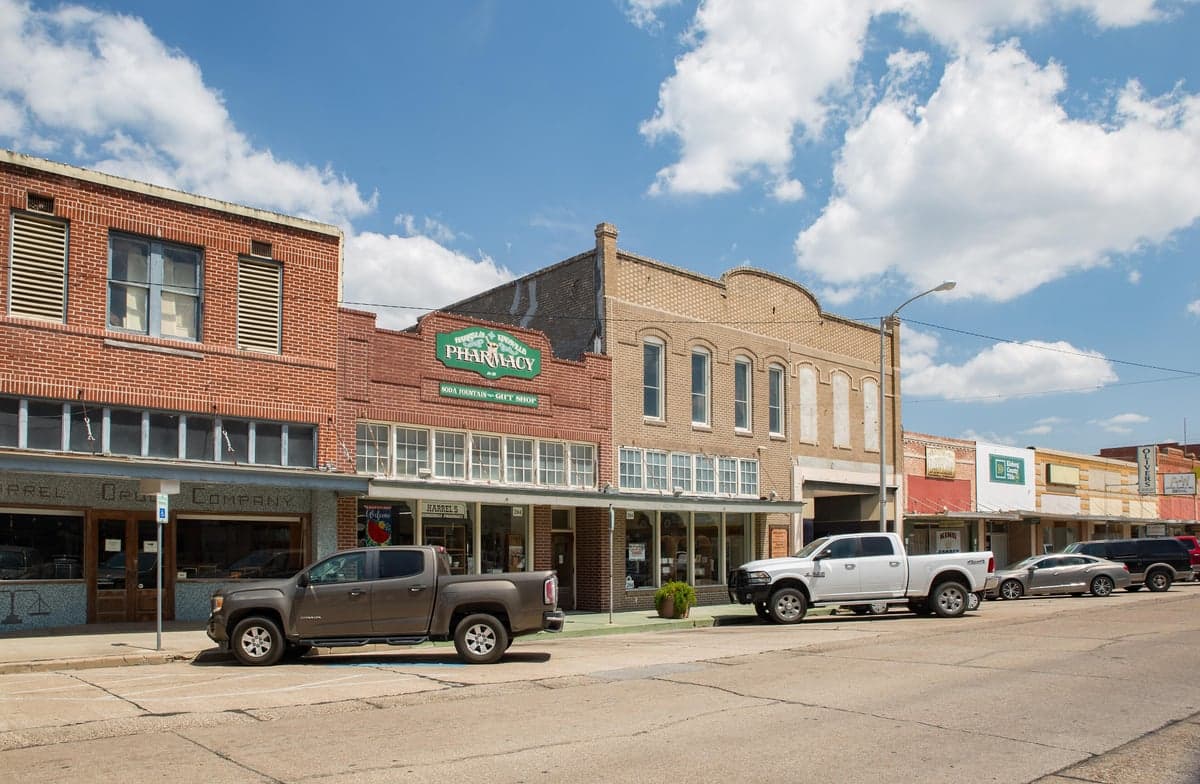
Kingsville was founded in 1904 as a railroad town and service center for the sprawling King Ranch, which drew the first major wave of settlers. The original population was a mix of Anglo-American ranch managers and Mexican-American vaqueros (cowboys) who had worked the land for generations. The historic Barrio de los Vaqueros neighborhood, located just south of the railroad tracks, became the heart of the Mexican-American community, where ranch workers and their families built homes and established the city’s early Catholic parish, St. Gertrude’s. The arrival of the St. Louis, Brownsville and Mexico Railway brought additional Anglo merchants and professionals, who settled in the Downtown Historic District around Kleberg Avenue, constructing brick storefronts and the Kleberg County Courthouse. A second wave came during the 1940s with the establishment of the Naval Air Station Kingsville (now part of Naval Air Station Corpus Christi), which drew military personnel and civilian contractors. These families, predominantly white and from other parts of Texas, settled in the Navy Housing Area near the base and in the Bishop Addition neighborhood, a post-war subdivision of modest single-family homes. By 1950, the city’s population had grown to roughly 16,000, with a clear Anglo-Hispanic divide in housing and social life.
Modern era (post-1965)
The post-1965 period saw significant demographic shifts as the Hispanic population grew from a majority-minority to the dominant group. The Immigration and Nationality Act of 1965, combined with ongoing migration from South Texas and northern Mexico, swelled the Hispanic share from roughly 50% in 1970 to over 70% by 2000. This growth was concentrated in the East Kingsville neighborhoods, including the Las Brisas subdivision, where new subdivisions of brick and frame homes absorbed young families. Meanwhile, the white population declined steadily, dropping from about 45% in 1970 to 18.7% today, as many Anglo families moved to larger cities like Corpus Christi or San Antonio for employment. The Black population, historically small at 3.8%, has remained stable, with most families residing in the Southside area near the university. The East/Southeast Asian community (1.0%) and Indian subcontinent community (0.5%) are tiny but visible, primarily composed of faculty and staff at Texas A&M University-Kingsville, who tend to live in the University Heights neighborhood near the campus. The city’s foreign-born share (4.0%) is low compared to the state average, indicating that most Hispanic growth comes from native-born families rather than recent immigration.
The future
Kingsville’s population is likely to continue its gradual homogenization as the Hispanic share edges toward 80% over the next decade. The white population is aging and not being replaced by younger families, while the Black and Asian communities are expected to remain small and stable. The city’s low college attainment rate (22.5%) and limited high-wage job growth outside of the university and the naval air station suggest that out-migration of educated young adults will persist, keeping the population flat or slightly declining. The immigrant community is not growing significantly, as most Hispanic residents are third-generation or deeper, and the city lacks the economic pull to attract new foreign-born arrivals. The next 10-20 years will likely see Kingsville become more uniformly Hispanic and working-class, with the Barrio de los Vaqueros and East Kingsville neighborhoods remaining the demographic core, while the Downtown Historic District struggles to retain commercial vitality.
For someone moving in now, Kingsville is a stable, family-oriented community with a strong Hispanic cultural identity and a low cost of living. It is not a place of rapid demographic change or new immigrant enclaves, but rather a city where long-established families and traditions continue to define daily life. The trade-off is a limited economic base and a population that skews younger and less educated, which may appeal to those seeking a quiet, affordable, and culturally cohesive environment over urban dynamism.

* Values derived from national, state, county, city and local statistics and may differ in a specific area. Last updated: 2026-05-16T21:53:52.000Z
Narrative content on this page is AI-generated and may contain mistakes. Verify any details that matter before acting on them.
ReloMaps may earn a commission from affiliate links at no extra cost to you.

