Photo: Wikipedia
Political ClimatePolitical Climate in Kingwood, WV
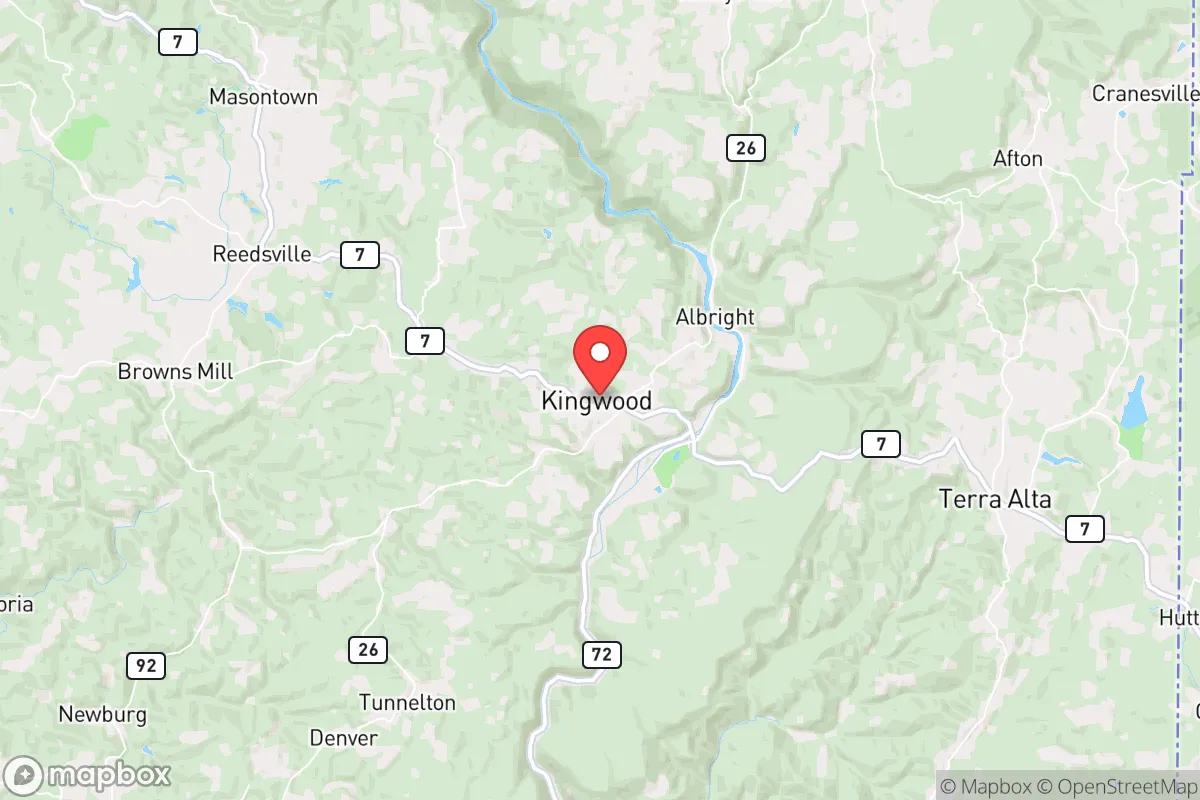
District shown is the primary district for this city’s centroid. Cities may span multiple districts.
Local Political AnalysisPolitical Analysis of Kingwood, WV
Kingwood, West Virginia, is about as solidly conservative as it gets, with a Cook PVI of R+20 that tells you everything you need to know about its political DNA. This isn't a place that flips or waffles—it's been reliably red for generations, and the local culture reflects that deep-rooted commitment to limited government, personal responsibility, and traditional values. If you're looking at Preston County as a whole, Kingwood is the anchor of that conservative sentiment, standing in stark contrast to the more progressive leanings you'd find in Morgantown or even parts of Fairmont, where university influence and out-of-state transplants have started shifting the needle leftward.
How it compares
When you stack Kingwood up against its neighbors, the political divide is pretty stark. Morgantown, just 20 miles north, is a blue island in a red sea—home to West Virginia University, it votes reliably Democratic and pushes policies that many locals here see as government overreach, like mask mandates and zoning overhauls. Fairmont, to the west, has a mixed record but has trended more purple in recent years. Kingwood, by contrast, hasn't budged. The county commission, school board, and local law enforcement all lean heavily conservative, and there's a palpable resistance to any progressive agenda items—think critical race theory in schools or restrictive gun ordinances. The surrounding towns like Rowlesburg and Tunnelton share this sentiment, but Kingwood is the hub where that conservative identity is most visible, from the local churches to the annual Preston County Buckwheat Festival, which feels like a celebration of small-town, self-reliant life.
What this means for residents
For folks living here, the political climate translates into a daily life that's largely free from the kind of bureaucratic meddling you see in bigger cities. Property taxes stay low, there's no income tax on personal earnings (West Virginia's state income tax is being phased down), and the local government generally takes a hands-off approach to business and personal choices. You won't find mask mandates or vaccine passports being enforced at the local diner or hardware store. The downside? If you're hoping for rapid infrastructure upgrades or big public investments, don't hold your breath—the conservative ethos here prioritizes fiscal restraint over flashy projects. But for most residents, that trade-off is a no-brainer. The real concern is watching nearby areas like Morgantown adopt policies that feel like a slow creep of government control—things like rent control debates or expanded public health orders—and hoping that influence doesn't trickle down the interstate.
One cultural distinction worth noting: Kingwood has a strong Second Amendment culture, and it's not just talk. Open carry is common, and local officials have publicly opposed any state-level red flag laws or magazine capacity limits. There's also a deep skepticism of federal land management, especially given the proximity to the Monongahela National Forest—locals remember fights over logging restrictions and ATV trail access. The long-term trajectory here is stable, but there's an undercurrent of worry that as West Virginia's population ages and younger folks move away, outside money and progressive transplants could start shifting the balance. For now, though, Kingwood remains a place where you can live your life without the government breathing down your neck, and that's exactly how most folks want it to stay.

State Political ClimatePolitical Climate in West Virginia
State Political AnalysisPolitical Environment in the State
West Virginia has long been one of the most reliably Republican states in the nation, but that wasn’t always the case. As recently as the 1990s, it was a Democratic stronghold at the state and local level, but a massive realignment over the past 20 years has flipped it deep red. In 2024, Donald Trump carried the state by nearly 40 points, and Republicans now hold supermajorities in both chambers of the legislature, the governor’s office, and every statewide elected position. The shift is driven by cultural conservatism, union-member disillusionment with national Democrats, and a fierce independence that runs through the Mountain State’s DNA. If you’re looking for a place where conservative values aren’t just tolerated but celebrated, West Virginia is about as solid as it gets.
Urban vs. rural divide
The political map of West Virginia is surprisingly simple: rural areas are overwhelmingly Republican, and the few urban pockets lean blue but lack the population to swing statewide elections. The largest city, Charleston, and its surrounding Kanawha County have trended purple but still vote Republican in most races—Trump won Kanawha by 12 points in 2024. Morgantown, home to West Virginia University, is the state’s most liberal enclave, with Monongalia County voting for Biden in 2020 and Harris in 2024, though by narrow margins. Huntington and Cabell County are reliably red, while Wheeling in the Northern Panhandle and Martinsburg in the Eastern Panhandle are solidly conservative, with the latter seeing an influx of former Maryland and Virginia residents seeking lower taxes and fewer regulations. The rural counties—places like Mingo, Logan, and McDowell in the southern coalfields—routinely deliver 80%+ margins for Republicans. There’s no real suburban swing district; the divide is simply city vs. country, and the country dominates.
Policy environment
West Virginia’s policy environment is aggressively pro-business and pro-liberty by design. There is no state income tax on Social Security benefits, and the state has been phasing down its personal income tax—the rate dropped from 6.5% to 3.99% in 2024, with a path to elimination by 2028 if revenue targets are met. The corporate net income tax is a flat 6.5%, and the state has right-to-work laws, meaning you can’t be forced to join a union as a condition of employment. On education, the state passed a robust school choice program in 2021—the Hope Scholarship—which gives families roughly $4,600 per child to spend on private school tuition, homeschooling materials, or tutoring. It survived a court challenge and is now fully operational. Healthcare is a mixed bag: the state expanded Medicaid under the Affordable Care Act, but Governor Jim Justice and the legislature have resisted further federal encroachment. Election integrity is taken seriously—West Virginia requires voter ID, has no same-day registration, and conducts post-election audits. It’s one of the few states that hasn’t expanded mail-in voting beyond what’s strictly necessary.
Trajectory & freedom
West Virginia is moving decisively toward more personal freedom, not less. The 2024 legislative session was a banner year for liberty: the state passed a constitutional carry law (permitless carry for handguns), eliminated the business inventory tax, and expanded the Hope Scholarship to cover more families. On parental rights, the state enacted a Parents’ Bill of Rights in 2023, requiring schools to notify parents of any curriculum involving sexuality or gender identity and to obtain consent before administering surveys on sensitive topics. Medical autonomy is respected—West Virginia has some of the loosest vaccine mandate laws in the country, and the legislature banned COVID-19 vaccine passports in 2021. Property rights are strong, with no statewide zoning mandates and a low property tax rate (capped at 1% of assessed value for owner-occupied homes). The only area where freedom has contracted is on the drug front: the state has strict penalties for fentanyl trafficking and has resisted marijuana legalization, though medical cannabis is legal with a doctor’s recommendation. Overall, the trajectory is toward less government interference in daily life.
Civil unrest & political movements
West Virginia is not a hotbed of civil unrest, but it has a proud tradition of political activism, mostly on the right. The 2018 teachers’ strike—which shut down schools statewide for nine days—was a rare moment of left-leaning labor activism, but it was focused on pay and benefits, not social issues. Since then, the dominant grassroots energy has been from conservative groups like the West Virginia Family Foundation and the local chapter of Moms for Liberty, which have successfully pushed for school choice and parental rights legislation. There have been no significant sanctuary city movements; in fact, the legislature passed a law in 2020 requiring local law enforcement to cooperate with federal immigration authorities. Election integrity controversies are minimal—West Virginia’s paper ballot system and post-election audits have kept trust high. The most visible flashpoint for a new resident might be the “thin blue line” flags and “Don’t Tread on Me” decals you’ll see on trucks and storefronts, especially in rural areas. Protests are rare and usually small, focused on issues like abortion (with a near-total ban in place) or energy policy (coal miners have held rallies against the Green New Deal). It’s a state where political disagreement is handled at the ballot box, not in the streets.
Projection
Over the next 5-10 years, West Virginia will likely become even more conservative. The state is losing population overall—down about 3% since 2020—but the people leaving tend to be younger and more liberal, while those moving in (especially retirees and remote workers from the Northeast and Mid-Atlantic) are often fleeing high taxes and progressive policies. The Eastern Panhandle, particularly Berkeley County and Jefferson County, is growing fast as a bedroom community for Washington, D.C., and these newcomers are generally conservative-leaning, though they bring some suburban sensibilities. The income tax phase-out, if completed, will make West Virginia one of nine states with no personal income tax, which could accelerate in-migration. The biggest wildcard is the energy transition: as coal continues to decline, the state will need to diversify its economy without abandoning its cultural identity. Expect continued fights over land use, natural gas development, and federal overreach. For someone moving in now, the state will likely feel freer and more aligned with conservative values in a decade than it does today.
For a conservative individual or family, West Virginia offers a rare combination: low taxes, strong gun rights, school choice, and a culture that values self-reliance and community. The political climate is stable and moving in your favor. You won’t find the culture war battles of coastal states here—just a place where you can live your life without the government breathing down your neck. If you’re looking to escape the chaos and cost of blue states, this is one of the best bets in the country.
* Values derived from national, state, county, city and local statistics and may differ in a specific area. Last updated: 2026-10-10T16:27:55.000Z
Narrative content on this page is AI-generated and may contain mistakes. Verify any details that matter before acting on them.
ReloMaps may earn a commission from affiliate links at no extra cost to you.

