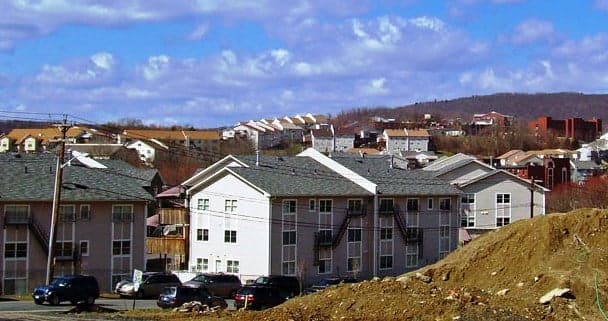
Photo: Wikipedia
Demographics of Kiryas Joel, NY
Affluence Level in Kiryas Joel, NY
A middle-class area roughly in line with national averages across income, home values, education, and employment.
People of Kiryas Joel, NY
The people of Kiryas Joel, New York, are overwhelmingly Yiddish-speaking Hasidic Jews of the Satmar sect, forming one of the most demographically homogeneous and densely populated municipalities in the United States. With a population of 36,572, the village is 96.2% white, 1.8% Hispanic, and 0.2% Black, with a foreign-born share of just 2.2% and a strikingly low college education rate of 6.1%. This is a community defined by religious insularity, high birth rates, and a deliberate separation from secular American culture, making it a unique destination for those seeking a life governed by strict Halakhic law and Yiddish-language daily life.
How the city was settled and grew
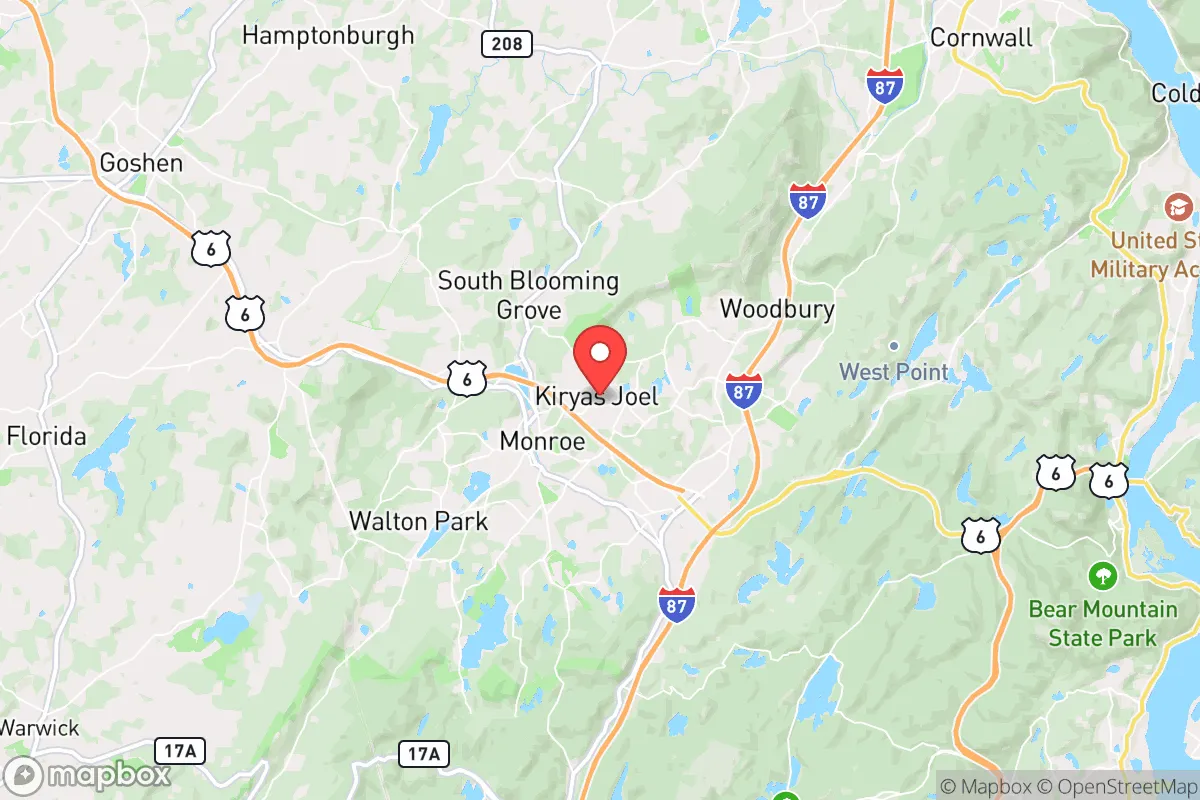
Kiryas Joel was not settled gradually over centuries but was founded in the 1970s as a planned religious enclave. The Satmar Hasidic community, originally centered in the Satu Mare region of Romania and Hungary, was decimated in the Holocaust. After World War II, surviving Satmar followers, led by their revered Rebbe, Rabbi Joel Teitelbaum, regrouped in the Williamsburg neighborhood of Brooklyn, New York. By the 1970s, the Williamsburg enclave had become overcrowded and faced rising crime and secular pressures. Rabbi Teitelbaum’s successor, Rabbi Moshe Teitelbaum, sought a rural refuge where the community could expand without assimilation. In 1974, the village of Kiryas Joel—named after the late Rebbe—was incorporated on roughly 1,000 acres of farmland in the Town of Monroe, Orange County. The first wave of settlers, numbering a few hundred families, moved into what is now the Satmar Center district, the original core around the main synagogue and the Rebbe’s residence. These early residents were almost entirely Holocaust survivors and their American-born children, who built a self-contained world of yeshivas, kosher markets, and mikvahs from scratch.
Modern era (post-1965)
Kiryas Joel’s explosive growth is a post-1965 phenomenon, driven entirely by natural increase and internal migration from the Satmar community in Williamsburg, not by foreign immigration. The village’s foreign-born share of 2.2% is minuscule, reflecting that nearly all residents are American-born descendants of the original postwar settlers. The population ballooned from roughly 7,000 in 1990 to over 20,000 by 2010, and to 36,572 by the 2020s, fueled by an average of six to eight children per family. This growth pushed development outward from the original Satmar Center into new neighborhoods. The Bais Sarah district, named after the community’s girls’ school, absorbed many young families in the 1990s and 2000s, featuring dense rows of single-family homes and duplexes. The Vizhnitz area, settled by a smaller Hasidic group affiliated with the Vizhnitz dynasty, emerged as a distinct sub-enclave within the village, maintaining its own synagogue and customs. The Monroe Woodbury section, straddling the village line into the Town of Monroe, saw the construction of large, modern homes for more affluent families. The racial and ethnic data—96.2% white, 0.0% East/Southeast Asian, 0.0% Indian subcontinent—confirms that Kiryas Joel has not experienced the diversification seen in most American suburbs. The 1.8% Hispanic population is a very recent and small presence, likely consisting of a few dozen families working in service roles, but they remain a negligible demographic force.
The future
The population of Kiryas Joel is heading toward continued, rapid homogenization, not diversification. With a fertility rate among the highest in the developed world—estimated at over 6.0 children per woman—the village is projected to reach 50,000 to 60,000 residents by 2040, all overwhelmingly Satmar Hasidic. The community is not tribalizing into distinct enclaves in the way a multi-ethnic city might; rather, it is expanding its existing Hasidic footprint into new subdivisions. The Kiryas Joel Village Expansion, a 507-acre annexation approved in 2017, is already being developed with thousands of new homes in the South Blooming Grove area, which will effectively become a new district of the village. This expansion is driven by a severe housing shortage—the village is the most densely populated municipality in New York State outside of New York City. The small Hispanic and Black populations are unlikely to grow significantly, as the community’s religious and linguistic barriers discourage in-migration from outside the Satmar orbit. The college education rate of 6.1% will remain low, as secular higher education is discouraged; most men study in yeshivas and work in community trades, while women often work as teachers or in family businesses.
For someone moving in now, Kiryas Joel is not a place of demographic transition or melting-pot assimilation. It is a deeply insular, rapidly expanding religious community where nearly every resident shares a single ancestry, language, and worldview. Newcomers who are not Satmar Hasidic will find virtually no social or economic infrastructure outside that framework. The village’s future is one of more of the same: more families, more children, more yeshivas, and a continued rejection of secular American culture. This is a destination for those who already belong—not a place for those seeking diversity or integration.

* Values derived from national, state, county, city and local statistics and may differ in a specific area. Last updated: 2026-05-01T08:55:00.000Z
Narrative content on this page is AI-generated and may contain mistakes. Verify any details that matter before acting on them.
ReloMaps may earn a commission from affiliate links at no extra cost to you.

