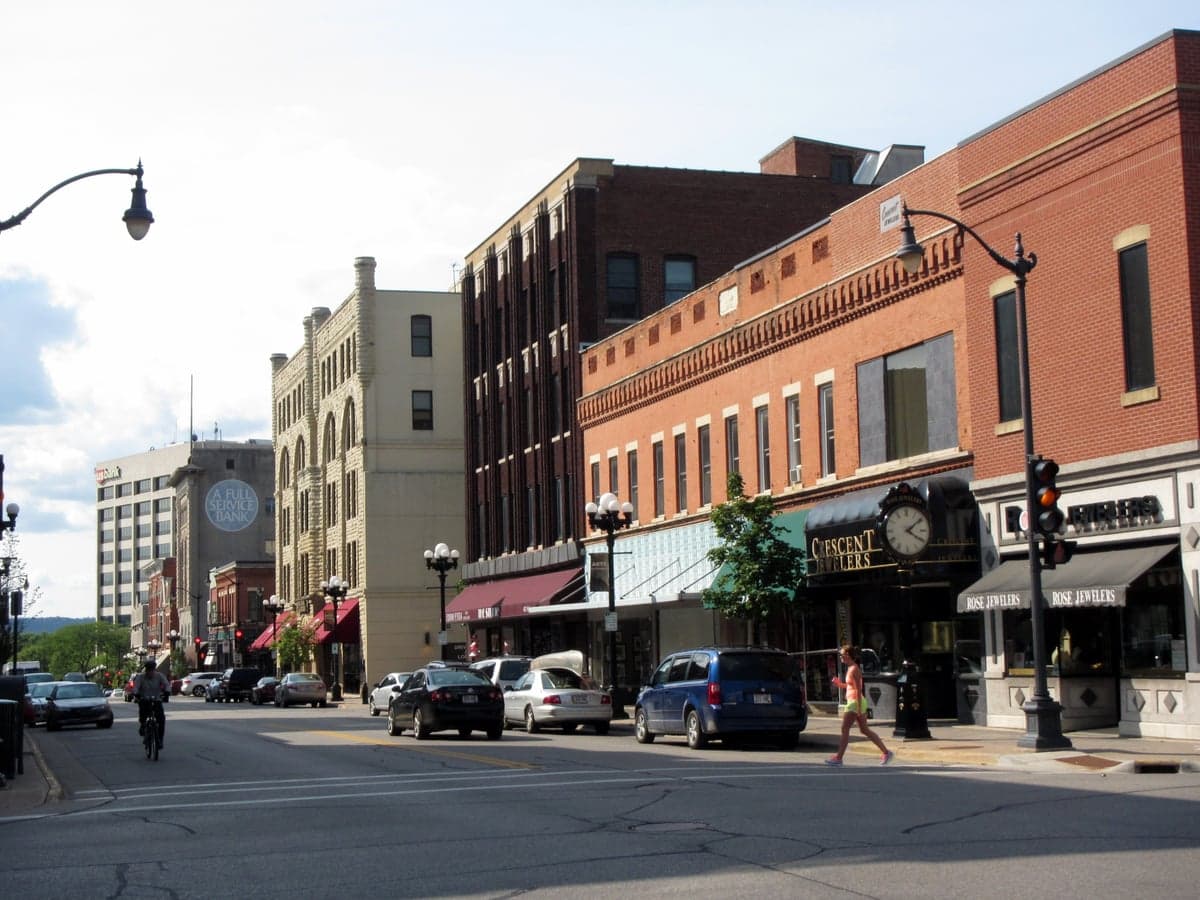
Photo: Wikipedia
Political ClimatePolitical Climate in La Crosse, WI
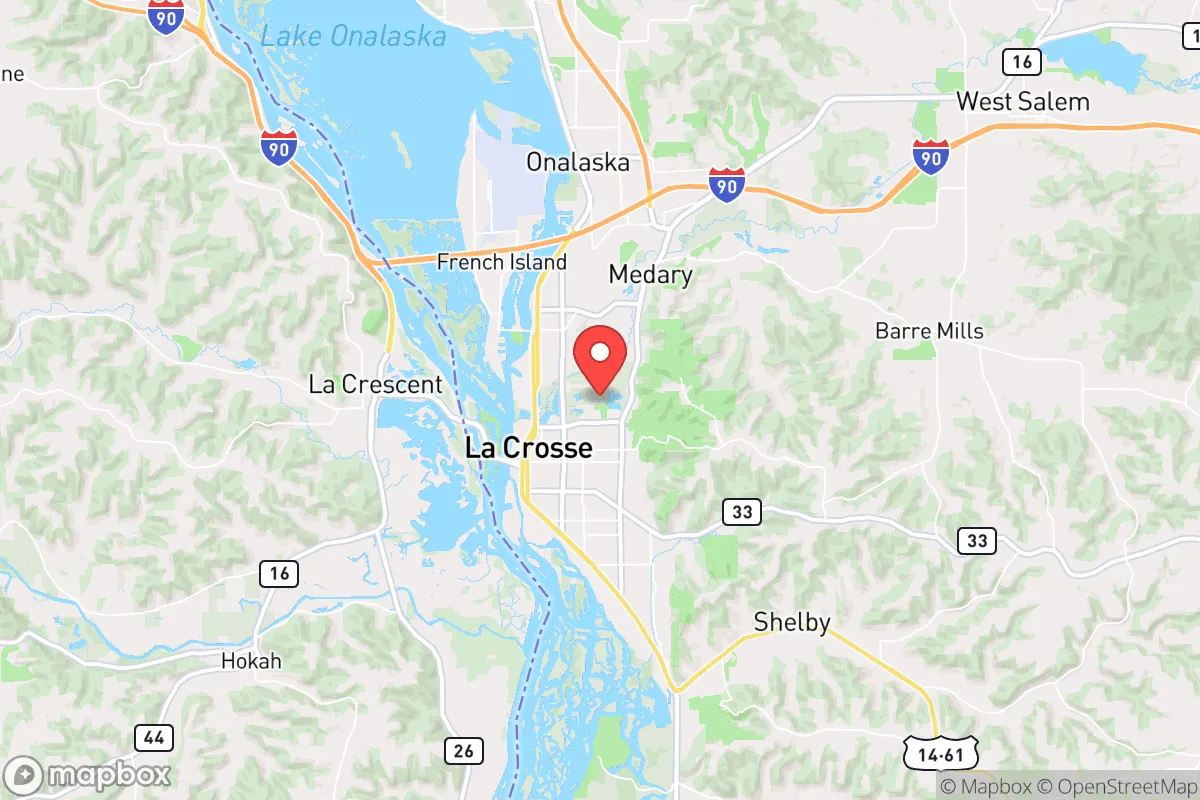
District shown is the primary district for this city’s centroid. Cities may span multiple districts.
Local Political AnalysisPolitical Analysis of La Crosse, WI
La Crosse is a bit of a blue dot in a red county, and honestly, that’s been the case for a while. The city itself leans left, but the surrounding areas—like Onalaska, Holmen, and the rural townships—keep things balanced. The Cook PVI for the area is R+3, which means the district as a whole is slightly more Republican than the national average. But if you’ve lived here as long as I have, you’ve watched the city council and county board slowly drift further from the common-sense, live-and-let-live values that used to define this place. It’s not a radical shift overnight, but it’s a steady creep that has folks like me paying closer attention.
How it compares
Drive twenty minutes in any direction from downtown La Crosse, and you’re in a different world politically. Onalaska and Holmen are reliably conservative, with town boards that still prioritize low taxes, property rights, and local control. West Salem and Bangor are even more so—places where people wave at you on the street and don’t want the county telling them what to do with their land. Meanwhile, La Crosse proper has become a magnet for progressive activists, especially around the university (UW-La Crosse and Viterbo). The contrast is stark: you’ll see “Defund the Police” signs in some campus-area yards, while just across the river in Minnesota, towns like Winona and Rochester are even further left. Compared to those places, La Crosse still has some backbone, but the gap is narrowing every election cycle.
What this means for residents
For those of us who value personal freedoms and limited government, the trend is concerning. The city council has pushed through zoning changes that make it harder to build a simple garage or add a fence without a permit, and there’s been talk of rent control measures that would hurt small landlords. The school board has also gotten tangled in culture-war debates, with some members pushing for curriculum changes that prioritize ideology over academics. If you’re a business owner, you’ve probably noticed the city’s new paid-leave mandate—a state-level policy, sure, but one that local politicians cheered on. It’s not that La Crosse is a nightmare; it’s that the slow erosion of local control and individual choice is real. Property taxes have climbed faster than inflation, and the city’s response to homelessness has leaned toward “housing first” programs that critics say enable dependency rather than accountability.
On the flip side, the rural and suburban parts of the county still offer a refuge. If you live just outside the city limits, you can avoid most of the overreach. The sheriff’s office is solid, and the county board has a conservative majority that pushes back on the worst ideas. But the city’s influence spreads—through school district boundaries, countywide votes, and state-level representation. The long-term worry is that as La Crosse grows, the progressive voting bloc will tighten its grip, and the freedoms we take for granted—like choosing your own healthcare, keeping your property taxes low, or sending your kids to a school that focuses on reading and math—will get squeezed further. It’s not time to panic, but it’s time to stay informed and vote in every local election. That’s where the real power lies.

State Political ClimatePolitical Climate in Wisconsin
State Political AnalysisPolitical Environment in the State
Wisconsin has long been a classic swing state, but over the past decade it has shifted from a true purple battleground into a state where Republicans hold structural advantages in the legislature and at the local level, even as Democrats have consolidated power in the two largest metros. The state’s overall partisan lean is roughly R+2 to R+4 in most statewide elections, but that masks a deep and growing urban-rural chasm. The 2022 gubernatorial race saw Democrat Tony Evers win by just 3.4 points, while Republican Ron Johnson won his Senate seat by 1 point in the same cycle. The 2024 presidential race here was again decided by less than a point, with Donald Trump carrying the state by roughly 20,000 votes. The 10-20 year trajectory shows a state that is slowly trending rightward in the exurbs and rural areas, while Milwaukee and Madison have become increasingly Democratic strongholds, creating a political tug-of-war that shows no signs of resolving.
Urban vs. rural divide
The political map of Wisconsin is a textbook case of the urban-rural split. Milwaukee County and Dane County (home to Madison) together deliver roughly 40% of the Democratic vote statewide, with Milwaukee proper voting over 80% Democratic and Madison hitting similar numbers. These two metros are the engine of the state’s progressive movement, driving policies on abortion access, renewable energy mandates, and public-sector union power. Meanwhile, the rest of the state is overwhelmingly Republican. The WOW counties (Waukesha, Ozaukee, Washington) surrounding Milwaukee are some of the most reliably Republican suburbs in the Midwest, routinely voting 60-70% GOP. Further north, the Fox Valley (Appleton, Green Bay, Oshkosh) has shifted rightward over the past decade, with Brown County flipping from blue to red in 2016 and staying there. The Driftless Region in the southwest, including towns like Prairie du Chien and Platteville, remains conservative but with a libertarian streak—these are areas where property rights and gun rights are taken very seriously. The Northwoods (Rhinelander, Minocqua, Hayward) is deeply Republican, driven by a mix of retirees, second-home owners, and outdoor recreation enthusiasts who value low taxes and minimal regulation.
Policy environment
Wisconsin’s policy environment is a mixed bag for conservatives. On the plus side, the state has a flat income tax rate of 4.4% (down from 7.75% in 2011), and the legislature has consistently passed tax cuts under Republican control. Property taxes are moderate, with the median effective rate around 1.6% of home value. The state is a right-to-work state (passed in 2015), and Act 10 (2011) effectively ended collective bargaining for most public employees, a major win for fiscal conservatives. However, Governor Evers has used his veto pen to block further tax cuts and has pushed for expanded Medicaid and renewable energy mandates. Education policy is a flashpoint: the state has a robust school choice program (the Milwaukee Parental Choice Program is the oldest in the nation), but Evers has proposed funding freezes for voucher schools. Election laws are relatively secure—Wisconsin requires voter ID, and the legislature has tightened absentee ballot rules since 2020. Gun rights are strong: the state is a shall-issue concealed carry state with no permit required for open carry, and there is no red flag law. However, local governments in Dane and Milwaukee counties have attempted to impose their own restrictions, creating a patchwork that frustrates gun owners.
Trajectory & freedom
On the freedom front, Wisconsin is a tale of two trends. At the state level, the Republican legislature has consistently expanded personal liberty: Act 169 (2023) eliminated the state’s personal property tax on business equipment, and the 2024 budget included a $2 billion income tax cut. Gun rights were expanded in 2023 with the passage of SB 169, which allowed concealed carry in churches and schools with permission. Parental rights got a boost with the Parental Bill of Rights (2023), which requires schools to notify parents about curriculum changes and medical services. However, Governor Evers has used his veto to block further expansions, including a bill that would have banned gender transition procedures for minors. The 2023 Act 12 also preempted local governments from imposing rent control and certain labor mandates, a win for property rights. The concerning trend for conservatives is the growing power of Dane and Milwaukee counties to impose local ordinances that restrict gun rights, mandate paid leave, and push green energy mandates. The state Supreme Court flipped to a 4-3 liberal majority in 2023, and that court has already struck down the state’s legislative maps, ordering new ones that could give Democrats more seats in 2024. This court is the single biggest threat to conservative policy gains in the next decade.
Civil unrest & political movements
Wisconsin has a history of intense political activism. The 2011 Act 10 protests in Madison drew over 100,000 people to the Capitol, and the 2020 Kenosha riots (following the Jacob Blake shooting) saw two nights of arson and looting, with a 17-year-old Kyle Rittenhouse famously acquitted of all charges in a self-defense case that became a national flashpoint. The Waukesha Christmas Parade attack in 2021, where a man drove an SUV through a parade killing six, further polarized the state along cultural lines. Immigration politics are relatively muted compared to border states, but the issue flared in 2023 when Evers vetoed a bill that would have required local law enforcement to cooperate with ICE. There are no sanctuary cities in Wisconsin, but Dane County has declared itself a “welcoming community,” which conservatives view as a de facto sanctuary policy. Election integrity remains a hot-button issue: the 2020 election saw Milwaukee and Madison use “democracy in the park” ballot drop boxes that were later ruled illegal by the state Supreme Court (before the liberal majority reversed that ruling in 2024). The Wisconsin Election Commission has been a target of conservative ire, with calls for its abolition or restructuring. You’ll see “Stop the Steal” flags in rural areas and “Defend Democracy” signs in Madison—the cultural divide is visible in every county.
Projection
Over the next 5-10 years, Wisconsin is likely to become more politically volatile, not less. The new legislative maps (ordered by the liberal Supreme Court) will probably give Democrats a few more seats in the Assembly and Senate, but the state’s overall partisan lean is unlikely to flip blue permanently. In-migration is a wild card: the state is seeing an influx of remote workers from Illinois and Minnesota, many of whom are drawn to lower taxes and housing costs but bring progressive voting habits. The Fox Valley and WOW counties are growing, while Milwaukee and Dane counties are losing population, which should help Republicans in the long run. However, the state Supreme Court will remain a battleground—the next election in 2025 could flip it back to conservative control. The biggest wildcard is the 2026 gubernatorial race: if a Republican wins, expect a wave of conservative legislation on school choice expansion, tax cuts, and election integrity reforms. If Evers or another Democrat holds the seat, expect continued gridlock and more local preemption battles. For a conservative moving in now, the state offers a solid foundation of low taxes and gun rights, but you’ll need to be strategic about where you live—choose a county like Waukesha, Washington, or Ozaukee if you want to avoid the progressive policies of Madison and Milwaukee.
Bottom line: Wisconsin is a state where your local government matters more than the state government. If you settle in a conservative county, you’ll enjoy low taxes, strong gun rights, and good schools with school choice options. If you end up in Dane or Milwaukee County, you’ll face higher taxes, more regulations, and a local government that often clashes with state law. The state as a whole is a battleground, but the suburbs and rural areas remain a stronghold for conservative values. For a single person or family looking to relocate, the key is picking the right town—places like Waukesha, Appleton, or Hudson offer a high quality of life with a political environment that aligns with traditional American freedoms. Just keep an eye on the state Supreme Court—that’s where the real fight for Wisconsin’s future is happening.
* Values derived from national, state, county, city and local statistics and may differ in a specific area. Last updated: 2026-04-21T10:34:26.000Z
Narrative content on this page is AI-generated and may contain mistakes. Verify any details that matter before acting on them.
ReloMaps may earn a commission from affiliate links at no extra cost to you.

