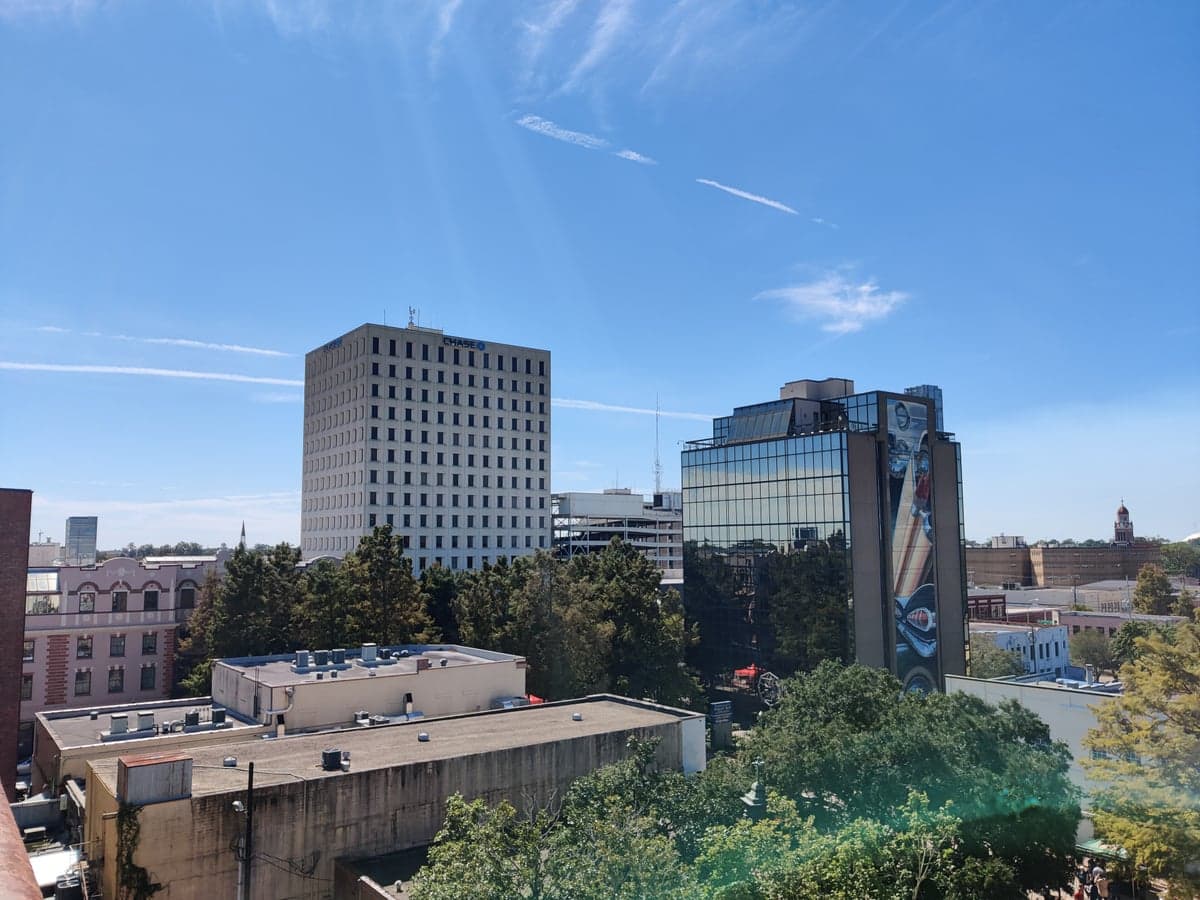
Photo: Wikipedia
Demographics of Lafayette, LA
Affluence Level in Lafayette, LA
A middle-class area roughly in line with national averages across income, home values, education, and employment.
People of Lafayette, LA
The people of Lafayette, Louisiana today form a dense, culturally rooted urban core of 121,537 residents, distinct from the surrounding Acadiana parishes by its higher college attainment rate (40.6%) and its role as a regional hub for energy, healthcare, and higher education. The city’s identity remains deeply tied to its Cajun and Creole French heritage, yet its population is notably more diverse than the surrounding countryside: 57.8% White, 28.5% Black, 7.6% Hispanic, and small but growing East/Southeast Asian (1.3%) and Indian-subcontinent (0.8%) communities. Lafayette is a place where a French-language revival coexists with a modern Sun Belt economy, and where historic racial boundaries are slowly shifting amid suburban expansion.
How the city was settled and grew
Lafayette was founded in the 1820s as Vermilionville, a trading post on the Vermilion River, and incorporated in 1836. The original settlers were Acadian exiles (Cajuns) who had been expelled from Nova Scotia by the British in the 1750s and resettled in south Louisiana under Spanish rule. They were joined by Creoles—French and Spanish colonial descendants, including free people of color—and by Anglo-American planters who arrived after the Louisiana Purchase. The early economy was cotton and sugar plantations, worked by enslaved Black laborers whose descendants form the core of Lafayette’s historic Black neighborhoods. The Freetown-Port Rico district, just south of downtown, was settled by freedmen after the Civil War and remains a predominantly Black, working-class area. The Saint Streets neighborhood (Saint John, Saint Landry, etc.) developed in the early 1900s as a middle-class Black enclave, home to educators and small business owners. Meanwhile, the city’s White Cajun population concentrated in Downtown and the University District around South College Road, where the University of Louisiana at Lafayette (founded 1898) became a major employer and cultural anchor. Oil was discovered in the 1930s, and by the 1950s Lafayette had become the headquarters for the Louisiana Gulf Coast oil industry, drawing engineers and managers from Texas and the Northeast. This boom created the Oil Center district on Kaliste Saloom Road, a commercial hub that remains the city’s white-collar employment core.
Modern era (post-1965)
The 1965 Hart-Cellar Act opened immigration channels that slowly diversified Lafayette, though the city’s foreign-born share remains low at 4.0%. The most visible post-1965 change was suburbanization. White families moved west and south into River Ranch (a master-planned community developed from the 1990s) and Youngsville (an adjacent city that has absorbed much of Lafayette’s growth). These areas are overwhelmingly White and affluent, with home prices often double the city median. Black middle-class families moved into Broadmoor and Broussard, while the historic Black core of Freetown-Port Rico and the Saint Streets experienced population loss and aging housing stock. Hispanic growth (now 7.6%) began in the 1990s, driven by construction and oilfield labor; the Northside area near I-10 and Evangeline Thruway has a visible Hispanic commercial corridor. East/Southeast Asian residents (1.3%) are mostly Vietnamese and Filipino families who arrived post-1975, many working in healthcare and hospitality, with a small cluster near the university. The Indian-subcontinent community (0.8%) is newer—mostly professionals in IT and medicine—and is dispersed rather than concentrated in a single neighborhood. Notably, Lafayette’s Black population share (28.5%) has remained stable since 2000, while the White share has declined from 64% to 57.8%, reflecting both Hispanic in-migration and White flight to outlying suburbs.
The future
Lafayette’s population is tribalizing into distinct enclaves rather than homogenizing. The city proper is becoming more diverse, but the surrounding unincorporated areas and satellite cities (Youngsville, Broussard, Scott) are becoming whiter and more affluent. The Hispanic share is likely to grow to 10-12% by 2035, driven by continued oilfield and construction demand, but will remain concentrated in Northside and a few apartment complexes near the airport. The East/Southeast Asian and Indian communities are small and likely to remain so, as Lafayette lacks the tech or academic magnets that draw larger numbers. The Black population is aging in place in historic neighborhoods, with younger Black families choosing suburban subdivisions over the city core. The biggest unknown is the University of Louisiana at Lafayette, which enrolls 19,000 students and is a major driver of young adult in-migration; if it continues to grow, it could slow the city’s overall aging trend. However, Lafayette’s foreign-born share (4.0%) is less than half the national average, and the city is not a primary destination for new immigrants. The city is becoming more polarized by income and race between the urban core and the outer ring, a pattern common across mid-sized Southern cities.
For someone moving in now, Lafayette offers a stable, culturally distinct community with a strong local identity and a moderate cost of living. The trade-off is that the city is not becoming more cosmopolitan—it is becoming more stratified, with clear geographic lines between groups. New residents should expect to choose a neighborhood that aligns with their demographic and lifestyle preferences, as the city’s social fabric is woven from distinct, historically rooted enclaves rather than a melting pot.

* Values derived from national, state, county, city and local statistics and may differ in a specific area. Last updated: 2026-05-01T19:29:10.000Z
Narrative content on this page is AI-generated and may contain mistakes. Verify any details that matter before acting on them.
ReloMaps may earn a commission from affiliate links at no extra cost to you.

