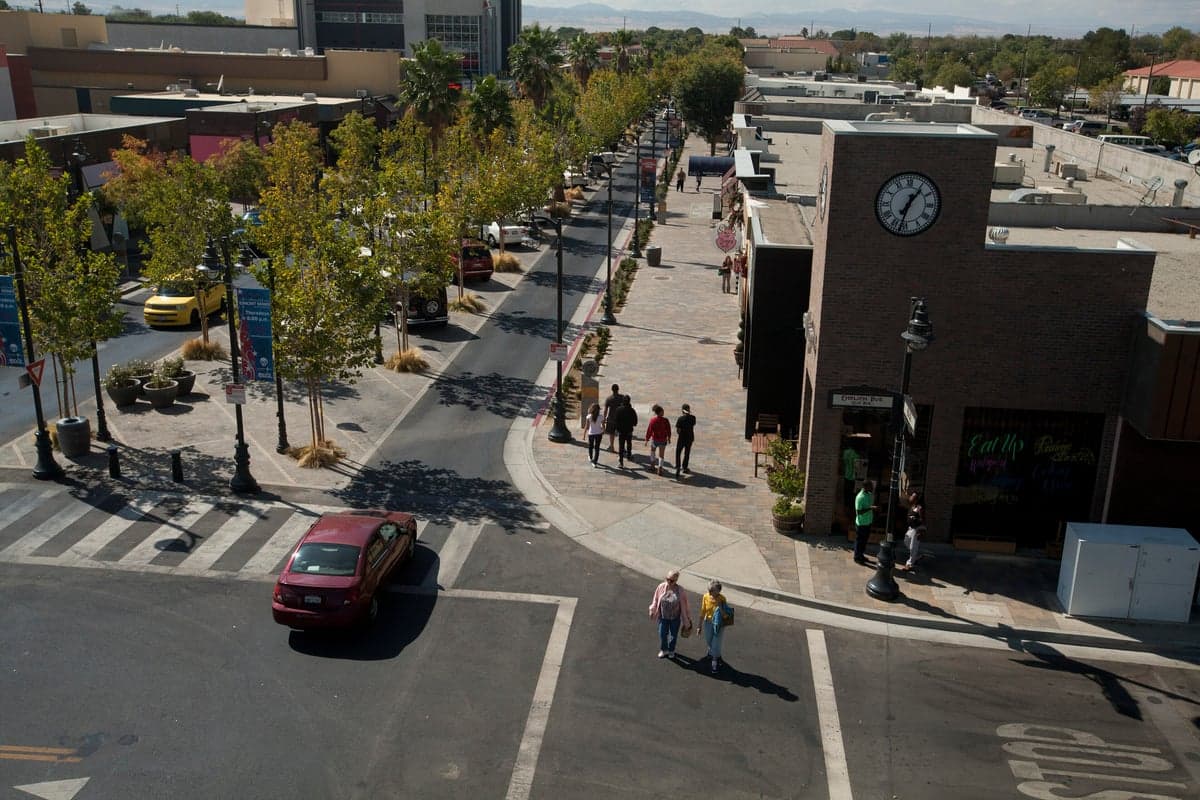
Photo: Wikipedia
Personal Sovereignty in Lancaster, CA
Moderate friction. Expect trade-offs in some aspect of personal liberty and independence.
What does Personal Sovereignty tell us?
Personal Sovereignty measures your capacity for self-reliance and independence with minimal government friction. Higher scores mean fewer barriers between you and the way you want to live... but it assumes you have the space you need and good neighbors.
What does this tell us?
Personal Sovereignty measures your capacity for self-reliance and independence with minimal government friction. Higher scores mean fewer barriers between you and the way you want to live... but it assumes you have the space you need and good neighbors.
State Policy
Energy independence: Importer (33% of energy produced in-state)
Personal Liberty
Homesteading

Personal Liberty Analysis
Lancaster, California, presents a complex environment for personal sovereignty, where the promise of high desert space and a lower cost of living relative to coastal California is sharply constrained by one of the nation’s most interventionist state governments. For the individual or family prioritizing autonomy—whether in self-defense, medical choice, or economic self-reliance—the city offers tangible advantages in land availability and a more conservative local culture, but these are perpetually at odds with Sacramento’s regulatory reach. The net result is a location that demands constant vigilance: you gain breathing room and a like-minded community, but you must navigate a legal landscape that actively works against the principles of self-rule. This analysis breaks down the specific sovereignty factors for those considering a strategic relocation to the Antelope Valley.
Tax burden and regulatory posture: The cost of California’s overreach
The most immediate threat to personal sovereignty in Lancaster is the state’s aggressive tax and regulatory apparatus. While Lancaster itself benefits from a relatively modest sales tax rate (around 10.25% as of 2026, typical for Los Angeles County), the state-level burden is crushing. California’s progressive income tax—topping out at 13.3%—directly penalizes economic productivity and savings, a core concern for anyone building a self-reliant lifestyle. Property taxes, while capped at 1% of assessed value under Proposition 13, are supplemented by Mello-Roos community facility districts and other special assessments that can add hundreds of dollars monthly to a mortgage payment, effectively taxing your land twice. For the prepper or homesteader, the regulatory posture is even more stifling. State-level building codes, environmental review (CEQA), and water-use restrictions make any significant modification to your property—from adding a workshop to installing a rainwater catchment system—a bureaucratic ordeal. The city’s own municipal code is generally less onerous than Los Angeles proper, but you are never free from the long arm of Sacramento. This is not a low-tax, low-regulation haven; it is a place where you pay a premium for space and must fight for every ounce of personal freedom.
Self-defense and gun law specifics: Navigating a hostile state framework
For the sovereignty-minded individual, the right to self-defense is non-negotiable, and here Lancaster sits in a frustrating paradox. The local culture in the Antelope Valley is markedly pro-Second Amendment, with a strong shooting sports community and multiple gun ranges within a short drive. However, you are operating under California’s strict statewide gun laws, which are among the most restrictive in the nation. California’s roster of handguns certified for sale is limited, magazine capacity is capped at ten rounds, and “assault weapon” bans prohibit common rifle platforms like the AR-15 in standard configurations. The process to purchase a firearm requires a Firearm Safety Certificate, a 10-day waiting period, and a background check through the state’s Dealer Record of Sale (DROS) system. Carrying a concealed weapon (CCW) is possible—Lancaster is in Los Angeles County, which after the Bruen decision has become “shall-issue,” but the application process remains expensive, time-consuming, and subject to local sheriff’s office discretion. For the prepper, this means you can own firearms for home defense and hunting, but building a serious defensive arsenal requires navigating a maze of paperwork, restricted lists, and potential legal pitfalls. The state’s red flag laws and ammunition purchase controls further erode the principle of immediate, unfettered self-reliance. You can defend your home, but the state has deliberately made it harder to do so.
Self-reliance and homesteading viability: Lot sizes, zoning, and off-grid feasibility
This is where Lancaster offers its strongest hand for the sovereignty seeker. The city’s defining feature is its large, flat lots—many in the half-acre to one-acre range, with some rural parcels exceeding two acres. This is a direct advantage over the postage-stamp lots of suburban Southern California. Zoning in much of Lancaster (particularly in the “R-1” and “Rural” designations) explicitly allows for small-scale agriculture, including keeping chickens, goats, and even horses on sufficient acreage. This is a critical enabler of food sovereignty. However, the dream of true off-grid living is severely limited. California’s building codes require connection to the municipal power grid in most residential zones, and while solar panels are encouraged, you cannot legally disconnect from the utility. Rainwater catchment is permitted but regulated—you must obtain a permit for systems over a certain size, and water rights are a complex state-level issue. Septic systems are allowed on larger parcels not served by sewer, but must meet strict Title 22 standards. For the serious homesteader, Lancaster provides the space to practice self-reliance—gardening, animal husbandry, food preservation—but the infrastructure of independence (off-grid power, water independence) is largely illegal or impractical. It is a place to build resilience within the system, not escape it.
Personal liberties: Parental rights, medical autonomy, speech, and property
The broader landscape of personal liberties in Lancaster is a mixed bag, heavily influenced by state preemption. On parental rights, California law is aggressively progressive: the state mandates comprehensive sexual health education in public schools, and parents cannot opt their children out of curriculum that conflicts with their values. Medical autonomy is severely compromised by California’s vaccine mandates for school attendance and healthcare workers, and the state’s strict scope-of-practice laws limit access to alternative or direct-primary care models. Free speech is constitutionally protected, but local ordinances in Lancaster can regulate public assembly and noise, which can be used to suppress larger gatherings or political demonstrations. Property rights are the most significant bright spot. While you cannot do whatever you want with your land, the city’s zoning is generally permissive for home-based businesses, workshops, and storage—essential for the prepper’s need to stockpile supplies and maintain equipment. The key takeaway: your sovereignty over your children’s education and your own medical decisions is heavily circumscribed by the state, but your sovereignty over your physical property—what you build, store, and do on your land—is comparatively strong for California.
In the final analysis, Lancaster offers a strategic compromise for the sovereignty-minded relocator. It is not a libertarian paradise like a rural county in Idaho or Texas. Instead, it is a high-desert outpost where you can secure affordable land, build a resilient home, and find a community of like-minded individuals who value self-reliance. But you must accept that you will be fighting a constant rear-guard action against a state government that views personal autonomy as a threat. The trade-off is clear: you get space and a local culture that respects independence, but you pay for it with high taxes, restrictive gun laws, and a regulatory environment that limits your ability to fully opt out. For the strategic prepper who cannot leave California entirely, Lancaster is one of the better options—a place to dig in and build a redoubt, not a refuge.

* Values derived from national, state, county, city and local statistics and may differ in a specific area. Last updated: 2026-04-24T14:31:54.000Z
Narrative content on this page is AI-generated and may contain mistakes. Verify any details that matter before acting on them.
ReloMaps may earn a commission from affiliate links at no extra cost to you.

