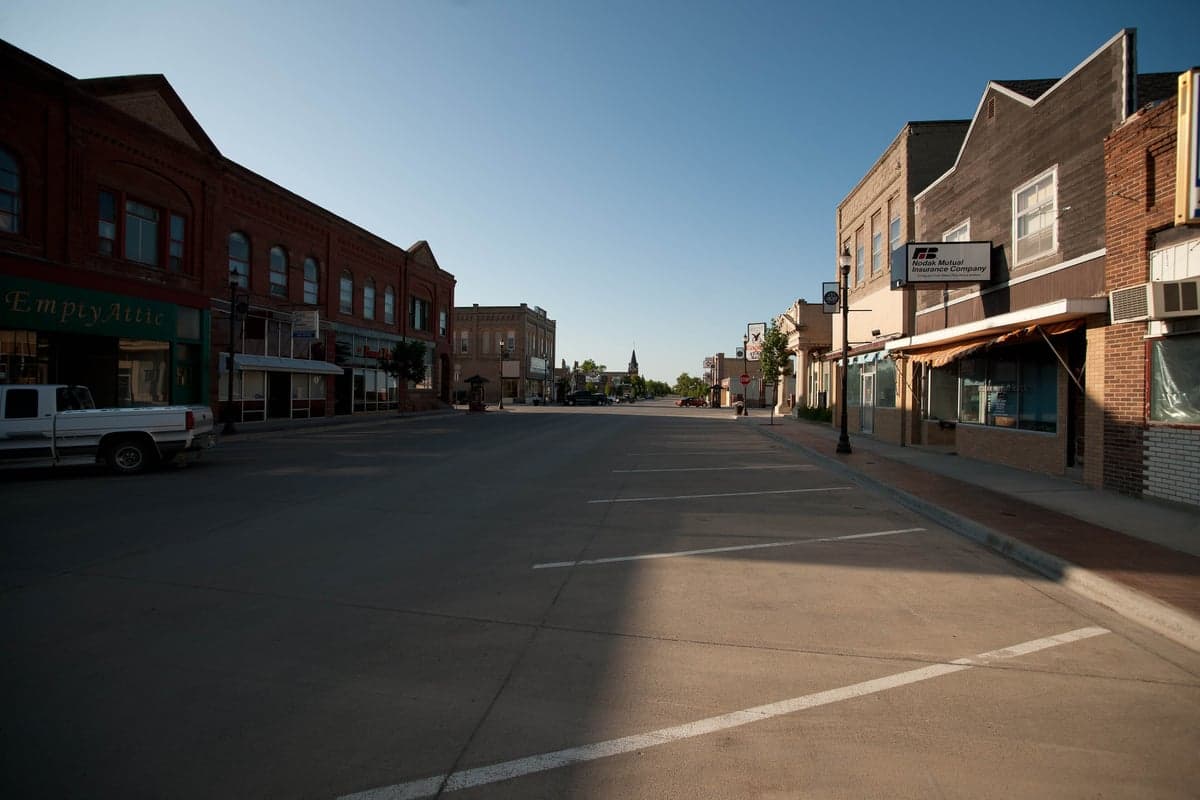
Photo: Wikipedia
Political ClimatePolitical Climate in Langdon, ND
District shown is the primary district for this city’s centroid. Cities may span multiple districts.
Inherited from parent state — no local data available.
Local Political AnalysisPolitical Analysis of Langdon, ND
Langdon, North Dakota, is about as solidly conservative as it gets, with a Cook PVI of R+18 that tells you exactly where things stand. This isn't a place that's been drifting leftward like some of the bigger towns out west; it's held its ground, and most folks here see that as a good thing. The local elections and county commission races rarely see much of a progressive push, and when they do, it's usually a short-lived thing that gets shut down fast. The trajectory here is steady, not swinging—people vote for lower taxes, fewer regulations, and a government that stays out of their business.
How it compares
Drive an hour south to Grand Forks, and you'll feel the difference immediately. That's a college town with a younger, more transient population, and it's got a noticeable progressive streak—higher taxes, more zoning, more noise about climate initiatives and social programs. Langdon, by contrast, is surrounded by small farming communities like Cavalier and Walhalla that share the same conservative values, but even among them, Langdon stands out as a bit more stubborn about keeping government small. The contrast with Fargo, which has gotten noticeably more liberal over the last decade, is even starker. In Langdon, you don't see the same push for bike lanes, diversity committees, or public art projects that eat up tax dollars. It's a place where the county commission still talks about road maintenance and grain elevator permits, not social engineering.
What this means for residents
For the people who live here, the political climate means you're left alone to live your life. There's no city council debating mask mandates or vaccine passports, no school board pushing critical race theory into the curriculumcars. The local government's main job is keeping the streets plowed and the water clean, and they do that without a lot of fuss. Property taxes are low compared to the state average, and there's no income tax to worry about. If you're a business owner, you won't be buried in red tape—permits are straightforward, and the zoning board isn't looking for reasons to say no. For families, it means your kids aren't getting indoctrinated in the classroom; the schools focus on reading, writing, and arithmetic, not social justice. The trade-off is that if you're looking for a lot of government services or social programs, you won't find them here. But that's exactly how most residents want it.
One thing that sets Langdon apart culturally is the strong sense of self-reliance. You don't see people waiting around for the government to solve their problems—neighbors help neighbors, and the church community is tight-knit. There's a healthy skepticism of federal programs and outside money, because folks remember how the last big government grant came with strings attached that ended up costing more than it was worth. The long-term concern here is that as the state's oil money and population growth push Bismarck and the western counties toward more moderate positions, Langdon could get left behind in terms of state funding for roads and schools. But most residents would rather have less money and more freedom than the alternative. The vibe is: we'll take care of ourselves, thanks, and we don't need anyone in Washington or even in the state capital telling us how to live.

State Political ClimatePolitical Climate in North Dakota
State Political AnalysisPolitical Environment in the State
North Dakota has long been one of the most reliably Republican states in the nation, with a deep-rooted conservative culture that has only solidified over the past two decades. The state hasn’t voted for a Democratic presidential candidate since Lyndon Johnson in 1964, and in 2024, Donald Trump carried it by over 20 points. The dominant coalition is a blend of rural agricultural interests, energy-sector workers from the Bakken oil fields, and a growing number of conservative transplants fleeing high-tax states. Over the last 10-20 years, the political center of gravity has shifted further right, driven by an influx of out-of-state workers and a backlash against federal overreach during the pandemic.
Urban vs. rural divide
The political map of North Dakota is starkly divided between a handful of small urban centers and the vast, deeply conservative rural expanse. Fargo, the largest city, is the state’s most politically competitive area—Cass County voted for Trump by only about 10 points in 2024, a relatively narrow margin by state standards. The city’s growing tech and healthcare sectors, anchored by Sanford Health and Microsoft, have brought in a younger, slightly more moderate workforce. Bismarck, the capital, leans reliably Republican, with Burleigh County delivering margins closer to 25 points. Grand Forks, home to the University of North Dakota, is a mixed bag—the university community trends left, but the surrounding county remains solidly red. The real conservative strongholds are the rural counties west of the Missouri River, where Williston, Watford City, and Dickinson sit at the heart of the oil patch. These areas vote Republican by 50-60 point margins, driven by energy workers who value low taxes and minimal regulation. The only notable exception is the Turtle Mountain and Fort Berthold reservations, where Native American communities lean heavily Democratic, though their population is too small to shift statewide outcomes.
Policy environment
North Dakota’s policy environment is a model of limited government, with no state income tax and a property tax structure that is among the lowest in the nation. The state legislature, controlled by a supermajority of Republicans, has consistently passed pro-business and pro-energy policies, including streamlined permitting for oil and gas development and a right-to-work law that keeps unions weak. Education policy is largely local, with school choice options limited but a strong tradition of rural public schools. Healthcare is a mixed bag—the state expanded Medicaid under the Affordable Care Act in 2013, a move that was controversial among conservatives, but the system remains relatively free-market compared to coastal states. Election laws are straightforward: voter ID is required, early voting is available, and there is no same-day registration. The state has also passed laws to restrict ballot initiatives after out-of-state groups tried to push progressive measures, including a 2022 law raising the signature threshold for constitutional amendments. Governor Doug Burgum, a conservative businessman, has been a steady hand, vetoing few bills and generally deferring to the legislature.
Trajectory & freedom
Over the past five years, North Dakota has moved decisively toward greater personal freedom, particularly in response to federal overreach during COVID-19. The state never imposed a mask mandate or lockdown, and the legislature passed HB 1472 in 2021, which prohibits employers from requiring COVID-19 vaccinations as a condition of employment—a strong stand for medical autonomy. Gun rights are expansive: permitless carry was signed into law in 2017, and the state has a strong castle doctrine and stand-your-ground law. In 2023, the legislature passed SB 2215, which prohibits the enforcement of federal gun laws that violate the Second Amendment, a clear nullification-style move. Parental rights were bolstered by HB 1205 in 2021, which requires schools to notify parents of any curriculum involving sexuality or gender identity. Property rights are strong, with no statewide zoning mandates and minimal eminent domain abuse. The only area where freedom has been curtailed is in the realm of ballot initiatives—the 2022 law making it harder to amend the constitution was a direct response to out-of-state progressive groups trying to legalize marijuana and impose new taxes. Overall, the trajectory is toward more liberty, not less.
Civil unrest & political movements
North Dakota has seen its share of political flashpoints, most notably the Standing Rock protests in 2016-2017, where thousands of activists from across the country descended on the state to oppose the Dakota Access Pipeline. The protests turned violent at times, with clashes between demonstrators and law enforcement, and the state government under then-Governor Jack Dalrymple called in the National Guard. The episode left a lasting scar, with many locals viewing it as an invasion by outside agitators. Since then, the state has seen a rise in organized conservative activism, including the North Dakota Republican Party’s grassroots wing pushing for even stricter election integrity measures. There have been no major sanctuary city movements—in fact, the legislature passed a law in 2019 requiring local law enforcement to cooperate with federal immigration authorities. Election integrity controversies have been minimal, though the 2020 election saw a brief push for an audit in a few rural counties, which found no irregularities. The most visible political movement today is the Bakken energy workforce, which has become a vocal advocate for keeping regulations light and taxes low. New residents will notice a general distrust of federal authority and a strong sense of local self-reliance.
Projection
Looking ahead 5-10 years, North Dakota is likely to remain one of the most conservative states in the Union, but demographic shifts could introduce subtle changes. The oil boom has brought in a younger, more transient population to the western counties, and while these workers are generally conservative, they are less rooted in the state’s traditional agrarian culture. The eastern cities, particularly Fargo and Grand Forks, are seeing modest growth from out-of-state transplants, some of whom bring more moderate views. However, the state’s overall population is aging and slowly declining in rural areas, which could concentrate political power in the cities over time. The biggest wildcard is the energy sector—if federal policies under a future administration crack down on fossil fuels, the state’s economy and political identity could shift. For now, the legislature shows no signs of moderating, and the state’s low taxes and high personal freedom will continue to attract conservatives from blue states. Someone moving in now should expect a decade of continued Republican dominance, with occasional fights over property taxes and school funding, but no major leftward shift.
For a conservative individual or family considering relocation, North Dakota offers a rare combination of low taxes, strong gun rights, and a government that largely stays out of your life. The winters are brutal, but the political climate is as free as it gets in the Lower 48. You’ll find like-minded neighbors in places like Bismarck and Williston, while Fargo offers a bit more diversity of thought without being hostile. Just be prepared for long drives between towns and a state that values self-reliance above all else.
* Values derived from national, state, county, city and local statistics and may differ in a specific area. Last updated: 2026-04-19T05:42:57.000Z
Narrative content on this page is AI-generated and may contain mistakes. Verify any details that matter before acting on them.
ReloMaps may earn a commission from affiliate links at no extra cost to you.

