Photo: Wikipedia
Demographics of Lansing, KS
Affluence Level in Lansing, KS
A middle-class area roughly in line with national averages across income, home values, education, and employment.
People of Lansing, KS
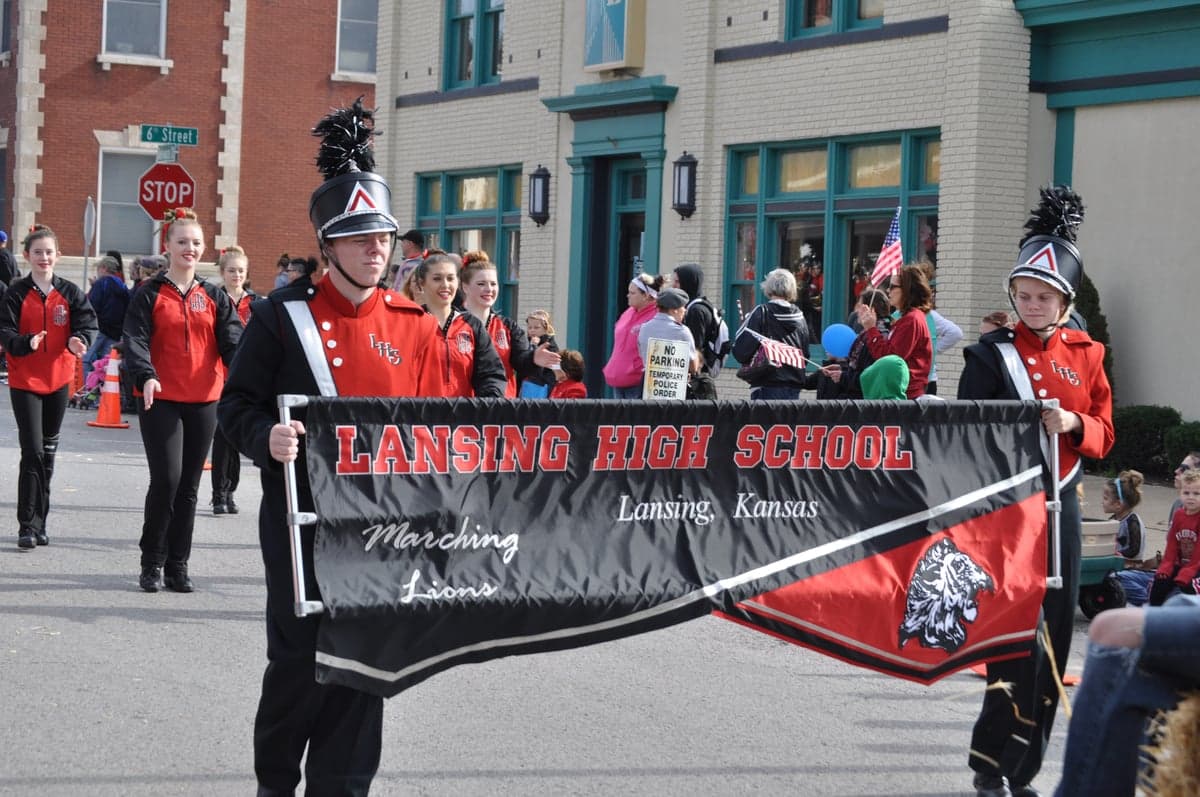
Lansing, Kansas, is a small, predominantly white city of 11,229 residents with a notable Black population (12.1%) and a growing Hispanic community (8.3%), giving it a more diverse character than many neighboring Leavenworth County towns. The city’s identity is shaped by its history as a prison town—the Lansing Correctional Facility has been the dominant employer for generations—and by its recent evolution into a quiet bedroom suburb for military and civilian workers commuting to Fort Leavenworth and Kansas City. With 41.3% of adults holding a college degree, the population is well-educated, yet the foreign-born share is very low at 1.4%, reflecting limited recent immigration. The people of Lansing today are a mix of long-standing working-class families, corrections employees, and newer professionals seeking affordable housing within commuting distance of the metro.
How the city was settled and grew
Lansing was founded in 1864 as a railroad stop on the Missouri River, but its population remained tiny until the state built a prison here in 1869. The Lansing Correctional Facility (originally the Kansas State Penitentiary) drew the first real wave of residents: guards, administrators, and their families, who settled in the Old Town district near the prison and the railroad depot. These early residents were overwhelmingly native-born white Kansans, many from farm backgrounds. A second wave came during the 1930s and 1940s, when the prison expanded and the federal government built the Sunflower Ordnance Works (a WWII munitions plant) just south of town. That plant brought a temporary influx of workers from across the Midwest, though most left after the war. The neighborhoods that grew during this era—Westside and North Lansing—were built by and for these prison and industrial workers, with small frame houses and a blue-collar character that persists today. By 1950, Lansing had barely 2,000 residents, still almost entirely white.
Modern era (post-1965)
Lansing’s modern demographic shift began after the 1965 Immigration and Nationality Act, but the change was driven less by foreign immigration than by domestic migration. The city’s Black population grew from negligible to 12.1% today, largely through the expansion of the prison system and the nearby Fort Leavenworth military base. Black corrections officers and military personnel moved into the Eastside neighborhood, near the prison complex, and into newer subdivisions like Prairie View Estates in the 1990s and 2000s. The Hispanic population (8.3%) is a more recent phenomenon, growing from under 2% in 2000 to its current share, driven by construction and service jobs in the expanding prison and the broader Kansas City metro. These families have concentrated in the South Lansing area, near the newer retail corridor along Main Street. The East/Southeast Asian population remains tiny at 0.6%, and the Indian-subcontinent population is negligible at 0.1%, reflecting the city’s lack of the high-tech or university sectors that attract those groups elsewhere. The foreign-born share (1.4%) is among the lowest in the region, meaning nearly all population growth has come from domestic in-migration, not immigration.
The future
Lansing’s population is slowly diversifying, but the trend is toward assimilation into a mainstream white-majority culture rather than the formation of distinct ethnic enclaves. The Hispanic share is growing steadily, driven by births and continued migration from other parts of Kansas, and is expected to reach 12-15% by 2040. The Black population has plateaued near 12% and may decline slightly as older corrections workers retire and younger families move to more diverse suburbs closer to Kansas City. The white share (69.4%) is declining gradually but remains dominant. The city is not tribalizing into separate enclaves; instead, newer subdivisions like Stonebridge and Riverbend are attracting a mix of white, Black, and Hispanic families, reflecting a homogenizing trend. The foreign-born share is unlikely to rise significantly, as Lansing lacks the job base or housing stock to attract immigrants. The next decade will likely see slow growth (1-2% annually), with the population becoming slightly more Hispanic and slightly less white, but remaining overwhelmingly native-born and English-speaking.
For someone moving in now, Lansing is becoming a stable, moderately diverse bedroom community where the prison and military base remain the economic anchors. The population is family-oriented, politically moderate to conservative, and increasingly college-educated. Newcomers will find a place where racial and ethnic change is gradual and largely uncontentious, and where the dominant culture remains Midwestern and traditional. The city is not a melting pot of distinct communities but a slow-blending suburb where most residents share similar lifestyles and values, regardless of background.

* Values derived from national, state, county, city and local statistics and may differ in a specific area. Last updated: 2026-05-03T13:32:33.000Z
Narrative content on this page is AI-generated and may contain mistakes. Verify any details that matter before acting on them.
ReloMaps may earn a commission from affiliate links at no extra cost to you.

