
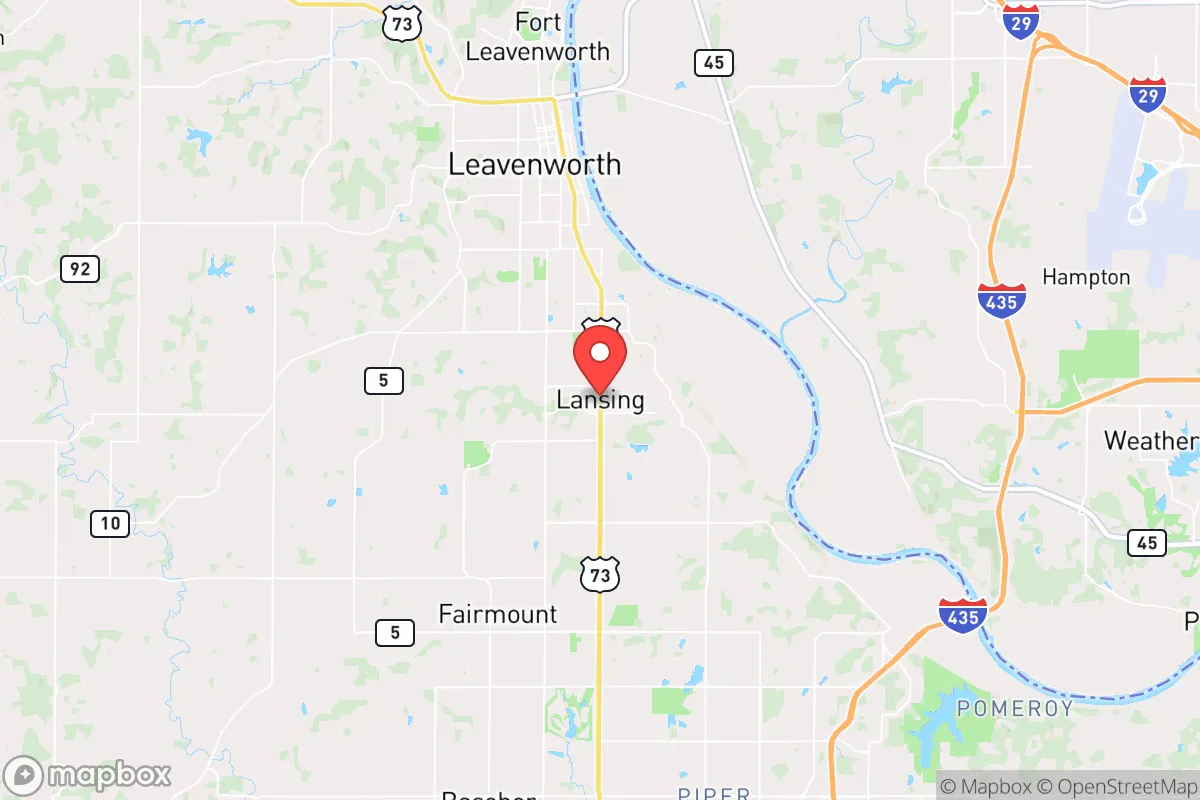
Photo: Wikipedia
Personal Sovereignty in Lansing, KS
Viable for self-reliance. Generally workable, though some barriers may limit total independence.
What does Personal Sovereignty tell us?
Personal Sovereignty measures your capacity for self-reliance and independence with minimal government friction. Higher scores mean fewer barriers between you and the way you want to live... but it assumes you have the space you need and good neighbors.
What does this tell us?
Personal Sovereignty measures your capacity for self-reliance and independence with minimal government friction. Higher scores mean fewer barriers between you and the way you want to live... but it assumes you have the space you need and good neighbors.
State Policy
Energy independence: Self-sufficient (80% of energy produced in-state)
Personal Liberty
Homesteading

Personal Liberty Analysis
For the individual or family prioritizing personal sovereignty—the ability to live, defend, and provide for oneself without undue interference—Lansing, Kansas, presents a notably favorable environment within the broader context of the American heartland. While no location is a fortress against federal overreach, this Leavenworth County community benefits from a state-level legal framework that consistently ranks among the most protective of individual rights in the nation. The calculus here is straightforward: Kansas law deliberately carves out wide latitude for personal decision-making in areas of taxation, self-defense, property use, and family autonomy, making Lansing a strategic choice for those who view government as a necessary but limited partner rather than a guardian. The key is understanding how these state-level protections actually play out on the ground in a small city of roughly 12,000 residents, where local ordinances can either amplify or mute the constitutional guarantees from Topeka.
Tax burden and regulatory posture for the self-reliant individual
Kansas operates under a relatively light tax and regulatory regime compared to its coastal counterparts, and Lansing residents benefit directly from this posture. The state levies a flat income tax rate of 5.7% on all taxable income above certain thresholds, with no progressive brackets that penalize increased earnings—a structure that rewards entrepreneurship and side hustles common among preppers and homesteaders. Property taxes in Leavenworth County hover around 1.3% of assessed value, which is moderate for the region but significantly lower than states like Illinois or New York. More critically, Kansas has no state-level estate tax or inheritance tax, meaning assets you accumulate—land, tools, supplies—can pass to your heirs without the government taking a cut. On the regulatory side, Kansas is a right-to-work state, which limits union influence on local employment, and it maintains a generally permissive attitude toward home-based businesses. For the survivalist mindset, this means fewer licensing hurdles for activities like small-scale manufacturing, food preservation sales, or firearm-related services. The city of Lansing itself does not impose a local income tax, and its zoning code is less restrictive than in nearby Johnson County suburbs, though you will still need to navigate building permits for major structures. The net effect is a tax and regulatory environment that leaves more money and time in your hands—both critical resources for building resilience.
Self-defense and gun law specifics in a constitutional carry state
Kansas is a constitutional carry state, meaning that as of 2015, any law-abiding adult 21 or older can carry a concealed firearm without a permit. This is not a privilege granted by the state; it is recognized as a pre-existing right. Lansing sits in Leavenworth County, which has a sheriff's office that is generally supportive of Second Amendment rights, and there are no local ordinances that override state preemption—meaning city council cannot ban carry in parks, libraries, or other public spaces. The state also has strong castle doctrine and stand-your-ground laws, with no duty to retreat if you are in a place you have a legal right to be. For the prepper, this legal framework is foundational: your home, vehicle, and property are legally defensible spaces. Kansas also prohibits any state or local government from enforcing federal gun laws that conflict with state law, a provision that adds a layer of resistance against potential federal overreach. Magazine capacity restrictions, assault weapon bans, and waiting periods are all nonexistent at the state level. The practical reality in Lansing is that you can maintain a full-spectrum personal armory without bureaucratic interference, and the local culture—with its proximity to Fort Leavenworth—tends to view armed preparedness as normal rather than alarming. The only notable limitation is that Kansas does not recognize out-of-state concealed carry permits for non-residents, but for a resident, the legal landscape is about as favorable as it gets in the continental United States.
Self-reliance and homesteading viability: lot sizes, zoning, and off-grid feasibility
Lansing offers a meaningful opportunity for those seeking a self-reliant lifestyle, though it requires careful property selection. The city's zoning code allows for residential lots ranging from standard subdivision parcels of a quarter-acre up to larger tracts of two to five acres in the more rural fringes. Within city limits, keeping chickens is generally permitted, and some areas allow for small livestock like goats or rabbits, though you will need to check the specific zoning district. The real potential lies just outside the city limits in unincorporated Leavenworth County, where zoning is minimal and five-to-twenty-acre parcels are still available at prices far below those in Douglas or Johnson counties. Off-grid feasibility is mixed: Kansas has no state law prohibiting rainwater collection, and solar panel installation is straightforward, but the county does enforce standard building codes for habitable structures, meaning a true "no-permit" cabin is unlikely. However, you can legally install a composting toilet and use propane for heating without triggering major regulatory hurdles. The growing season runs roughly April through October, and the soil in the Missouri River valley is fertile enough for substantial vegetable production. For the prepper, the key trade-off is proximity: Lansing gives you access to a Lowes, a Walmart, and a regional hospital within ten minutes, while still allowing you to own enough land to dig a well, store a year's worth of supplies, and practice marksmanship on private property (subject to county noise ordinances). It is not frontier living, but it is a workable middle ground for those building resilience without abandoning civilization entirely.
Personal liberties: parental rights, medical autonomy, speech, and property
Kansas has become a battleground for personal liberties in recent years, and the outcomes have generally favored individual sovereignty. On parental rights, the state passed the Parental Bill of Rights in 2021, which affirms that parents have the fundamental right to direct the upbringing, education, and healthcare of their children. This means Lansing parents can opt their children out of curriculum they find objectionable, and the school district—part of the Lansing USD 469 system—has not been aggressive in challenging these rights. Medical autonomy is more nuanced: Kansas does not have a state-level vaccine mandate for adults, and while COVID-era restrictions were present, they were lighter than in many states. The state has also resisted federal pressure on masking and lockdowns, with local officials generally deferring to personal choice. On speech, Kansas has no hate speech laws that criminalize political expression, and the state's public universities have been relatively restrained in viewpoint policing compared to coastal institutions. Property rights are strongly protected under Kansas law, with a robust eminent domain statute that requires just compensation and a demonstrated public use—a safeguard against the kind of regulatory takings seen in more progressive states. The one area of concern for the liberty-minded is the state's medical marijuana prohibition; Kansas remains one of the few states with no legal cannabis program, and possession can still lead to criminal charges. For those who view this as a personal choice issue, it is a notable limitation. Overall, the legal climate in Lansing respects the individual as the primary decision-maker in family, health, and property matters, with the state acting as a backstop rather than a director.
In the broader landscape of American personal sovereignty, Lansing, Kansas, ranks as a strong contender for those who value autonomy over convenience. It lacks the extreme libertarian ethos of a place like rural Idaho or Alaska, but it compensates with practical infrastructure, a supportive state legal framework, and a community that largely minds its own business. The tax burden is manageable, the gun laws are among the best in the nation, the potential for self-reliant living is real if you choose your land wisely, and the legal protections for family and property are solid. The trade-offs—no medical marijuana, moderate property taxes, and the ever-present risk of federal preemption—are manageable for most strategic relocation planners. For the conservative-leaning individual or family looking to build a life with maximum personal control and minimum government friction, Lansing offers a realistic, defensible base of operations in an increasingly uncertain country.

* Values derived from national, state, county, city and local statistics and may differ in a specific area. Last updated: 2026-05-03T13:32:33.000Z
Narrative content on this page is AI-generated and may contain mistakes. Verify any details that matter before acting on them.
ReloMaps may earn a commission from affiliate links at no extra cost to you.

