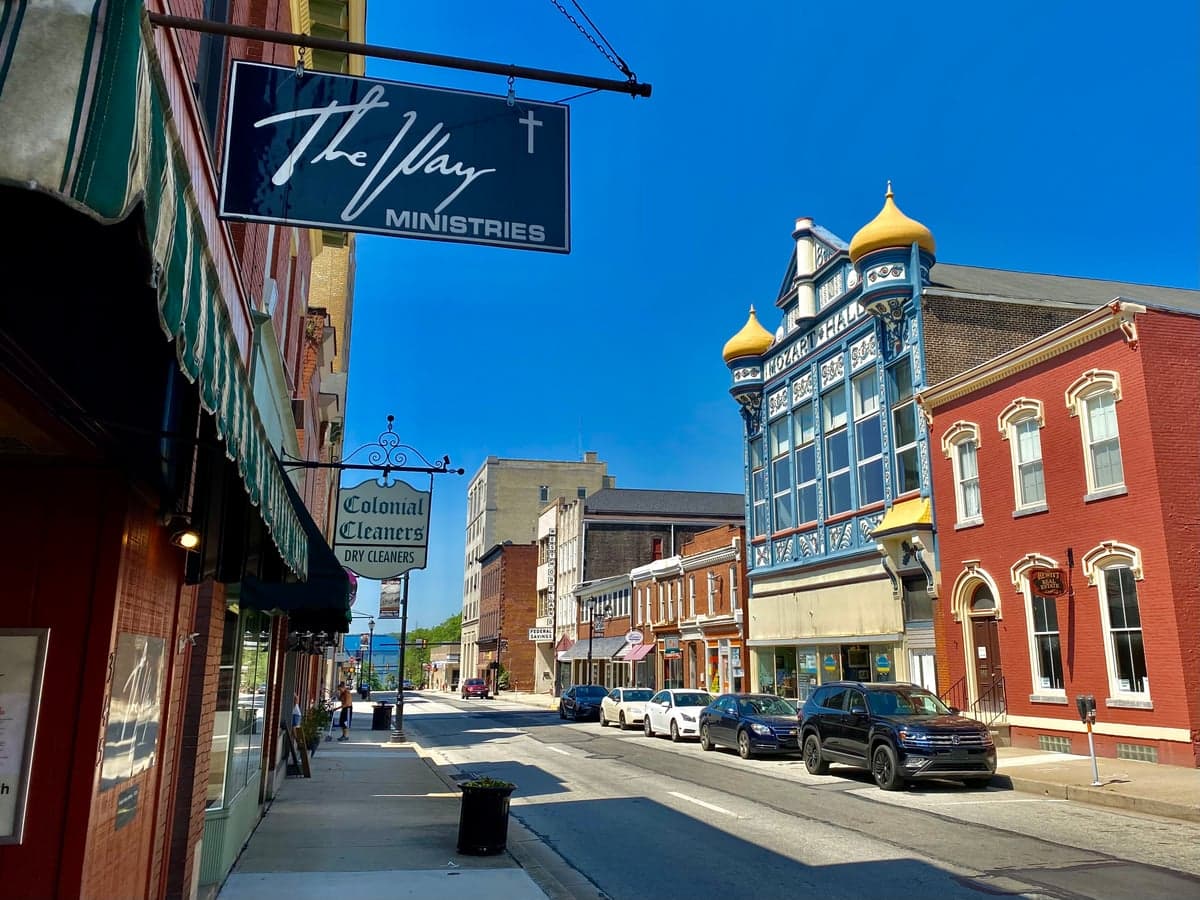
Photo: Wikipedia
Personal Sovereignty in Latrobe, PA
Strong independent fundamentals that actively favor personal liberty and low regulation.
What does Personal Sovereignty tell us?
Personal Sovereignty measures your capacity for self-reliance and independence with minimal government friction. Higher scores mean fewer barriers between you and the way you want to live... but it assumes you have the space you need and good neighbors.
What does this tell us?
Personal Sovereignty measures your capacity for self-reliance and independence with minimal government friction. Higher scores mean fewer barriers between you and the way you want to live... but it assumes you have the space you need and good neighbors.
State Policy
Energy independence: Net exporter (150% of energy produced in-state)
Personal Liberty
Homesteading

Personal Liberty Analysis
Latrobe, Pennsylvania offers a personal sovereignty environment that is notably stronger than in nearby coastal states, but it operates within the constraints of a commonwealth with moderate state-level regulations and a local culture that values self-reliance. For individuals and families prioritizing autonomy, the area provides a solid foundation—low property taxes relative to the Northeast, a permissive self-defense legal framework, and zoning that supports modest self-sufficiency—while still requiring navigation of Pennsylvania’s state-level income tax and business regulations. The overall balance leans toward personal freedom, especially when compared to jurisdictions like New York or New Jersey, but it is not a libertarian free-for-all.
Tax burden and regulatory posture in Westmoreland County
Pennsylvania’s tax structure is generally favorable for those seeking to keep more of their earnings. The state imposes a flat personal income tax of 3.07%, one of the lowest flat rates in the nation, and does not tax retirement income such as Social Security, 401(k) distributions, or pensions. For a retiree or a family relying on investment income, this is a significant advantage. Local taxes in Latrobe add a modest earned income tax of roughly 1% to 1.5%, and property taxes in Westmoreland County are among the lowest in the Pittsburgh metro area. The average effective property tax rate in Westmoreland County is approximately 1.5% of assessed value, which is below the Pennsylvania average and far below rates in many New England states. However, Pennsylvania’s regulatory posture is moderate. The state has a business-friendly corporate net income tax rate of 8.49% (down from 9.99% in recent years), but it also maintains a gross receipts tax on certain utilities and a capital stock and franchise tax that is being phased out. For a small business owner or freelancer in Latrobe, the regulatory burden is manageable but not negligible—permitting for home-based businesses is generally straightforward, though zoning in residential areas can restrict certain commercial activities. The state’s environmental regulations, particularly regarding land use and water rights, are more stringent than in states like Texas or Florida, but they are enforced with a practical, less adversarial approach than in the Northeast corridor.
Self-defense and gun law specifics in Pennsylvania
Pennsylvania is a shall-issue state for concealed carry permits, meaning that if you meet basic criteria—age 21, no felony record, no involuntary mental health commitment—the county sheriff must issue a License to Carry Firearms (LTCF). Westmoreland County, where Latrobe is located, is known for efficient processing, with permits typically issued within 45 days. Open carry is legal without a permit for anyone who can legally possess a firearm, though it is restricted in Philadelphia and during declared emergencies. The state preempts local firearm ordinances, so Latrobe cannot enact its own bans or restrictions beyond state law. Stand-your-ground laws are not explicitly codified in Pennsylvania statute, but the state’s Castle Doctrine provides a strong presumption of reasonable fear of death or serious bodily injury when using deadly force against an intruder in your home or vehicle. There is no duty to retreat in your own dwelling. For a reader prioritizing self-defense, Pennsylvania’s legal framework is solidly pro-rights, though not as permissive as states like Texas or Arizona. Magazine capacity is not restricted, and there is no state-level assault weapons ban. The main friction point is the requirement for a permit to carry concealed, which involves a background check and a fee (typically $20-$25), but the process is straightforward and non-discretionary in Westmoreland County.
Self-reliance and homesteading viability: lot sizes, zoning, and off-grid feasibility
Latrobe sits in a region where rural and suburban living blend, offering genuine opportunities for self-reliance. Residential lots in the city proper are typically a quarter-acre to half-acre, but just outside town—in areas like Unity Township or Derry Township—zoning allows for 1- to 5-acre parcels with minimal restrictions. Agricultural zoning is common, and raising chickens, goats, or even a small herd of cattle is feasible on parcels of 2 acres or more. The county’s soil quality is decent for gardening, and the growing season runs from late April to mid-October, long enough for a substantial vegetable garden. Off-grid living is legally possible but practically challenging. Pennsylvania does not have a state law explicitly prohibiting off-grid systems, but local building codes in Westmoreland County require connection to a public sewer or an approved septic system, and well water permits are issued by the county health department. Solar panels are allowed, but net metering rules require interconnection with the grid for any system over 10 kW. Rainwater collection is legal for non-potable uses, but the state’s Department of Environmental Protection regulates large-scale cisterns. For a homesteader, the main regulatory hurdle is the Uniform Construction Code, which applies to all new dwellings and major renovations. This means that building a tiny house or a straw-bale home requires engineered plans and inspections, adding cost and time. Still, compared to states like California or Oregon, the regulatory burden is light. Many residents in the Latrobe area heat with wood, maintain large gardens, and keep livestock without significant government interference.
Personal liberties: parental rights, medical autonomy, speech, and property
Pennsylvania generally respects parental rights in education. The state allows for homeschooling under a relatively straightforward statute: parents must file an affidavit with the local school district, maintain a portfolio of work, and have the child evaluated annually by a certified teacher or through standardized testing. There is no requirement for a specific curriculum, and parents have broad discretion over content. Medical autonomy is more mixed. Pennsylvania has not enacted broad vaccine mandates beyond those required for school attendance, and religious exemptions are available for most childhood vaccines. However, the state does not have a right-to-try law for terminally ill patients that is as expansive as some states, and medical marijuana is legal only for certified conditions, with no home cultivation allowed. For a family seeking maximum medical freedom, Pennsylvania is moderate—better than New York or California, but not as permissive as Idaho or Oklahoma. Free speech protections are robust, as Pennsylvania courts have historically interpreted the state constitution’s free expression clause more broadly than the First Amendment in some contexts. Property rights are well-protected; eminent domain is limited to public use projects, and the state’s Right-to-Farm Act shields agricultural operations from nuisance lawsuits if they predate nearby residential development. For a landowner in Latrobe, this means that if you buy a 5-acre parcel and start a small farm, you are largely protected from complaints by future neighbors.
Overall, Latrobe offers a personal sovereignty profile that is above average for the Northeast but below the libertarian strongholds of the Mountain West or rural Alaska. The tax burden is low for the region, gun laws are favorable, and the regulatory environment for homesteading is permissive enough to allow meaningful self-reliance. The main trade-offs are the state income tax (which is flat and moderate) and the building code requirements, which add friction to off-grid construction. For a family or individual who values personal freedom and is willing to work within a moderate regulatory framework, Latrobe provides a solid base—especially when compared to the high-tax, high-regulation environments of nearby states like New York, New Jersey, or Maryland.

* Values derived from national, state, county, city and local statistics and may differ in a specific area. Last updated: 2026-08-24T07:10:29.000Z
Narrative content on this page is AI-generated and may contain mistakes. Verify any details that matter before acting on them.
ReloMaps may earn a commission from affiliate links at no extra cost to you.

