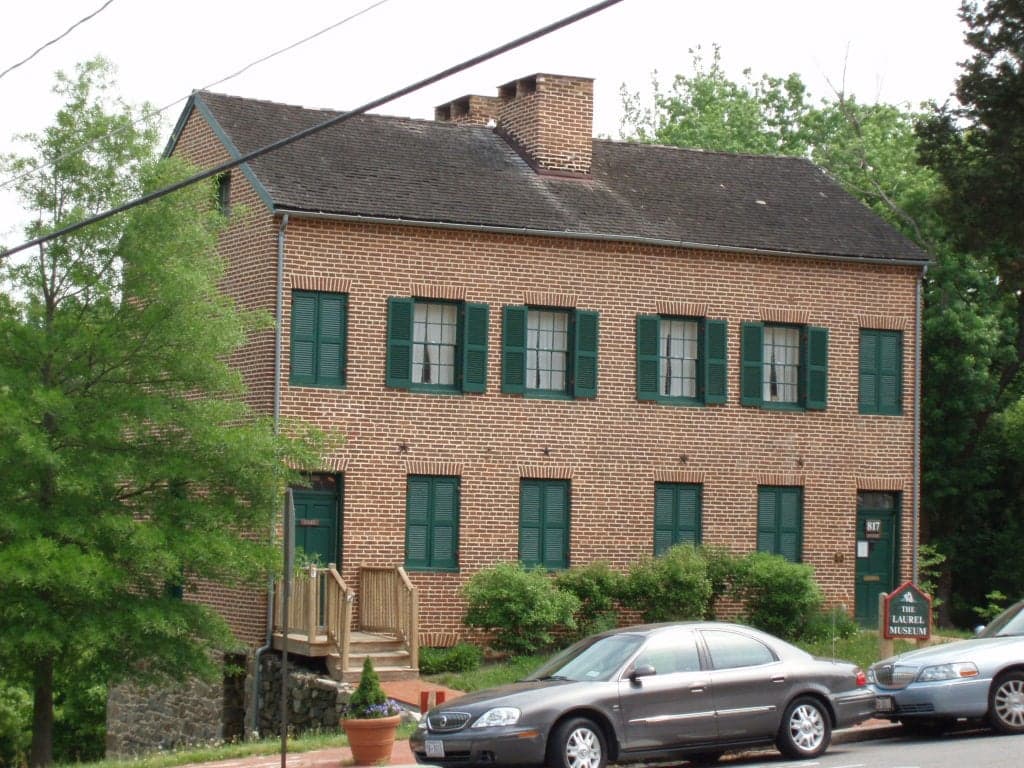
Photo: Wikipedia
Demographics of Laurel, MD
Affluence Level in Laurel, MD
A middle-class area roughly in line with national averages across income, home values, education, and employment.
People of Laurel, MD
Laurel, Maryland, is a densely populated city of 29,594 residents that stands out for its pronounced racial and ethnic diversity, with a Black plurality (48.8%) and significant Hispanic (22.4%), White (14.2%), and East/Southeast Asian (7.1%) communities. The city’s character is defined by its role as a stable, middle-class suburb along the I-95 corridor, where a high share of college-educated adults (44.5%) and a foreign-born population of 15.8% create a distinctly multicultural, family-oriented atmosphere. Unlike many older East Coast suburbs, Laurel’s identity is less about a single founding ethnic group and more about successive waves of migration that have layered new communities over older ones, producing a city that feels both transient and deeply rooted.
How the city was settled and grew
Laurel’s original population was drawn by the Patuxent River’s water power and the Baltimore and Ohio Railroad, which arrived in 1835. The city was formally incorporated in 1870, but its early growth centered on the Laurel Factory district, a mill village where European immigrants—primarily Irish and German laborers—built the first homes and churches. The mill owners constructed row houses and small cottages along Main Street and Washington Boulevard, neighborhoods that still contain some of the city’s oldest housing stock. A second wave came with the expansion of the Washington-Baltimore streetcar line in the early 1900s, which turned Laurel into a commuter suburb. This era brought middle-class White families to areas like Montpelier, a planned community of single-family homes built in the 1920s and 1930s, and Brock Hall, a rural crossroads that gradually filled with bungalows. By 1950, Laurel was still a small, predominantly White town of about 8,000 residents, with a tiny Black population concentrated in the West End neighborhood near the railroad tracks.
Modern era (post-1965)
The 1965 Hart-Cellar Act and the subsequent expansion of the federal government in the Washington region transformed Laurel’s population. Black families, many moving from Washington, D.C., and Prince George’s County, began settling in the West Laurel and South Laurel subdivisions during the 1970s and 1980s, drawn by affordable housing and proximity to federal jobs. By 1990, the Black share had risen to roughly 35%, and it continued climbing to its current 48.8% plurality. Hispanic migration accelerated in the 1990s and 2000s, with Salvadoran, Guatemalan, and Mexican families moving into apartment complexes along Route 1 and the Laurel Lakes area, often working in construction, landscaping, and the nearby food-processing plants. East/Southeast Asian communities—particularly Vietnamese and Korean families—established a presence in the Brock Hall and Montpelier neighborhoods, opening small businesses and churches. The Indian-subcontinent population (2.5%) is smaller but growing, concentrated in newer townhome developments near the Laurel Regional Hospital corridor. The White share has fallen from over 80% in 1970 to 14.2% today, with many older White families aging in place in Main Street and Washington Boulevard historic homes, while younger White residents are often renters in the Laurel Lakes apartment complexes.
The future
Laurel’s population is likely to continue diversifying, though the pace of change may slow as the city approaches build-out. The Hispanic share (22.4%) is the fastest-growing segment, driven by both immigration and higher birth rates, and is expected to reach 28-30% within a decade, particularly in the Route 1 corridor and South Laurel apartment districts. The Black plurality is stable but aging, with younger Black families increasingly choosing newer suburbs farther out in Anne Arundel and Howard counties. The East/Southeast Asian and Indian communities are growing slowly through chain migration and professional recruitment, with new arrivals often settling in Montpelier and Brock Hall. The city is not homogenizing; instead, it is tribalizing into distinct enclaves—West Laurel remains predominantly Black, Route 1 is heavily Hispanic, and Montpelier is a mixed Asian and White area. The foreign-born share (15.8%) is plateauing as second-generation residents assimilate and move outward. Laurel is becoming a mature, multi-ethnic suburb where no single group dominates, but where neighborhoods retain distinct ethnic identities.
For someone moving in now, Laurel offers a genuinely integrated environment where diversity is the norm, not a trend. The city’s schools and public spaces reflect its multicultural character, and the high share of college-educated residents (44.5%) signals a stable, professional class. However, the city’s future is one of slow growth and gradual demographic consolidation, not explosive change. New residents should expect a community where ethnic enclaves coexist peacefully but remain distinct, and where the historic White population continues to shrink. Laurel is becoming a model of the American suburb in the 2020s: diverse, middle-class, and quietly evolving.

* Values derived from national, state, county, city and local statistics and may differ in a specific area. Last updated: 2026-04-22T02:20:32.000Z
Narrative content on this page is AI-generated and may contain mistakes. Verify any details that matter before acting on them.
ReloMaps may earn a commission from affiliate links at no extra cost to you.

