
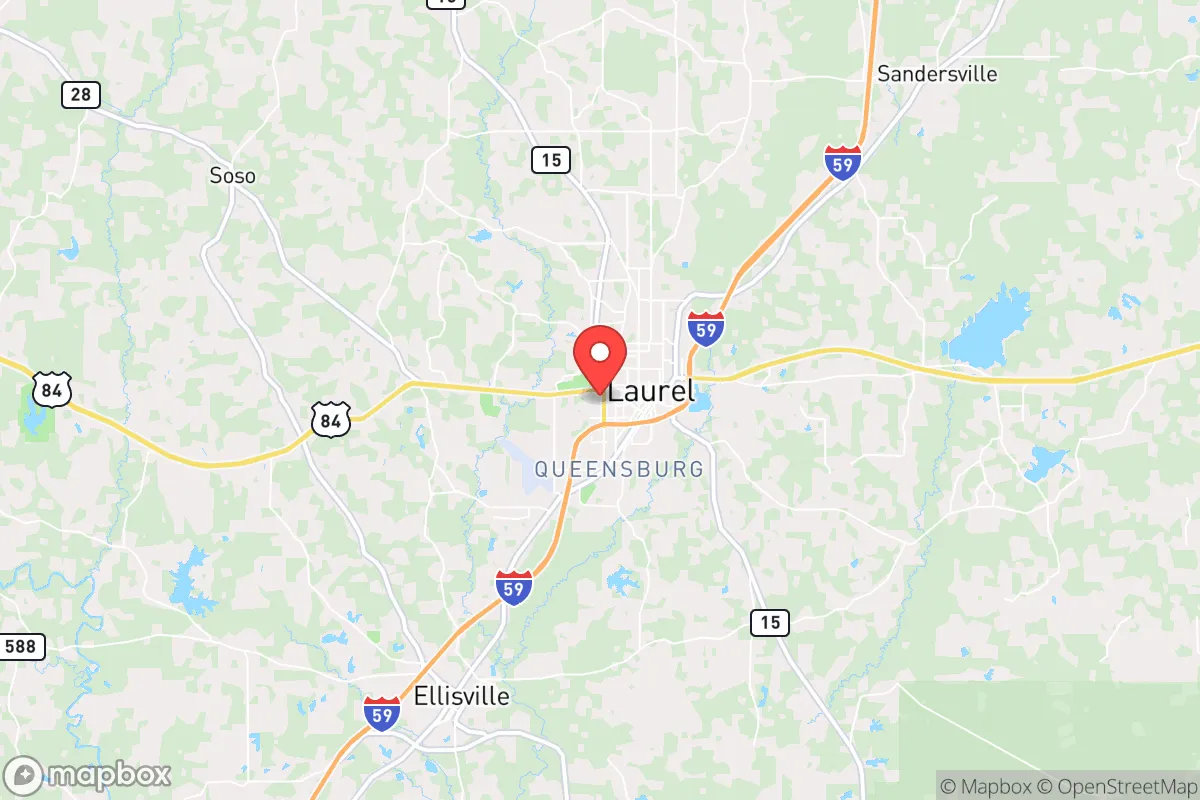
Photo: Wikipedia
Personal Sovereignty in Laurel, MS
Viable for self-reliance. Generally workable, though some barriers may limit total independence.
What does Personal Sovereignty tell us?
Personal Sovereignty measures your capacity for self-reliance and independence with minimal government friction. Higher scores mean fewer barriers between you and the way you want to live... but it assumes you have the space you need and good neighbors.
What does this tell us?
Personal Sovereignty measures your capacity for self-reliance and independence with minimal government friction. Higher scores mean fewer barriers between you and the way you want to live... but it assumes you have the space you need and good neighbors.
State Policy
Energy independence: Importer (50% of energy produced in-state)
Personal Liberty
Homesteading

Personal Liberty Analysis
Laurel, Mississippi, offers a notably high degree of personal sovereignty compared to much of the coastal United States, largely due to the state’s constitutional protections and a political culture that resists federal overreach. For a single individual or parent operating from a survivalist or prepper mindset, the environment here is one where the default posture of local and state government leans toward non-interference, not paternalistic control. The key question is whether this autonomy is durable against national trends, and the answer, grounded in Mississippi’s legal framework and Laurel’s local governance, is that it remains one of the more resilient pockets for self-directed living in the South.
Tax burden and regulatory posture: How Laurel compares to high-tax states
Mississippi’s tax structure is a clear advantage for anyone seeking to minimize government extraction from their labor and resources. The state levies a flat personal income tax rate of 4.0% (as of 2026, following a phased reduction), and there are serious legislative discussions about eliminating it entirely. Property taxes in Laurel are among the lowest in the nation, with effective rates typically around 0.6% to 0.8% of assessed home value, meaning a $200,000 home might incur roughly $1,200 to $1,600 annually in property taxes. This is a fraction of what you’d pay in states like New York, Illinois, or California. Sales tax in Laurel is 7.0% (state plus local), which is moderate but not oppressive. The regulatory posture at the state level is explicitly pro-business and anti-red tape. Mississippi is a right-to-work state, has no state-level occupational licensing for many trades, and its environmental and building code enforcement is minimal compared to the West Coast or Northeast. For a prepper, this means fewer hurdles for constructing outbuildings, storing supplies, or running a home-based business. The city of Laurel itself does not impose onerous business license fees or zoning overlays that would stifle a self-reliant operation. The trade-off is that public services—roads, schools, emergency response—are funded at lower levels, but for the sovereignty-minded, that’s often a feature, not a bug.
Self-defense and gun law specifics: Constitutional carry and castle doctrine
Mississippi is a constitutional carry state, meaning no permit is required to carry a concealed or open firearm for anyone legally allowed to possess one. This went into effect in 2016, and Laurel’s local law enforcement has not attempted to undermine it. The state’s castle doctrine is unequivocal: there is no duty to retreat in any place where you are lawfully present, including your home, vehicle, or workplace. Stand Your Ground protections apply fully. For a parent, this means the legal framework supports defending your family against a home invasion without fear of prosecution. The state also preempts local gun ordinances, so Laurel cannot pass its own restrictions on magazine capacity, firearm types, or storage requirements. This is a critical point: unlike cities in blue states where local governments chip away at state preemption, Mississippi’s preemption law is strong and enforced. Background checks are only required for purchases from licensed dealers; private sales between individuals require no paperwork. For the survivalist, this means you can build an arsenal, train with it, and rely on it as a last-resort tool without the state treating you as a potential criminal. The only caveat is that federal laws still apply (e.g., NFA items require tax stamps), but the state does not add its own layer of restriction.
Self-reliance and homesteading viability: Lot sizes, zoning, and off-grid feasibility
Laurel’s zoning code is permissive enough to make serious homesteading a realistic goal, especially outside the immediate downtown core. Within the city limits, residential lots typically range from a quarter-acre to half-acre, but many neighborhoods have larger parcels, and the city does not prohibit keeping chickens, goats, or even a small garden for personal use. The real opportunity lies in the unincorporated areas of Jones County surrounding Laurel, where lot sizes of one to five acres are common and affordable—often under $10,000 per acre. Zoning in the county is minimal; there are no HOA-style restrictions on what you can build, how you store water, or whether you can install solar panels. Off-grid feasibility is high: the area gets ample sun for photovoltaic systems, well water is accessible at reasonable depths (typically 100-200 feet), and the climate allows for year-round growing seasons. Septic systems are standard, and there are no county-level bans on rainwater collection. The main limitation is that the city does enforce building codes for new construction within its limits, but these are based on the International Residential Code with local amendments, not the more stringent California or New York versions. For a prepper looking to establish a self-sufficient compound, the path of least resistance is to buy land just outside the city limits, where you can build a pole barn, install a composting toilet, and run a generator without a permit. The local culture is also supportive: neighbors are likely to help rather than report you to code enforcement.
Personal liberties: Parental rights, medical autonomy, speech, and property
Mississippi has some of the strongest parental rights protections in the country. The state’s Parents’ Bill of Rights, enacted in 2023, explicitly affirms that parents have the fundamental right to direct their children’s education, healthcare, and moral upbringing. This means no school district in Laurel can hide curriculum decisions or medical treatments from parents. The state also bans nearly all forms of gender transition procedures for minors, and parental consent is required for any medical treatment. For the conservative parent, this is a fortress against the kind of overreach seen in blue states where schools and medical providers bypass family authority. Medical autonomy for adults is more mixed: Mississippi has not expanded Medicaid, so low-income individuals may face gaps in coverage, but the state does not mandate COVID-19 vaccines or any other experimental treatments. Religious and philosophical exemptions to vaccine mandates are available. Free speech is protected under the state constitution, and there are no local hate speech ordinances or social media censorship laws that would chill political expression. Property rights are robust: Mississippi is a strong private property rights state, with no statewide rent control, no inclusionary zoning mandates, and a relatively straightforward eminent domain process that requires just compensation. For the prepper, this means you can post no-trespassing signs, build a fence, and defend your land without the state second-guessing your right to exclude others. The only notable limitation is that the state does have a sales tax on most goods, but there is no state-level property tax on personal belongings (no “personal property tax” on vehicles or equipment, unlike Virginia).
Overall, Laurel, Mississippi, ranks among the top-tier locations in the United States for personal sovereignty, especially when measured against the creeping authoritarianism seen in states like California, New York, or Illinois. The combination of constitutional carry, low taxes, minimal zoning, strong parental rights, and a culture of self-reliance creates an environment where a single individual or family can live largely free from government interference. The trade-offs—lower public service funding, a hotter climate, and limited economic diversity—are real, but for someone prioritizing autonomy over convenience, Laurel offers a rare and durable sanctuary. If national trends continue toward centralization and control, this area will likely remain a redoubt for those who value the right to live as they see fit, without asking permission from the state.

* Values derived from national, state, county, city and local statistics and may differ in a specific area. Last updated: 2026-05-01T01:04:07.000Z
Narrative content on this page is AI-generated and may contain mistakes. Verify any details that matter before acting on them.
ReloMaps may earn a commission from affiliate links at no extra cost to you.

