
Photo: Wikipedia
Political ClimatePolitical Climate in Laurel, MS
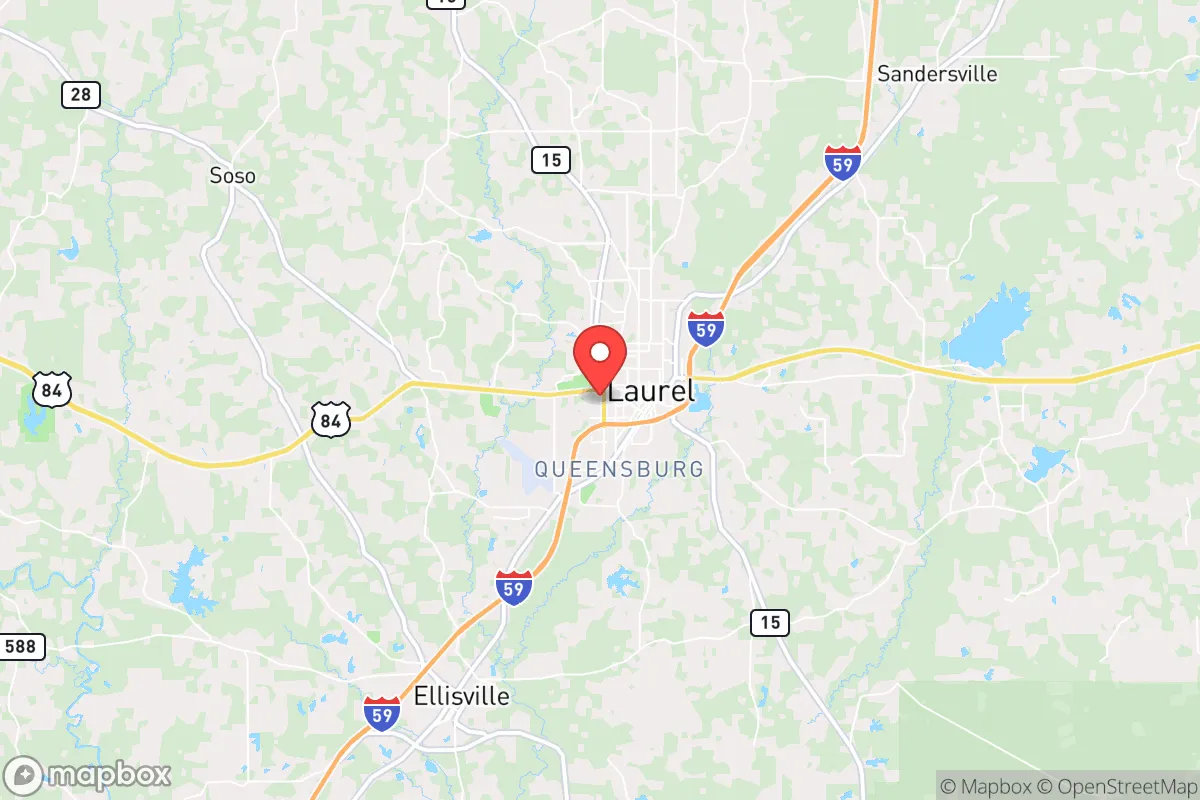
District shown is the primary district for this city’s centroid. Cities may span multiple districts.
Local Political AnalysisPolitical Analysis of Laurel, MS
Laurel, Mississippi, sits deep in the heart of a solidly conservative region, with a Cook PVI of R+21 that tells you everything you need to know about its political DNA. This isn't a place that flips on a dime; it's a community where the old-school values of personal responsibility, limited government, and a hard day's work still mean something. You'll find folks here who remember when the town was a booming lumber and railroad hub, and that independent, self-reliant spirit hasn't faded. The political lean is overwhelmingly Republican, and while the national trends have shifted, Laurel's core has held firm, though there's a quiet unease about the direction of the state and country as a whole.
How it compares
Drive thirty minutes north to Hattiesburg, and you'll feel a different vibe entirely. That university town leans noticeably more moderate, with pockets of progressive thought that would raise eyebrows in Laurel. Head west to Jackson, and the contrast is stark—a deeply Democratic city where the political conversation is about different priorities altogether. Even within Jones County, Laurel stands out as the conservative anchor. The surrounding rural areas are even more red, but Laurel is the economic and cultural hub, so its politics carry weight. The real comparison, though, is with the past. Twenty years ago, the political conversation here was about local roads and school boards. Now, it's about federal overreach, mandates, and the creeping sense that the government in Washington—and even in Jackson—doesn't trust people to run their own lives. That's the shift that bothers most folks I know.
What this means for residents
For the people living here, the political climate translates into a daily life that still feels, for the most part, free. You don't see the heavy hand of government in every decision. Property taxes are reasonable, zoning is light, and there's a general understanding that you can run your business or raise your family without a bureaucrat looking over your shoulder. That said, there's a growing concern about the state's willingness to adopt national progressive trends. The push for more centralized control over education, the talk of expanding Medicaid in ways that tie the state to federal strings, and the quiet pressure to align with corporate diversity mandates—these are all red flags for long-time residents. The fear is that Laurel's way of life, built on self-sufficiency and local decision-making, could be eroded one regulation at a time. People are watching closely, and they're not shy about voicing their opposition at the county commission meetings or the local coffee shop.
Culturally, Laurel still holds onto distinctions that set it apart. The city's famous for its historic downtown and the "Laurel way" of doing things—neighbor helping neighbor, church on Sunday, and a fierce independence from outside influence. You won't find the same push for bike lanes, public art installations funded by grants, or the kind of "smart city" initiatives that are popping up in more progressive towns. Instead, the focus stays on practical things: keeping the police department funded, maintaining the local hospital, and making sure the schools teach the basics without indoctrination. The biggest policy distinction is the local resistance to any form of gun control, with most residents viewing the Second Amendment as non-negotiable. The long-term outlook is cautious. If the national trend toward centralization continues, Laurel will likely dig in its heels, becoming even more of a conservative stronghold. But if the state starts to mirror the federal government's overreach, you might see a real fight—the kind that defines a community for generations.

State Political ClimatePolitical Climate in Mississippi
State Political AnalysisPolitical Environment in the State
Mississippi is one of the most reliably conservative states in the country, with a deep-rooted Republican lean that has only solidified over the past two decades. The state voted for Donald Trump by over 16 points in 2024, and no Democratic presidential candidate has carried Mississippi since Jimmy Carter in 1976. The dominant coalition is a mix of rural white evangelicals, suburban families in the Jackson metro exurbs, and Gulf Coast retirees, all of whom have pushed the state legislature and governor’s mansion firmly rightward since the early 2000s. However, the state’s political landscape is not monolithic—pockets of Democratic strength remain in the Mississippi Delta and majority-Black urban centers, creating a sharp geographic and cultural divide that any new resident should understand before settling in.
Urban vs. rural divide
The political map of Mississippi breaks down along stark urban-rural lines. The state’s largest city, Jackson, is a Democratic stronghold where over 80% of voters backed Joe Biden in 2020, driven by a predominantly Black population and a history of civil rights activism. But Jackson’s influence is shrinking—its population has declined by roughly 10% since 2010, and the surrounding Madison County suburbs, including the town of Madison, have become some of the most reliably Republican areas in the state. The Gulf Coast cities of Biloxi and Gulfport lean conservative, though they occasionally elect moderate Democrats at the local level due to union ties in the casino and shipbuilding industries. The real engine of Republican dominance is the rural and small-town vote: counties like DeSoto County (just south of Memphis), Rankin County (east of Jackson), and Lamar County (near Hattiesburg) routinely deliver 70-80% margins for GOP candidates. The Mississippi Delta, including towns like Greenville and Clarksdale, remains a Democratic holdout, but its declining population means it carries less weight in statewide elections every cycle.
Policy environment
Mississippi’s policy environment is among the most conservative in the nation, with a strong emphasis on low taxes, limited regulation, and traditional social values. The state has no individual income tax on wages (phased out as of 2023), and the corporate income tax rate is a flat 4%—one of the lowest in the country. Property taxes are also low, with a median effective rate of just 0.65%, though local school districts can levy additional millage. Education policy is a mixed bag: the state has a school choice program (the Mississippi Education Scholarship Account) that allows parents to use public funds for private or homeschool expenses, but the program is capped at around 5,000 students and faces annual legislative battles. Healthcare is a flashpoint—Mississippi has not expanded Medicaid under the Affordable Care Act, leaving roughly 75,000 low-income adults in a coverage gap. The state’s election laws are restrictive by design: voter ID is required, early voting is limited to in-person absentee with an excuse, and no-excuse mail voting is not available. In 2023, the legislature passed a law banning ranked-choice voting and limiting ballot drop boxes, moves that were framed as election integrity measures but drew criticism from voting rights groups.
Trajectory & freedom
Over the past five years, Mississippi has moved decisively toward expanding personal liberty in several key areas, particularly gun rights, parental rights, and tax freedom. In 2023, the legislature passed a permitless carry law, allowing any adult who can legally possess a firearm to carry it openly or concealed without a license—a significant expansion of Second Amendment rights. The same year, the state enacted the “Parents’ Bill of Rights,” which requires schools to notify parents of any medical or mental health services offered to their child and prohibits classroom instruction on sexual orientation or gender identity in grades K-3. On the tax front, the 2022 income tax phase-out was a major win for economic freedom, and the state has resisted calls to reimpose a state-level gas tax or property tax hikes. However, there are concerning trends: the state’s medical marijuana program, passed by voter initiative in 2020, was heavily restricted by the legislature in 2023, limiting the number of dispensaries and capping THC potency. This has frustrated advocates who see it as government overreach into personal medical choices. Additionally, the state’s abortion ban—triggered by the Dobbs decision—is one of the strictest in the country, with no exceptions for rape or incest, which some conservatives view as a necessary protection of life but others see as an overreach into personal tragedy.
Civil unrest & political movements
Mississippi has seen relatively low levels of civil unrest compared to other Southern states, but there have been notable flashpoints. In 2020, following the murder of George Floyd, protests erupted in Jackson and Oxford (home to the University of Mississippi), with some demonstrations turning violent and leading to property damage. The state’s political response was swift: the legislature passed a law in 2021 increasing penalties for rioting and blocking efforts to defund the police. Immigration politics are less heated here than in border states, but the issue still surfaces—in 2023, Governor Tate Reeves deployed the National Guard to the Texas border as part of a multi-state operation, and the state has passed laws requiring local law enforcement to cooperate with federal immigration authorities. Election integrity remains a live issue: after the 2020 election, the state conducted a forensic audit of its voting machines (finding no irregularities), and the legislature has since banned private funding of election administration and tightened absentee ballot rules. A new resident would notice that political activism is mostly channeled through church groups and local civic organizations rather than street protests, and the state’s culture of politeness means open political arguments are rare in public spaces.
Projection
Over the next 5-10 years, Mississippi is likely to become even more conservative, driven by two demographic trends: the continued exodus of Black residents from the Delta to other states (Mississippi lost roughly 2% of its population between 2020 and 2024) and the influx of conservative-leaning retirees and remote workers from higher-tax states like California and Illinois. The suburbs of Olive Branch and Southaven in DeSoto County are growing rapidly, attracting families who want low taxes and good schools without the crime of Memphis. This in-migration will likely reinforce the state’s Republican supermajority in the legislature and keep the governor’s mansion red. However, there are risks: the state’s aging population and brain drain (young college graduates often leave for Atlanta or Nashville) could create a hollowing-out effect in rural areas, leading to declining tax bases and strained public services. The Medicaid expansion debate will likely resurface as hospitals in rural counties continue to close—five rural hospitals have shut down since 2020—and pressure from the business community may eventually force a compromise. For now, the trajectory is clear: Mississippi is doubling down on its conservative identity, and anyone moving here should expect that trend to continue.
For a new resident, the bottom line is this: Mississippi offers a high degree of personal freedom in terms of taxation, gun rights, and parental control over education, but it comes with trade-offs. The state’s infrastructure is aging, healthcare access is limited in rural areas, and the political climate is deeply traditional—if you value low taxes and limited government, you’ll feel at home. But if you’re looking for a place where progressive policies are gaining ground, this is not it. The state is stable, predictable, and increasingly conservative, making it a safe bet for those who prioritize liberty over government expansion. Just be prepared for hot summers, slow internet in some areas, and a culture that moves at its own pace.
* Values derived from national, state, county, city and local statistics and may differ in a specific area. Last updated: 2026-05-01T01:04:07.000Z
Narrative content on this page is AI-generated and may contain mistakes. Verify any details that matter before acting on them.
ReloMaps may earn a commission from affiliate links at no extra cost to you.

