Photo: Wikipedia
Demographics of Laurel, MT
Affluence Level in Laurel, MT
A middle-class area roughly in line with national averages across income, home values, education, and employment.
People of Laurel, MT
The people of Laurel, Montana, today form a predominantly white, working-class community of 7,198 residents, characterized by a strong railroad and refinery heritage and a notably low foreign-born population of just 1.3%. With 85.4% of residents identifying as white and 6.3% as Hispanic, the city is less diverse than the national average but more so than many rural Montana towns. Distinctive identity markers include a deep-rooted sense of local independence, a population that is 20.1% college-educated, and a demographic profile that has remained remarkably stable over the past half-century.
How the city was settled and grew
Laurel’s founding and early growth were driven entirely by the railroad. Established in 1882 as a division point on the Northern Pacific Railway, the city was platted and named after the laurel bushes growing along the Yellowstone River. The first major population wave consisted of railroad workers—largely Irish and German immigrants—who built the yards and the roundhouse. These workers settled in what is now the Old Town district, the original grid of streets south of the tracks, where modest worker cottages still stand. A second wave arrived with the construction of the Laurel Oil Refinery (now ExxonMobil) in the 1910s, drawing a mix of Midwestern transplants and Scandinavian immigrants. These refinery families concentrated in the North Side neighborhood, north of the railroad tracks, where larger homes and tree-lined streets reflect a slightly more prosperous era. By 1950, the population had reached roughly 4,000, and the city’s character as a blue-collar railroad and refinery town was firmly set.
Modern era (post-1965)
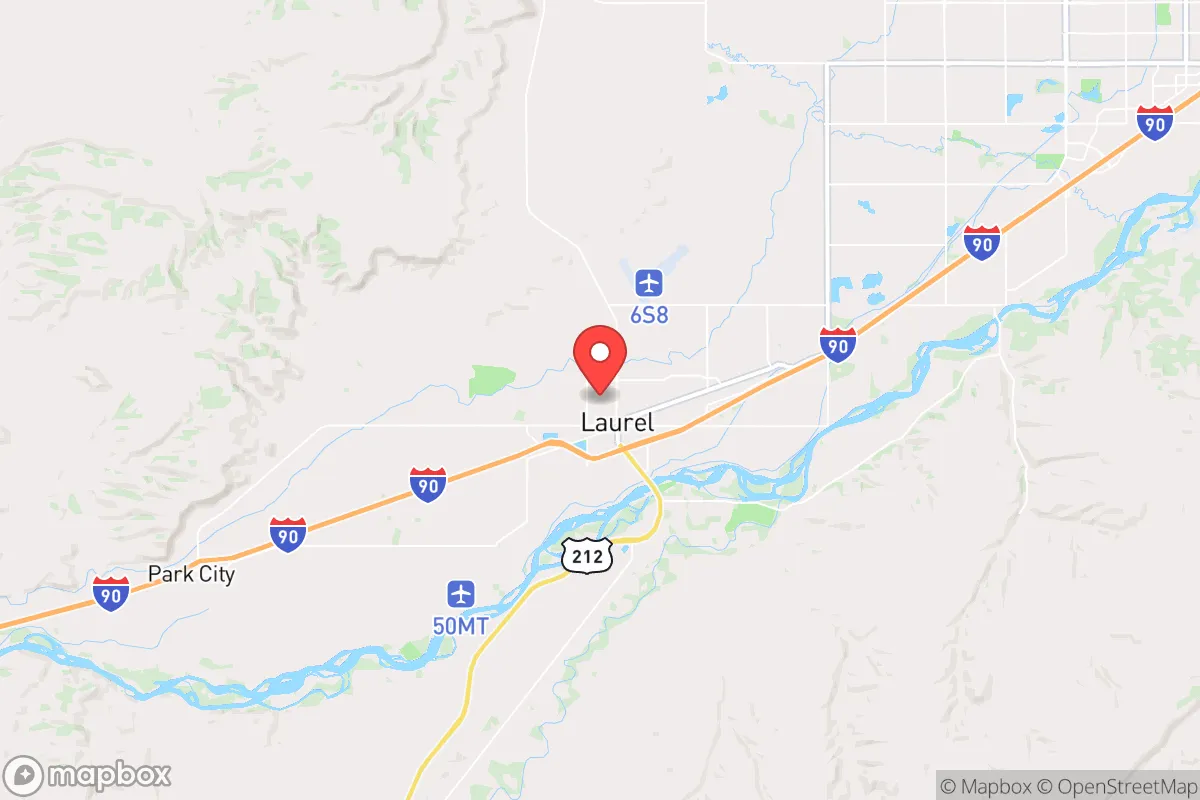
The post-1965 period saw little demographic change in Laurel, largely because the city did not experience the immigration waves that reshaped many American towns. The foreign-born share remains at just 1.3%, and the white population has held steady at over 85%. The most notable shift has been the growth of the Hispanic population to 6.3%, driven by families working in agriculture and the service sector. These residents have concentrated in the South Laurel area, a newer subdivision south of Interstate 90, where affordable housing and proximity to Billings (15 miles west) have attracted a mix of younger families and Hispanic workers. The East/Southeast Asian community, at 2.5%, is small but visible, with many families employed in healthcare and technical roles at the refinery; they are scattered across the West End, a post-1990 development of ranch-style homes. The Black population remains negligible at 0.5%, and the Indian-subcontinent population is effectively zero. Suburbanization from Billings has brought some white-collar commuters to the Mountain View subdivision on the city’s eastern edge, but Laurel has largely avoided the rapid growth seen in Bozeman or Missoula.
The future
Laurel’s population is projected to grow slowly, likely reaching 8,000–8,500 by 2040, driven by spillover from Billings’ expanding economy. The city is not homogenizing into a single enclave but is instead tribalizing along income and lifestyle lines: the Old Town district remains a lower-income, rental-heavy area with a transient population; the North Side retains its stable, multigenerational refinery families; and the South Laurel and West End subdivisions attract younger families and a modest number of Hispanic and Asian residents. The immigrant communities are not growing significantly—the foreign-born share is likely to remain below 3%—but the Hispanic population may rise to 8–10% as families settle in South Laurel. The white share will decline slightly but remain above 80%. For a conservative-leaning audience, this means Laurel will stay a predominantly white, working-class town with a stable social fabric, low crime, and a strong sense of local identity—but with a slowly diversifying edge in the newer subdivisions.
In short, Laurel is becoming a slightly more diverse, commuter-oriented suburb of Billings while retaining its core identity as a railroad and refinery town. For someone moving in now, the city offers a predictable, family-oriented environment where neighborhoods are defined more by income and housing age than by ethnicity, and where the population is stable enough to feel rooted but growing enough to support new businesses and schools.

* Values derived from national, state, county, city and local statistics and may differ in a specific area. Last updated: 2026-04-30T07:50:24.000Z
Narrative content on this page is AI-generated and may contain mistakes. Verify any details that matter before acting on them.
ReloMaps may earn a commission from affiliate links at no extra cost to you.

