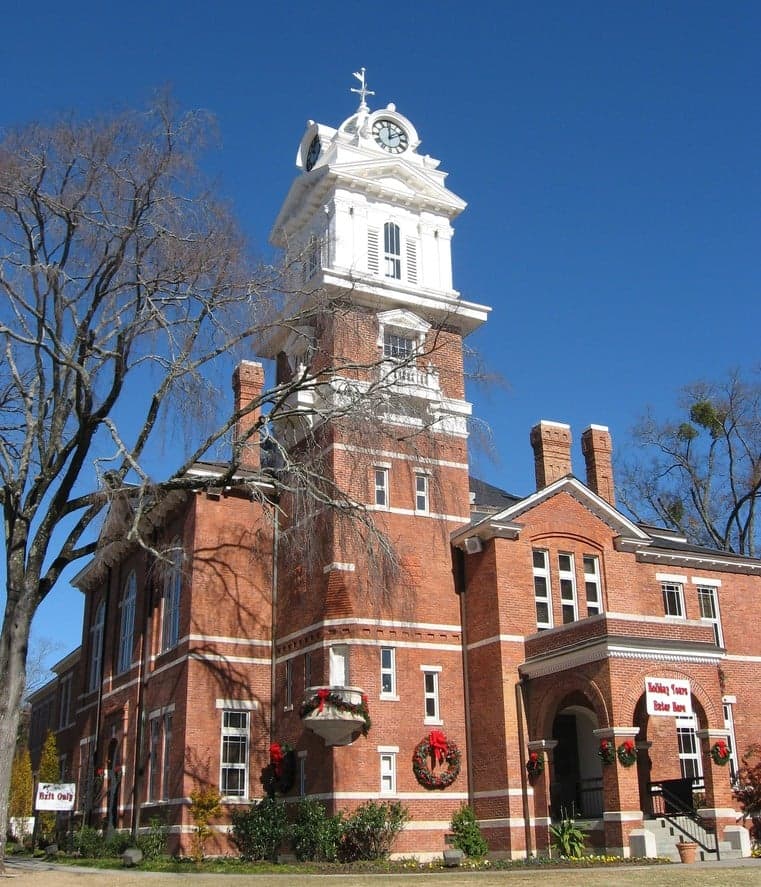
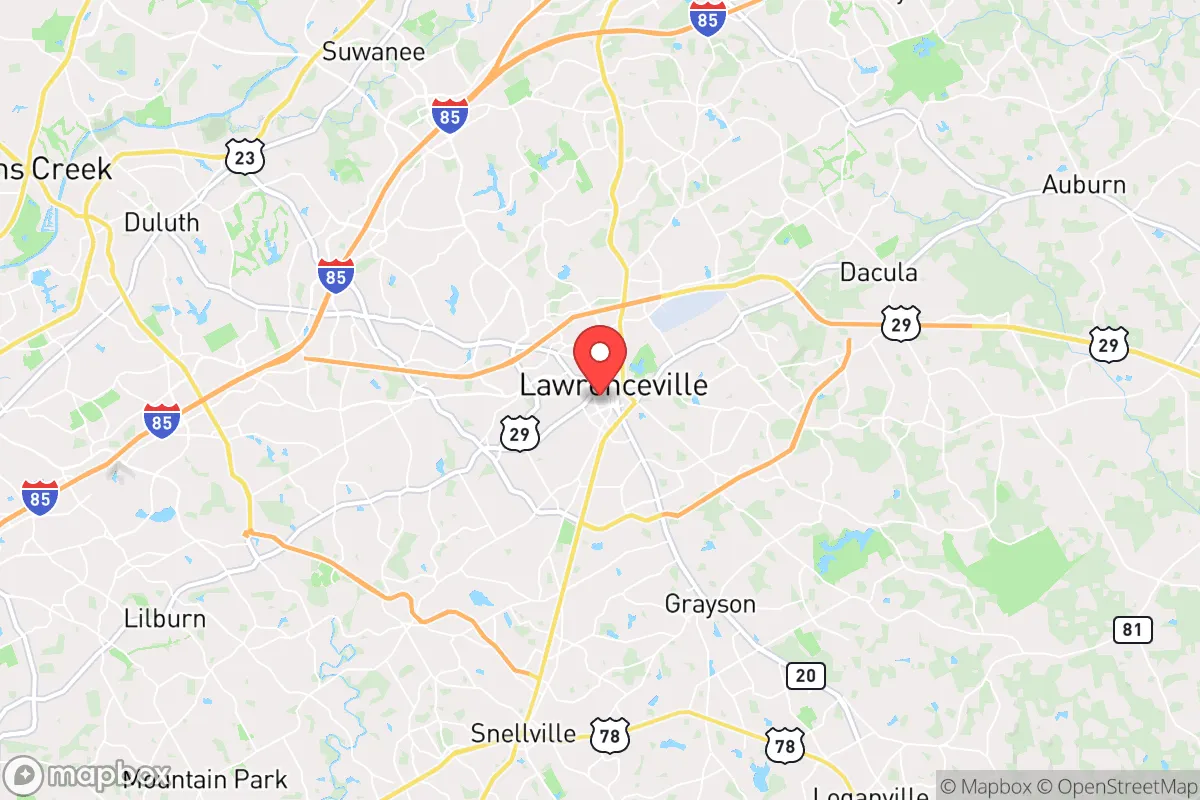
Photo: Wikipedia
Demographics of Lawrenceville, GA
Affluence Level in Lawrenceville, GA
A middle-class area roughly in line with national averages across income, home values, education, and employment.
People of Lawrenceville, GA
Lawrenceville, Georgia, is a city of roughly 30,600 residents that has transformed from a small county seat into a diverse, majority-minority suburb. Its population is nearly evenly split among White (29.6%), Black (30.7%), and Hispanic (26.0%) residents, with a notable East/Southeast Asian community (6.1%) and a smaller Indian-subcontinent population (1.6%). The city is younger and less college-educated than the Atlanta metro average, with 26.5% holding a bachelor's degree, giving it a working-to-middle-class character shaped by successive waves of migration.
How the city was settled and grew
Lawrenceville was founded in 1821 as the seat of Gwinnett County, carved from Creek and Cherokee lands ceded after the War of 1812. The original settlers were mostly yeoman farmers of English, Scots-Irish, and German descent from the Piedmont regions of Virginia and the Carolinas, drawn by the state's land lottery system. These families built the town around the historic Lawrenceville Square, which remains the civic and commercial core. Through the 19th and early 20th centuries, the population remained small and overwhelmingly White, with a modest Black community concentrated in the Old Norcross and Pleasant Hill areas, working as sharecroppers and domestic laborers. The railroad arrived in the 1880s, but Lawrenceville stayed a quiet agricultural hub until the post-World War II era.
Modern era (post-1965)
The 1965 Hart-Cellar Act and the construction of Interstate 85 in the 1970s reshaped Lawrenceville's population. The city began absorbing White families leaving Atlanta's intown neighborhoods, settling in subdivisions like River Plantation and Parkview in the 1970s and 1980s. Simultaneously, Black families moved from rural Georgia and Atlanta's inner core into areas around Oakwood and Dacula Road, seeking newer housing and better schools. The 1990s and 2000s brought a surge of Hispanic immigrants, primarily from Mexico and Central America, who found work in construction, landscaping, and the service economy. They concentrated in the Pleasant Hill Road corridor and around Lawrenceville-Suwanee Road, where Spanish-language businesses and churches now anchor the community. East/Southeast Asian immigrants—mostly Vietnamese and Korean—arrived in the 1990s and 2000s, settling in the Riverside and Duluth Highway areas, often drawn by Gwinnett County's reputation for strong schools and affordable housing. The Indian-subcontinent population remains small (1.6%) and is more dispersed, with no single concentrated enclave.
The future
Lawrenceville's population is trending toward greater diversity, but not toward homogenization. The White share has declined steadily from over 60% in 1990 to 29.6% today, while the Hispanic and Black shares have grown. The foreign-born population stands at 16.4%, and that figure is likely to rise as Gwinnett County remains a primary destination for new immigrants in metro Atlanta. The Hispanic community is the fastest-growing segment, and its concentration along the Pleasant Hill Road corridor is deepening, with new grocery stores, churches, and small businesses serving a predominantly Spanish-speaking clientele. The Black population is stable but aging, while the East/Southeast Asian community is plateauing as second-generation families move to newer suburbs further north. The Indian-subcontinent population, though small, is growing slowly, often drawn by professional jobs in the tech and healthcare sectors. The city is not tribalizing into hostile enclaves, but distinct ethnic corridors are solidifying, with Pleasant Hill Road becoming a de facto Hispanic commercial district and the Riverside area retaining a strong Asian character.
For someone moving to Lawrenceville now, the city offers a genuinely multiethnic environment where no single group dominates. The schools and neighborhoods are integrated in practice, though social networks often follow ethnic lines. The city's trajectory is toward becoming a denser, more urban suburb with a younger, more diverse population—a place where a newcomer can find a community that matches their background while living alongside others who do not share it. This is not a homogenizing melting pot, but a mosaic of distinct, stable communities sharing a single city.

* Values derived from national, state, county, city and local statistics and may differ in a specific area. Last updated: 2026-04-24T08:36:58.000Z
Narrative content on this page is AI-generated and may contain mistakes. Verify any details that matter before acting on them.
ReloMaps may earn a commission from affiliate links at no extra cost to you.

