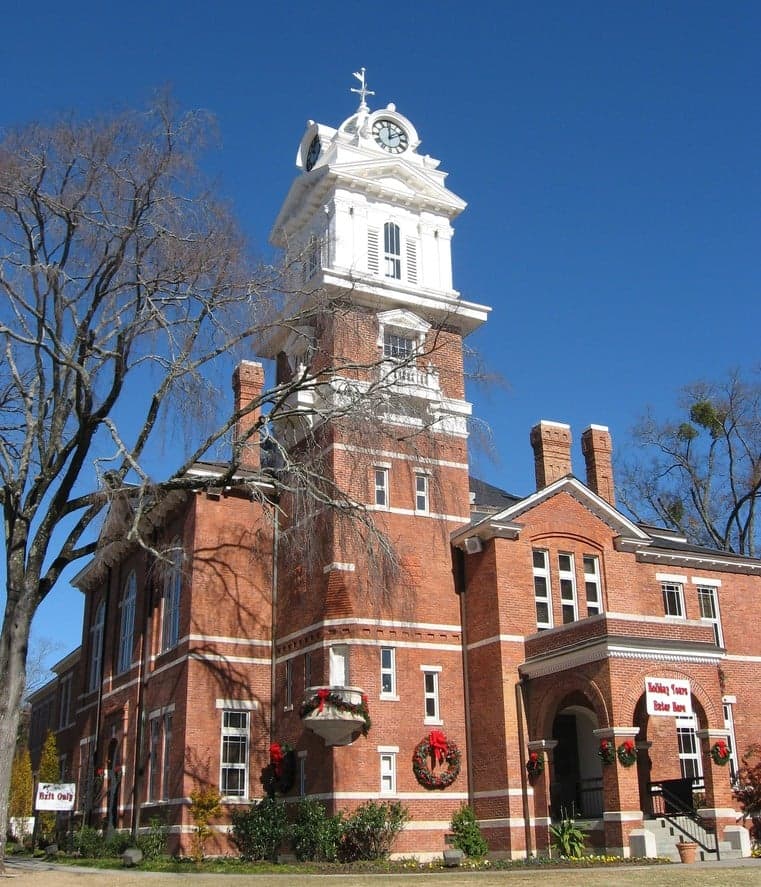
Photo: Wikipedia
Political ClimatePolitical Climate in Lawrenceville, GA
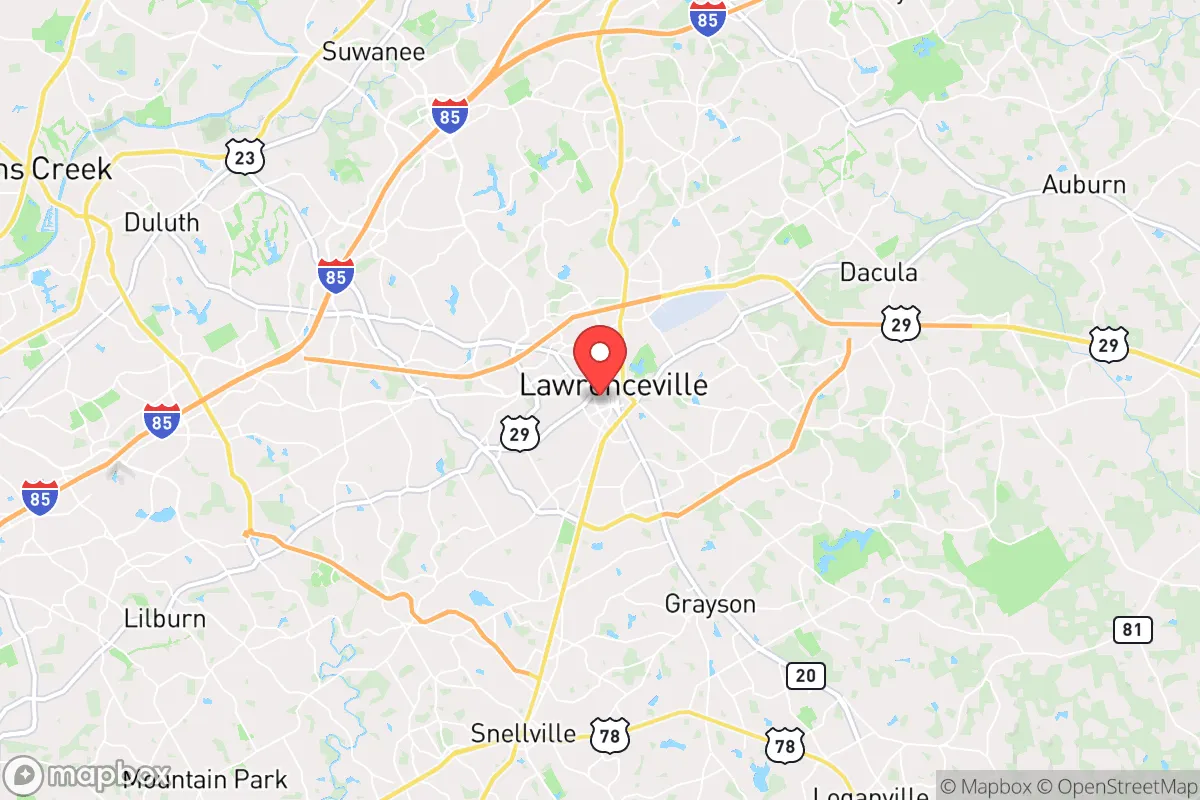
District shown is the primary district for this city’s centroid. Cities may span multiple districts.
Local Political AnalysisPolitical Analysis of Lawrenceville, GA
Lawrenceville, Georgia, has shifted hard to the left over the past decade, and if you’ve lived here as long as I have, you’ve felt it. The Cook PVI now sits at D+21, meaning the city votes 21 points more Democratic than the national average—a stark contrast to the reliably conservative Gwinnett County I grew up in. This isn’t a slow drift; it’s a rapid transformation driven by an influx of new residents from blue states and aggressive local organizing, and it’s reshaping everything from school board decisions to how the city handles property rights and public safety.
How it compares
Drive 15 minutes north to Buford or Suwanee, and you’ll find a completely different political world—those areas still lean Republican, with local governments that generally keep taxes low and stay out of your business. Head south to Snellville or west to Duluth, and you’ll see a similar blue trend, but Lawrenceville is the epicenter. The contrast is starkest at the county level: while Gwinnett County as a whole has gone purple-to-blue, Lawrenceville’s city council and school board have embraced progressive policies that neighboring towns have resisted. For example, Lawrenceville’s recent zoning changes have made it easier to build high-density apartments, which many of us see as a backdoor way to increase government control over housing and property values. In Buford, they’re still fighting to keep single-family neighborhoods intact.
What this means for residents
For those of us who value personal freedom and limited government, the shift is concerning. The city has expanded its code enforcement, with more inspectors checking for things like grass height and fence permits—small stuff that adds up to a bigger government footprint in your daily life. Property taxes have crept up as the city funds new public art projects and transit studies that many residents never asked for. On the school board, you’ve seen a push for curriculum changes that emphasize social justice over core academics, and parents who speak up at meetings often feel drowned out by organized activist groups. If you’re a conservative or even a moderate who just wants to be left alone, you’ll find yourself increasingly on the outside looking in. The local Republican Party is still active, but they’re fighting an uphill battle in city elections, and turnout among conservative voters has been low in recent cycles.
Culturally, Lawrenceville has leaned hard into its “creative” and “inclusive” branding, which sounds nice but often translates to policies that prioritize symbolic gestures over practical concerns. The city’s downtown redevelopment has brought new breweries and a performing arts center, but it’s also pushed out long-standing family-owned businesses that couldn’t afford the rent hikes. There’s a growing sense among longtime residents that the city government is more interested in catering to newcomers from out of state than listening to the folks who’ve been here for generations. If this trajectory holds, I expect Lawrenceville to continue moving left, with more regulations on housing, more spending on social programs, and less tolerance for traditional conservative values. For now, if you want a place where your voice still carries weight on local issues, you might want to look at the smaller towns just outside the city limits.

State Political ClimatePolitical Climate in Georgia
State Political AnalysisPolitical Environment in the State
Georgia has shifted from a reliably Republican stronghold to a genuine battleground state over the past two decades, but its political soul remains deeply conservative outside of a few metro corridors. The state voted for Joe Biden in 2020 by a razor-thin margin of about 0.2%, then re-elected both Republican Senators in 2022 and gave Donald Trump a 2.2-point win in 2024. The real story is the collision between a rapidly diversifying, left-leaning Atlanta metro and a deeply red exurban, small-town, and rural Georgia that still holds the balance of power.
Urban vs. rural divide
The political map of Georgia is a tale of two Georgias. Metro Atlanta, particularly the core counties of Fulton, DeKalb, Cobb, and Gwinnett, now drives the Democratic vote. Gwinnett County flipped from +15 Republican in 2012 to +18 Democratic in 2020, a 33-point swing driven by Asian-American and Hispanic in-migration and white college graduates. Meanwhile, the rest of the state is deeply red. Rural counties like Murray, Gilmer, and Union routinely vote 80%+ Republican. The exurban ring—counties like Forsyth, Cherokee, and Paulding—has actually gotten redder as Atlanta liberals push outward. Forsyth County, once a Klan stronghold, is now a booming, heavily conservative suburb where Republicans routinely win by 30 points. The "Blue Wall" of Georgia is essentially I-285 around Atlanta; outside that loop, it's Trump country. The 2024 election saw Hall County (Gainesville) and Houston County (Warner Robins) shift further right, cementing the rural-exurban axis as the GOP's firewall.
Policy environment
Georgia's policy environment is broadly conservative, but with some notable exceptions. The state has a flat income tax of 5.49%, which is being phased down to 4.99% by 2029 under HB 1437. Property taxes are locally set but capped by the statewide homestead exemption. Georgia is a right-to-work state with no state-level minimum wage above the federal $7.25, though Atlanta has its own $15.50 minimum. The state passed a six-week abortion ban (HB 481) in 2019, which was upheld by the Georgia Supreme Court in 2024. School choice is robust: Georgia has a $6,500 tax-credit scholarship program (SB 47) and a new Education Savings Account law (SB 233) for students in low-performing schools. Election integrity saw major reforms with SB 202 (2021), which added voter ID requirements for absentee ballots, limited drop boxes, and banned mobile voting buses. Critics call it suppression; supporters call it common sense. The state also has a constitutional carry law (HB 218, 2022) allowing permitless carry of firearms. On the downside, Georgia's certificate-of-need laws still restrict healthcare competition, keeping hospital prices high in rural areas.
Trajectory & freedom
On balance, Georgia has expanded personal freedom over the past five years, but the trajectory is mixed. The 2022 passage of constitutional carry was a major win for gun rights. HB 218 removed the permit requirement for carrying a concealed firearm, though a permit is still needed for reciprocity with other states. Parental rights got a boost with the 2023 passage of SB 88, which requires schools to notify parents of any "material change" in a student's health or well-being, effectively limiting secret gender-transition policies. The state also passed a ban on transgender athletes in K-12 sports (HB 1084, 2022). However, the state's medical cannabis program remains extremely limited—only low-THC oil is legal, and the licensing process has been a bureaucratic nightmare. Property rights are strong: Georgia is a "Dillon's Rule" state, meaning local governments only have powers explicitly granted by the state, which has prevented the kind of extreme local zoning seen in California. The biggest freedom concern is the continued growth of Atlanta's city-level regulations, including its $15.50 minimum wage and paid sick leave mandates, which don't apply outside the city limits.
Civil unrest & political movements
Georgia has been a flashpoint for political activism on both sides. The 2020 election cycle saw massive protests in Atlanta after the killing of George Floyd, with some turning violent along the I-75 corridor. The "Stop Cop City" movement—opposing the Atlanta Public Safety Training Center—has been a persistent source of conflict, with activists labeling it a "cop city" and law enforcement calling it a necessary training facility. In 2023, the state passed SB 44, which increased penalties for domestic terrorism and racketeering related to protest activity, directly targeting the Stop Cop City movement. Immigration politics are heated: Georgia has a strict E-Verify requirement for employers (SB 529, 2006) and a 2011 law (HB 87) that allows police to check immigration status during lawful stops. There are no sanctuary cities in Georgia, though Atlanta has a "welcoming city" policy that limits cooperation with ICE. Election integrity remains a live issue: the 2024 election saw record turnout, but the state's new voter roll maintenance procedures (removing inactive voters) have drawn lawsuits from the left. The "Georgia Election Integrity Act" (SB 202) remains the most contested piece of legislation, with activists on both sides still fighting over drop box access and absentee ballot deadlines.
Projection
Over the next 5-10 years, Georgia will likely remain a purple state, but with a conservative tilt that could harden. The Atlanta metro is growing fast—Forsyth County added 30,000 people between 2020 and 2024, and it's voting more Republican each cycle. The in-migration from blue states (California, New York, Illinois) is actually helping the GOP in exurbs, as these transplants often move for lower taxes and less regulation. The rural vote is shrinking but not dying—counties like Coffee, Tift, and Colquitt are losing population but voting 85%+ Republican. The wild card is the growing Hispanic population in Hall County and the Asian population in Gwinnett; these groups are not reliably Democratic and could shift right on economic issues. The state's political future likely looks like a more competitive version of North Carolina: close statewide races, a Republican legislature that can override a Democratic governor (if one is elected), and a slow drift rightward in the exurbs. If the GOP can hold the Atlanta suburbs from flipping further left, Georgia will remain a red-leaning swing state for the next decade.
For a conservative moving to Georgia, the bottom line is this: you can find a community that matches your values, but you need to pick your location carefully. The Atlanta core is increasingly progressive, but the exurbs (Forsyth, Cherokee, Paulding) and smaller cities like Gainesville, Warner Robins, and Augusta offer strong conservative communities with good schools and lower taxes. The state's policy environment is broadly friendly to personal freedom, especially on guns, school choice, and parental rights. Just be aware that the political fight is real and ongoing—especially in the legislature, where the battle over election laws and education policy will continue for years. If you want a state where your vote still matters and your values are respected, Georgia is a solid bet—just don't expect it to be as reliably red as it was in 2004.
* Values derived from national, state, county, city and local statistics and may differ in a specific area. Last updated: 2026-04-24T08:36:58.000Z
Narrative content on this page is AI-generated and may contain mistakes. Verify any details that matter before acting on them.
ReloMaps may earn a commission from affiliate links at no extra cost to you.

