

Photo: Wikipedia
Demographics of Le Mars, IA
Affluence Level in Le Mars, IA
A middle-class area roughly in line with national averages across income, home values, education, and employment.
People of Le Mars, IA
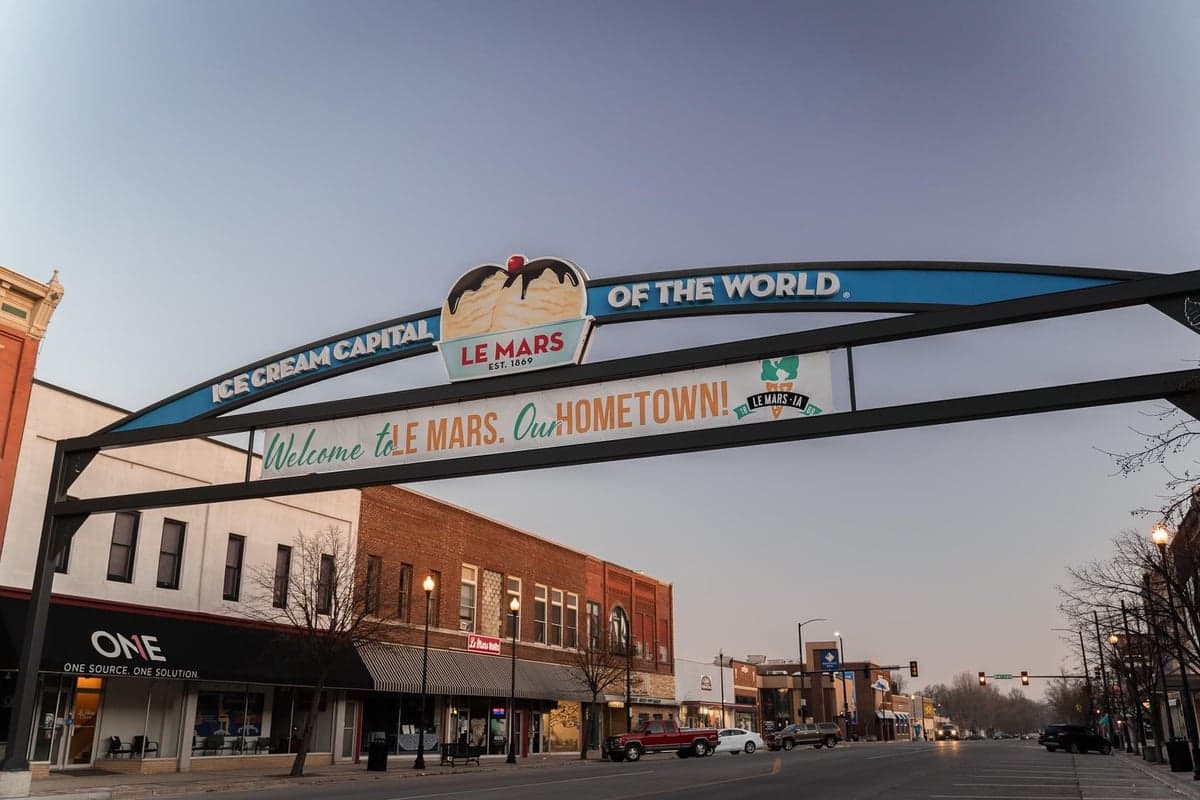
The people of Le Mars, Iowa, today number 10,597, forming a community that is predominantly white (83.3%) with a notable and growing Hispanic minority (9.9%) and a smaller Black population (5.3%). The city’s identity is rooted in its Dutch-American heritage, visible in its historic downtown and annual Ice Cream Days festival, but it is becoming more diverse than its rural reputation suggests. With a foreign-born population of 4.2% and a college attainment rate of 24.3%, Le Mars is a working-class hub where manufacturing and agriculture anchor daily life, and where newcomers are gradually reshaping a once-homogeneous social fabric.
How the city was settled and grew
Le Mars was founded in 1869 as a railroad town, named by combining the first initials of the wives of the town’s original investors. The first wave of settlers were Yankee and German immigrants drawn by the promise of fertile farmland and the newly laid tracks of the Sioux City and St. Paul Railroad. By the 1880s, a second wave of Dutch immigrants arrived, fleeing economic hardship in the Netherlands and seeking religious freedom. These Dutch families settled primarily in what is now the North Side Historic District, building the First Reformed Church and establishing the city’s enduring Calvinist character. A smaller group of Irish laborers, who worked on the railroad and in early brickyards, clustered in the South Le Mars area near the rail yards, though their numbers dwindled as the Dutch population grew dominant. The city’s population reached 4,000 by 1910, fueled by the dairy industry and the founding of Wells Enterprises (now Wells Blue Bunny) in 1913, which became the largest employer and a magnet for subsequent waves of workers.
Modern era (post-1965)
After the 1965 Immigration and Nationality Act, Le Mars saw only modest demographic change compared to larger Midwestern cities. The white share remained above 95% through the 1990s, but the 2000s brought a significant shift as Wells Enterprises expanded its production lines. The company actively recruited Hispanic workers from Texas and Mexico, many of whom settled in the West Le Mars neighborhood, a postwar subdivision of ranch homes and duplexes that became the city’s first ethnic enclave. By 2020, the Hispanic share had risen to 9.9%, with families concentrated in West Le Mars and the newer Prairie Ridge Addition, a development of single-family homes built in the 2010s. The Black population, now 5.3%, arrived more recently, largely through meatpacking and logistics jobs at the nearby Tyson Foods plant in Sioux City; these workers tend to rent in the East Le Mars area, near the industrial corridor along Highway 75. The East/Southeast Asian community remains tiny at 0.2%, mostly Korean and Vietnamese families who moved in during the 1980s and 1990s and have since assimilated into the broader white population, with no distinct neighborhood concentration. The Indian-subcontinent population is effectively zero, reflecting the city’s lack of tech or medical sectors that typically draw that group.
The future
Le Mars is slowly diversifying, but the pace is moderate. The Hispanic population is the fastest-growing segment, projected to reach 12–14% by 2035, driven by family reunification and continued recruitment by Wells Enterprises. This growth is geographically concentrated: West Le Mars and Prairie Ridge Addition are becoming more Hispanic, while the North Side Historic District and the older Central Business District remain overwhelmingly white and older (median age 42). The Black population appears stable, tied to the cyclical nature of meatpacking employment, and is unlikely to grow rapidly without a new major employer. The white population is aging and slightly declining, as younger white residents often leave for college or jobs in Sioux City or Des Moines. The city is not tribalizing into hostile enclaves—neighborhoods are still mixed by small-town standards—but distinct ethnic clusters are emerging, particularly around housing affordability. The foreign-born share (4.2%) is below the national average (13.7%) and is unlikely to surge, given the city’s limited rental stock and lack of refugee resettlement programs.
For someone moving to Le Mars now, the city offers a stable, family-oriented environment with a growing Hispanic community that is integrating into local schools and churches. The Dutch-American cultural core remains strong, but newcomers will find a place that is quietly becoming more diverse, especially in the western neighborhoods. The bottom line: Le Mars is a small, conservative-leaning city where demographic change is gradual and largely economic, not ideological—a practical choice for those seeking affordable housing and steady manufacturing jobs in a community that still knows its neighbors.

* Values derived from national, state, county, city and local statistics and may differ in a specific area. Last updated: 2026-04-19T08:27:43.000Z
Narrative content on this page is AI-generated and may contain mistakes. Verify any details that matter before acting on them.
ReloMaps may earn a commission from affiliate links at no extra cost to you.

