Photo: Wikipedia
Political ClimatePolitical Climate in Le Mars, IA
District shown is the primary district for this city’s centroid. Cities may span multiple districts.
Local Political AnalysisPolitical Analysis of Le Mars, IA
Le Mars, Iowa, sits in a deeply conservative corner of the state, with a Cook PVI of R+15 that puts it squarely in the "solid Republican" column. That number isn't just a statistic around here—it reflects a community where traditional values and limited-government principles have been the bedrock for generations. You won't find many yard signs for the other side, and the local elections tend to be decided in the primary, not the general. The political trajectory has been steady, but like a lot of rural Midwest towns, there's a quiet unease about the direction of the state and country, especially as Des Moines and other metro areas push policies that feel increasingly out of step with life here.
How it compares
Drive thirty minutes south to Sioux City, and you'll find a more mixed political landscape—still conservative overall, but with a noticeable progressive presence in city council races and school board elections. Head east to Storm Lake, and the difference is stark: that town's heavy immigrant population and reliance on meatpacking plants have created a more diverse, and politically competitive, environment. Le Mars, by contrast, has remained remarkably homogeneous in its politics. The surrounding Plymouth County is reliably red, and the city itself hasn't seen a serious challenge from the left in years. That's not to say there's no debate—there's plenty of it over property taxes, school funding, and how much the county should regulate things like short-term rentals or farm practices—but the baseline assumption is that government should stay out of your business, your family, and your wallet.
What this means for residents
For someone moving here, the political climate means a few practical things. First, you can expect low taxes relative to the state average—the city and county both lean heavily on sales tax rather than property tax, which keeps the annual bill manageable. Second, you'll find a school system that still emphasizes local control, with a school board that's been resistant to state-level mandates on curriculum and DEI initiatives. Third, and maybe most importantly, there's a strong sense that your personal freedoms—whether that's how you raise your kids, what you do on your own land, or how you run your small business—are respected. The flip side is that if you're hoping for rapid change on things like public transit expansion, renewable energy mandates, or social programs, you'll likely be frustrated. The community moves slowly and deliberately, and any proposal that smells like government overreach gets a skeptical reception.
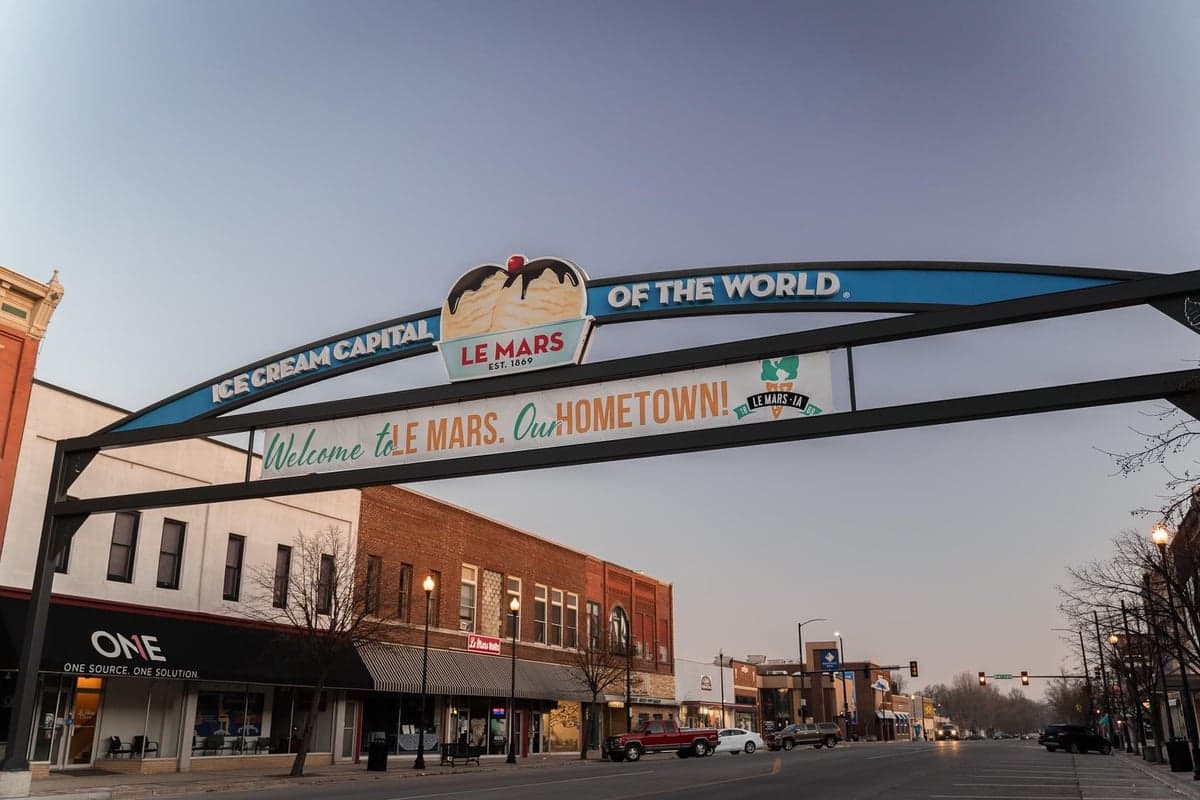
One cultural distinction worth noting: Le Mars is the "Ice Cream Capital of the World," home to Wells Enterprises (Blue Bunny), and that company's family ownership has historically fostered a paternalistic, pro-business atmosphere. The local chamber of commerce and city council tend to align closely with the needs of that major employer, which means zoning and development decisions are often made with an eye toward keeping the corporate headquarters happy. That's a double-edged sword—it keeps jobs stable, but it can also mean that dissenting voices on growth or environmental issues get sidelined. Looking ahead, the biggest political flashpoints will likely be around school choice (Iowa's new Education Savings Account program is already shifting the landscape) and any future attempts to impose state-level housing or land-use regulations. For now, Le Mars remains a place where you can pretty much live your life the way you see fit, and that's exactly how most folks here want to keep it.

State Political ClimatePolitical Climate in Iowa
State Political AnalysisPolitical Environment in the State
Iowa has been a reliably Republican state in presidential elections since 2016, but it wasn’t always that way. For decades, it was a classic swing state, voting for Barack Obama twice and Al Gore once. The shift has been dramatic: in 2024, Donald Trump won the state by over 13 points, a stark contrast to the razor-thin margins of the 2000s. The dominant coalition is now a mix of rural conservatives, evangelical voters, and working-class voters in smaller industrial towns, who have grown increasingly skeptical of the national Democratic Party’s progressive turn. The state’s political center of gravity has moved decisively rightward over the past 15 years, driven by a combination of cultural backlash, a strong agricultural economy, and a wave of conservative legislation from the statehouse.
Urban vs. rural divide
The political map of Iowa is a textbook example of the urban-rural split. The state’s two major metros, Des Moines and Iowa City, are the blue islands in a sea of red. Polk County (Des Moines) has been trending Democratic for years, and Johnson County (Iowa City), home to the University of Iowa, is one of the most liberal counties in the Midwest. But outside those corridors, the landscape is deeply conservative. Sioux County in the northwest routinely delivers 80%+ Republican margins, and Dallas County, a fast-growing Des Moines suburb, flipped from blue to red in 2020 and has stayed there. The rural counties along the Mississippi River, like Dubuque and Clinton, were once Democratic strongholds but have shifted hard right as union ties weakened and cultural issues took precedence. The divide isn’t just about population density—it’s about worldview. In places like Council Bluffs and Sioux City, the economy is tied to agriculture and manufacturing, and voters there see the Democratic Party as out of touch with their values on guns, faith, and family.
Policy environment
Iowa’s policy environment has become a model for conservative governance in the Midwest. The state has a flat income tax of 3.8%, set to drop to 3.5% by 2027, and no inheritance tax. Property taxes are relatively low, and the state has a right-to-work law, meaning no one can be forced to join a union as a condition of employment. On education, Iowa passed a universal school voucher program in 2023, allowing any family to use public funds for private or homeschool expenses—a huge win for parental rights. The state also enacted a six-week abortion ban in 2023, which was upheld by the Iowa Supreme Court in 2024. Election integrity is a priority: Iowa requires voter ID, has strict absentee ballot rules, and banned private funding of election administration. The regulatory climate is business-friendly, with no state-level minimum wage above the federal $7.25 and a strong push to limit environmental regulations on farms and factories. For a conservative relocating, this is a state that actively protects the Second Amendment, parental choice, and economic freedom.
Trajectory & freedom
Iowa is clearly moving in the direction of more personal freedom, at least as conservatives define it. The 2021 expansion of permitless carry (Constitutional Carry) was a landmark win for gun rights. The 2023 school voucher law (Students First Act) gave parents unprecedented control over their children’s education. The state also passed a law banning transgender athletes from girls’ sports and restricting gender-affirming care for minors, both of which were framed as protecting children and parental rights. On the economic front, the 2022 tax reform package accelerated income tax cuts and eliminated the inheritance tax entirely. However, there are warning signs. The state’s population growth is sluggish, and some rural counties are losing young people to faster-growing states like Texas and Florida. There’s also a growing tension between the libertarian-leaning wing of the GOP and the more interventionist social conservatives—for example, some lawmakers have pushed for stricter limits on hemp-derived THC products, which could be seen as a government overreach into personal choice. Overall, though, the trajectory is toward more freedom in the areas that matter most to conservatives: guns, education, taxes, and medical autonomy.
Civil unrest & political movements
Iowa has not seen the kind of large-scale civil unrest seen in coastal states, but there have been flashpoints. The 2020 Black Lives Matter protests in Des Moines and Iowa City were relatively small and peaceful compared to national standards, but they did lead to calls for police reform that were largely ignored by the Republican legislature. The most visible political movements in recent years have been on the right: the “Parents’ Rights” movement, which gained steam during COVID-19 school closures, and the “Save Our Schools” rallies that pushed for the voucher law. There’s also a strong anti-abortion movement, with annual marches at the state capitol. Immigration politics are less heated than in border states, but there have been controversies over a 2024 bill that would allow state law enforcement to arrest undocumented immigrants—a direct challenge to federal authority. Election integrity remains a hot topic; the 2020 audit of the presidential results in Linn County (Cedar Rapids) found no widespread fraud, but many conservatives remain skeptical of mail-in voting. For a new resident, the political atmosphere is generally calm, but you’ll notice a strong undercurrent of activism on both sides, especially around education and abortion.
Projection
Over the next 5-10 years, Iowa is likely to become even more Republican, but with some important caveats. The in-migration patterns are mixed: the state is attracting some conservative retirees and remote workers from the coasts, but it’s also losing young people to faster-growing states. The Des Moines metro will continue to grow and become more diverse, which could slowly shift the political balance in Polk and Dallas counties. However, the rural areas are aging and shrinking, which means the GOP’s base is getting smaller even as it becomes more reliable. The biggest wildcard is the national Democratic Party’s strategy—if they continue to lean into progressive cultural positions, Iowa will stay red for the foreseeable future. The state’s political leadership is likely to keep pushing on school choice, tax cuts, and Second Amendment protections. For a conservative moving in now, expect to live in a state that is broadly aligned with your values, but be aware that the urban centers will continue to be cultural battlegrounds. The real question is whether the state can attract enough new residents to sustain its economy and tax base without losing its character.
For a new resident, the bottom line is this: Iowa offers a high level of personal freedom in the areas that matter most—low taxes, strong gun rights, school choice, and a government that respects parental authority. The political climate is stable and conservative, but it’s not a monolith. You’ll find blue bubbles in Des Moines and Iowa City, and the rural-urban divide is real. If you’re looking for a place where your values are reflected in state law and where you can raise a family without constant political friction, Iowa is a solid bet. Just don’t expect it to stay exactly the same—the state is changing, but for now, it’s heading in a direction that most conservatives will appreciate.
* Values derived from national, state, county, city and local statistics and may differ in a specific area. Last updated: 2026-04-19T08:27:43.000Z
Narrative content on this page is AI-generated and may contain mistakes. Verify any details that matter before acting on them.
ReloMaps may earn a commission from affiliate links at no extra cost to you.

