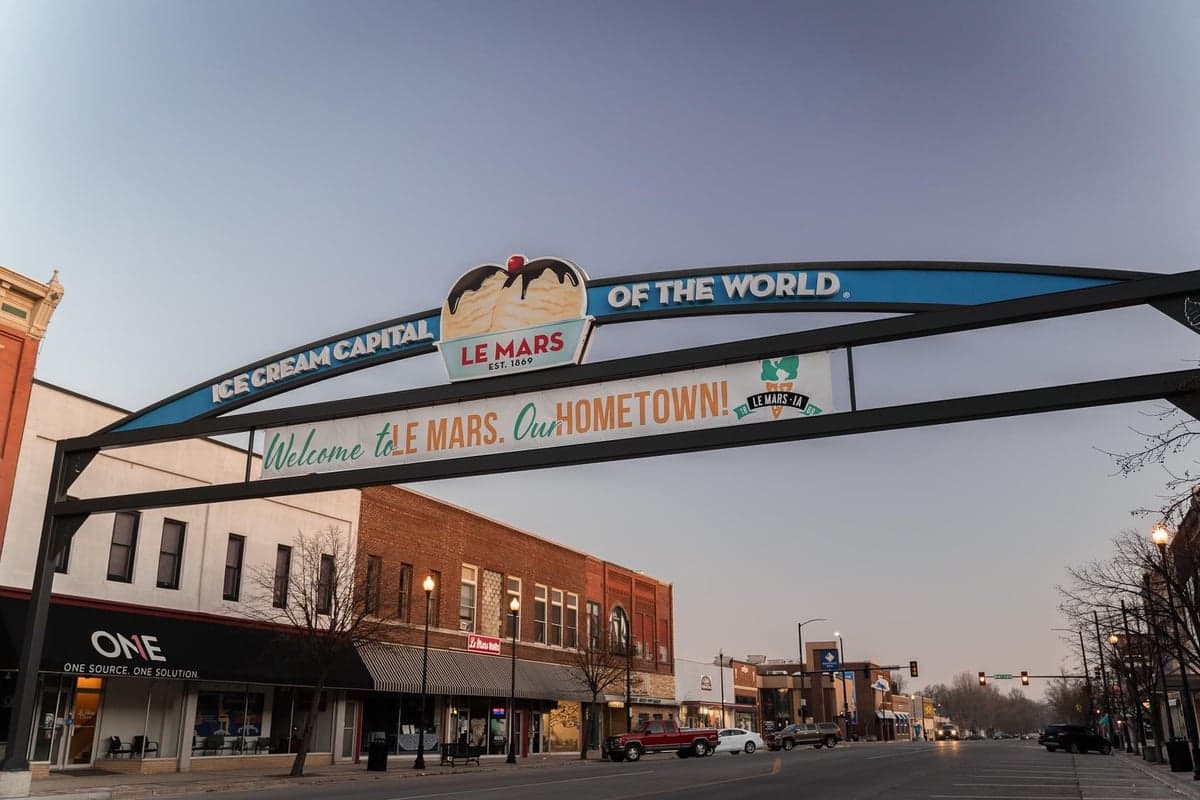
Photo: Wikipedia
Personal Sovereignty in Le Mars, IA
Viable for self-reliance. Generally workable, though some barriers may limit total independence.
What does Personal Sovereignty tell us?
Personal Sovereignty measures your capacity for self-reliance and independence with minimal government friction. Higher scores mean fewer barriers between you and the way you want to live... but it assumes you have the space you need and good neighbors.
What does this tell us?
Personal Sovereignty measures your capacity for self-reliance and independence with minimal government friction. Higher scores mean fewer barriers between you and the way you want to live... but it assumes you have the space you need and good neighbors.
State Policy
Energy independence: Importer (50% of energy produced in-state)
Personal Liberty
Homesteading

Personal Liberty Analysis
Le Mars, Iowa, offers a notably high degree of personal sovereignty, particularly when measured against the regulatory creep and fiscal pressures found in many coastal and Midwestern states. For the individual or family operating from a survivalist or prepper mindset, the city’s environment is defined by a state-level commitment to limited government, strong property rights, and a legal framework that actively resists federal overreach. While no location is a fortress against national trends, Le Mars sits in a state that has deliberately structured its laws to maximize personal autonomy, making it a serious consideration for those prioritizing self-reliance and minimal government interference in daily life.
Tax burden and regulatory posture: How Iowa's fiscal policies support self-reliance
Iowa’s tax and regulatory climate is a primary pillar of its sovereignty appeal. The state has been aggressively flattening and lowering its income tax, moving toward a single-rate system that will top out at 3.9% by 2026. This is a direct reduction in the state’s claim on your earnings, leaving more capital in your hands for land, supplies, and savings. Property taxes in Plymouth County, where Le Mars is the seat, are moderate—typically around 1.3% to 1.5% of assessed value—which is manageable compared to states like Illinois or New York. More importantly, Iowa has no inheritance tax and no estate tax, meaning your property and assets can pass to heirs without the state taking a cut. On the regulatory front, Iowa has been a leader in occupational licensing reform, reducing barriers for trades and small businesses. The state also preempts local governments from enacting stricter regulations than the state level on things like firearm carry, agricultural operations, and building codes. This means Le Mars city council cannot unilaterally impose burdensome ordinances that would hamper a homesteading operation or restrict your ability to build a workshop or root cellar. The net effect is a fiscal and regulatory environment that trusts individuals more than bureaucrats, a core tenet of personal sovereignty.
Self-defense and gun law specifics: Constitutional carry and castle doctrine in Le Mars
For those who view the right to self-defense as non-negotiable, Iowa is among the strongest states in the nation. Since 2021, Iowa has been a constitutional carry state, meaning any law-abiding adult 21 or older can carry a concealed firearm without a permit. No training requirement, no waiting period, no government permission slip. The state also has a robust castle doctrine and a stand-your-ground law, codified in Iowa Code 704.1. This means there is no duty to retreat from any place you are lawfully present, including your home, vehicle, or business, before using deadly force if you reasonably believe it is necessary to prevent death or serious injury. Le Mars itself is a quiet, low-crime community, but the legal framework ensures that if the worst happens, the law is on your side, not the aggressor’s. Additionally, Iowa does not maintain a state-level gun registry, and there are no magazine capacity restrictions or bans on common rifle platforms like AR-15s. The state also preempts local gun ordinances, so you won’t find Le Mars passing its own AWB or storage laws. For the prepper, this means your defensive capabilities are limited only by your own resources and training, not by a city council’s political whims.
Self-reliance and homesteading viability: Lot sizes, zoning, and off-grid feasibility in Plymouth County
Le Mars and its surrounding Plymouth County offer genuine opportunities for self-reliant living, though the specifics depend on whether you are inside city limits or on unincorporated land. Within Le Mars proper, standard residential lots range from 6,000 to 10,000 square feet, and city zoning typically allows for small-scale gardening, backyard chickens, and even a single beehive, but large livestock or extensive outbuildings are restricted. The real sovereignty play is just outside town. Plymouth County has minimal zoning restrictions on agricultural land, and you can easily find parcels of 5 to 40 acres within a 15-minute drive of Le Mars. On these parcels, you can build a home, erect a pole barn, keep goats, pigs, or cattle, and install a well and septic system without needing a parade of permits. Iowa law also strongly supports rainwater collection—there are no state-level restrictions on cisterns or rain barrels. Solar panels are permitted without HOA interference on unincorporated land, and net metering is available, though the rates have become less favorable in recent years. Off-grid living is legally feasible: you can build a home without connecting to the municipal power grid if you generate your own electricity, and composting toilets are allowed with proper septic design. The county’s building code is based on the state’s minimal standards, not the more onerous international codes adopted by many cities. For a family wanting to produce its own food, water, and energy, the Le Mars area provides a legal and practical foundation that is increasingly rare in the United States.
Personal liberties: Parental rights, medical autonomy, speech, and property protections
Iowa has been a battleground for personal liberties, and the current legal landscape is favorable for those prioritizing family autonomy and medical freedom. Parental rights are strongly protected under Iowa law. The state was an early adopter of school choice, with Education Savings Accounts available for any K-12 student, meaning you can direct your tax dollars to a private, religious, or homeschool curriculum without financial penalty. Homeschooling regulations are minimal: no state approval of curriculum, no standardized testing requirements, and no home visits. On medical autonomy, Iowa passed a law in 2023 prohibiting mask and vaccine mandates by local governments and school districts, and the state has banned the enforcement of federal public health orders that would restrict individual choice. This means no forced lockdowns or jab mandates from Des Moines or Plymouth County. Free speech is protected by the Iowa Constitution, which has its own free speech clause that the state supreme court has interpreted as providing broader protections than the First Amendment in some cases. Property rights are further secured by Iowa’s strong eminent domain protections; the state restricts the use of eminent domain for private economic development, meaning your land cannot be taken to build a shopping mall or a private pipeline. For the survivalist, these protections mean you can raise your children according to your values, make your own medical decisions, speak your mind without fear of government retaliation, and hold your land against corporate or state seizure. This is the bedrock of sovereignty.
In the broader national context, Le Mars and Plymouth County represent a pocket of high personal sovereignty within a state that has consciously resisted the trend toward centralized control. Compared to the Pacific Northwest, the Northeast, or even parts of the Upper Midwest, Iowa offers a legal environment that trusts the individual over the state. The tax burden is low and falling, gun laws are among the most permissive in the country, homesteading is legally straightforward, and parental and medical rights are codified. No location is immune from federal overreach or economic shocks, but for the strategic relocator who values self-reliance and minimal government interference, Le Mars provides a solid, legally defensible foundation to build a life of genuine autonomy.

* Values derived from national, state, county, city and local statistics and may differ in a specific area. Last updated: 2026-04-19T08:27:43.000Z
Narrative content on this page is AI-generated and may contain mistakes. Verify any details that matter before acting on them.
ReloMaps may earn a commission from affiliate links at no extra cost to you.

