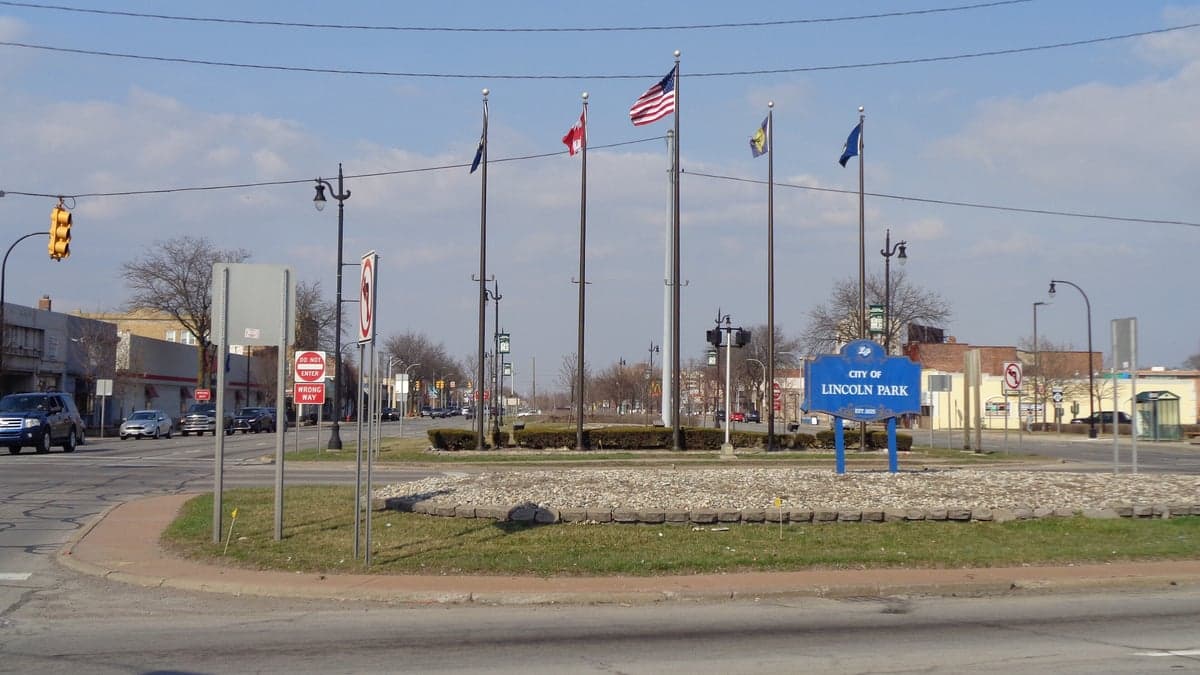
Photo: Wikipedia
Demographics of Lincoln Park, MI
Affluence Level in Lincoln Park, MI
A below-average socioeconomic profile. Incomes, home values, and educational attainment trail the U.S., with higher poverty and unemployment.
People of Lincoln Park, MI
The people of Lincoln Park, Michigan, today form a dense, working-class community of roughly 39,511 residents, characterized by a majority-white population (60.2%) alongside a substantial Hispanic minority (24.7%) and a smaller Black community (8.8%). The city is notably less diverse than neighboring Downriver communities like Allen Park or Southgate, with a foreign-born share of just 4.8% and a low college attainment rate of 11.3%, reflecting its blue-collar roots. Distinctive identity markers include a strong Polish-Catholic heritage, a deep attachment to the city's compact single-family home neighborhoods, and a reputation as a stable, family-oriented enclave within the Downriver region.
How the city was settled and grew
Lincoln Park was not a colonial-era settlement; its population history begins in earnest after 1900, driven by the explosive growth of Detroit's auto industry. The city was originally part of Ecorse Township, and its first major wave of settlers were Polish and German immigrants who arrived between 1910 and 1930 to work in Henry Ford's nearby River Rouge Complex and the Great Lakes Steel mill in neighboring Ecorse. These groups built the South Lincoln Park neighborhood, centered around Southfield Road and Fort Street, where modest wood-frame homes and Catholic parishes like St. Henry's Church anchored the community. A second wave of Italian and Maltese immigrants followed in the 1920s and 1930s, settling in the North Lincoln Park area near the Detroit border, particularly along Dix Highway and the Godwin district. The city incorporated in 1925, and by 1950 its population had surged past 29,000, nearly all white and overwhelmingly of European Catholic descent. The post-World War II boom brought a third wave of Appalachian white migrants from Kentucky and Tennessee, who moved into the Emerson and Southfield neighborhoods, drawn by factory jobs at Ford's Michigan Casting Center and the Wyandotte Chemical plant. These groups reinforced the city's white, blue-collar character, with ethnic parishes and social clubs—such as the Polish American Citizens Club and the Italian-American Club—serving as neighborhood anchors.
Modern era (post-1965)
The post-1965 period brought significant demographic change, though Lincoln Park's transformation was slower and less dramatic than in Detroit proper. The 1967 Detroit riots and subsequent white flight from the city accelerated domestic in-migration of white families from Detroit into Lincoln Park, particularly into the Beverly Hills and Southfield neighborhoods, where they sought stable housing and lower crime rates. However, the city's population peaked at 42,000 in 1970 and then began a gradual decline as deindustrialization hit the Downriver area. The most notable shift since 1990 has been the growth of the Hispanic population, which rose from roughly 5% in 1990 to 24.7% by 2025. This wave was primarily Mexican-American families moving from Southwest Detroit and the Mexicantown neighborhood, drawn by affordable housing stock in the Emerson and South Lincoln Park areas. The Black population, now at 8.8%, grew more slowly, with most Black residents settling in the Godwin district and the area around the Southfield Freeway corridor. The East/Southeast Asian population remains negligible at 0.6%, and the Indian-subcontinent population is effectively zero, making Lincoln Park one of the least Asian communities in Metro Detroit. The white population, while still a majority at 60.2%, has aged significantly, with many younger white families moving to further-out suburbs like Brownstown or Flat Rock.
The future
The population trajectory for Lincoln Park points toward continued slow decline and gradual ethnic diversification, but not rapid change. The city's population has fallen from 41,000 in 1990 to 39,511 today, and projections suggest it could dip below 38,000 by 2035 as the white population ages and younger families leave for larger lots in outer Downriver suburbs. The Hispanic share is likely to continue rising, potentially reaching 30-35% by 2040, as Mexican-American families from Detroit and Southwest Detroit find affordable housing in the South Lincoln Park and Emerson neighborhoods. However, the city is not tribalizing into distinct ethnic enclaves; rather, it is slowly homogenizing into a majority-Hispanic, working-class community, with the white population increasingly concentrated in the North Lincoln Park and Beverly Hills areas. The Black population is expected to plateau near 10%, as Lincoln Park competes with Southgate and Taylor for Black homebuyers. The foreign-born share will likely remain low (below 7%), as the city lacks the ethnic institutions or employer networks to attract significant new immigration. The low college attainment rate (11.3%) suggests the city will remain a blue-collar community, with residents employed in manufacturing, logistics, and healthcare at nearby employers like Beaumont Hospital, Ford's Dearborn Truck Plant, and Amazon's Romulus facility.
For someone moving in now, Lincoln Park is becoming a more Hispanic, still predominantly white, aging blue-collar city with stable but declining population. It offers affordable housing and a strong sense of neighborhood identity, but limited economic mobility and few amenities for young professionals. The city's future is one of gradual demographic transition, not rapid upheaval, making it a predictable choice for families seeking a low-cost, familiar Downriver environment.

* Values derived from national, state, county, city and local statistics and may differ in a specific area. Last updated: 2026-04-30T02:05:39.000Z
Narrative content on this page is AI-generated and may contain mistakes. Verify any details that matter before acting on them.
ReloMaps may earn a commission from affiliate links at no extra cost to you.

