Demographics of Linganore-Bartonsville, MD
Affluence Level in Linganore-Bartonsville, MD
An upper-middle-class area. Household wealth, education levels, and homeownership run ahead of national benchmarks.
People of Linganore-Bartonsville, MD
The 1,588 residents of Linganore-Bartonsville, Maryland, form a predominantly white, highly educated, and family-oriented community in Frederick County. With 81.0% of the population identifying as white and 69.0% holding a college degree, the area is characterized by its quiet, suburban-rural character and a notably low foreign-born share of just 0.4%. This is a place where long-term local roots and newer professional families seeking space and good schools converge, creating a stable, low-density enclave distinct from the faster-growing parts of the county.
How the city was settled and grew
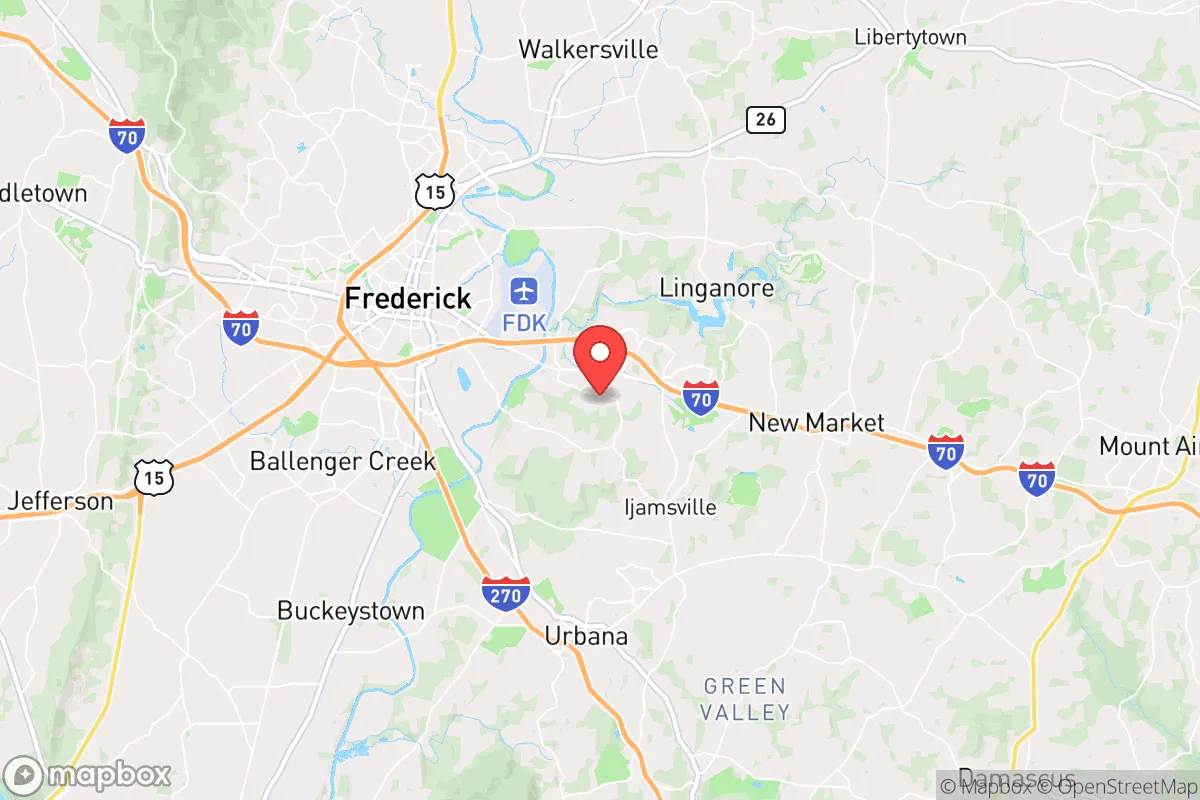
Linganore-Bartonsville was never a single, planned town but rather a collection of historic crossroads and mill villages that coalesced into a census-designated place (CDP). The area's original population was drawn by the fertile soils of the Monocacy River valley and the water power of Linganore Creek. In the 18th and 19th centuries, German and English farmers settled the land, establishing small communities like Bartonsville itself, named after the Barton family, and the mill-centered hamlet of Linganore. These early residents were primarily agricultural families, and their descendants formed the core of the area's white population for generations. The construction of the Baltimore and Ohio Railroad through nearby Libertytown in the mid-19th century provided a link to regional markets but did not trigger major population growth; the area remained a sparsely populated farming district through the first half of the 20th century.
Modern era (post-1965)
The modern character of Linganore-Bartonsville began to take shape after the 1960s, driven by the expansion of the Washington, D.C., and Baltimore metropolitan areas. The 1970s and 1980s saw the first significant wave of domestic in-migration, as professionals and families from the D.C. suburbs sought larger lots and lower taxes in Frederick County. This wave largely settled in newer subdivisions built on former farmland, such as the Linganore Estates and Bartonsville Woods neighborhoods. These areas attracted a predominantly white, college-educated population, a demographic profile that has only intensified. The post-1965 Hart-Cellar Act had minimal direct impact here; the foreign-born population remains negligible at 0.4%. The Hispanic share (5.2%) and Black share (4.8%) are modest and largely dispersed rather than concentrated in any single neighborhood, reflecting the area's role as a more expensive, less diverse alternative to nearby cities like Frederick or Mount Airy. The small East/Southeast Asian community (2.1%) and even smaller Indian subcontinent community (0.2%) are typically found in the newer, higher-end subdivisions like those along Bartonsville Road and near Linganore High School, drawn by the school system's reputation.
The future
Linganore-Bartonsville's population trajectory points toward slow, steady growth with a continued emphasis on single-family homes and open space. The area is unlikely to see the rapid diversification occurring in larger Maryland suburbs; its high home values and low rental stock act as a demographic filter. Future residents will likely continue to be domestic migrants—primarily white, married couples with children—moving from more expensive parts of the D.C. region. New development is concentrating in a few approved subdivisions, such as the Villages of Linganore master-planned community, which is adding hundreds of homes but maintaining the area's overall low-density feel. The cultural identity is evolving from a purely rural farming community to a commuter exurb, but the pace is deliberate. Over the next 10–20 years, the population will likely become slightly more diverse as Frederick County as a whole diversifies, but Linganore-Bartonsville will remain one of the county's most homogeneous and highly educated enclaves.
For someone moving in now, Linganore-Bartonsville offers a stable, safe, and academically strong environment with a distinctly low-key, land-conscious character. It is becoming a deliberate choice for families who prioritize space, school quality, and a predominantly white, conservative-leaning community over urban amenities or ethnic diversity. The area's future is one of managed, upscale growth—not transformation.

* Values derived from national, state, county, city and local statistics and may differ in a specific area. Last updated: 2026-08-26T18:49:14.000Z
Narrative content on this page is AI-generated and may contain mistakes. Verify any details that matter before acting on them.
ReloMaps may earn a commission from affiliate links at no extra cost to you.

