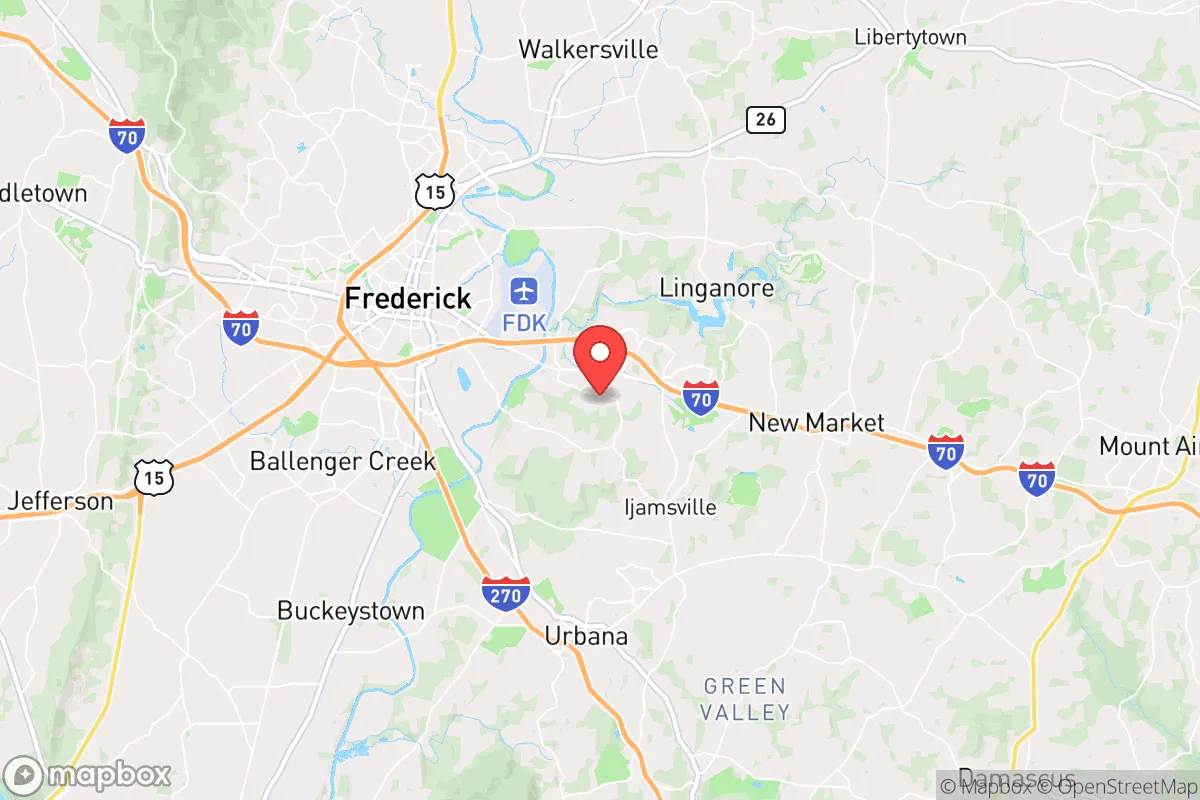
Personal Sovereignty in Linganore-Bartonsville, MD
Moderate friction. Expect trade-offs in some aspect of personal liberty and independence.
What does Personal Sovereignty tell us?
Personal Sovereignty measures your capacity for self-reliance and independence with minimal government friction. Higher scores mean fewer barriers between you and the way you want to live... but it assumes you have the space you need and good neighbors.
What does this tell us?
Personal Sovereignty measures your capacity for self-reliance and independence with minimal government friction. Higher scores mean fewer barriers between you and the way you want to live... but it assumes you have the space you need and good neighbors.
State Policy
Energy independence: Importer (8% of energy produced in-state)
Personal Liberty
Homesteading

Personal Liberty Analysis
Linganore-Bartonsville, Maryland, offers a nuanced personal sovereignty environment that balances the state’s generally progressive regulatory framework with the practical autonomy of a semi-rural Frederick County lifestyle. For individuals and families who prioritize independence, the area provides meaningful opportunities for self-reliance—particularly in housing, land use, and community life—while operating under Maryland’s higher tax burden and more restrictive gun laws. The key for a freedom-minded relocator is understanding where local county-level policies carve out breathing room within state-level constraints.
Tax burden and regulatory posture: what to expect in Frederick County
Maryland is a high-tax state overall, and Linganore-Bartonsville residents pay the full state income tax rate, which ranges from 2% to 5.75% depending on income bracket. Frederick County adds a local income tax of 2.96%, bringing the combined top marginal rate to roughly 8.71%—among the highest in the nation. Property taxes are moderate for the region: the county rate is $1.06 per $100 of assessed value, and there is no separate municipal tax in the unincorporated Linganore-Bartonsville area. For a $400,000 home, annual property tax runs about $4,240. The state’s 6% sales tax applies to most goods but exempts groceries and prescription drugs. On the regulatory side, Frederick County is generally more business-friendly than the Washington, D.C., suburbs. Zoning is administered by the county, and the Frederick County Livable Frederick Master Plan (updated 2024) emphasizes preserving agricultural and rural character while allowing limited residential infill. Permitting for home additions, sheds, or fences is straightforward but requires county approval; there is no city-level bureaucracy. The regulatory posture is best described as moderate-touch—not as light as rural West Virginia or Pennsylvania, but far less restrictive than Montgomery or Howard counties. Environmental regulations, particularly around the Chesapeake Bay watershed, add some compliance costs for larger land projects, but day-to-day life is not heavily burdened by red tape.
Self-defense and gun law specifics: what the Second Amendment landscape looks like
Maryland is a shall-issue state for concealed carry permits following the Supreme Court’s Bruen decision (2022), but the process remains more involved than in many states. Applicants must complete a 16-hour training course (including live-fire qualification), submit fingerprints, and pass a background check. The Maryland State Police typically process permits within 90 days. As of 2025, the state also requires a Handgun Qualification License (HQL) to purchase a handgun, which involves a separate training class and a 7-day waiting period. Long gun purchases require a 7-day wait as well, with no HQL needed. Magazine capacity is capped at 10 rounds for both handguns and long guns. Frederick County is generally more supportive of Second Amendment rights than the state as a whole; the Sheriff’s Office has a reputation for issuing permits without undue delay, and local gun ranges like the Frederick County Rifle & Pistol Club are active. Open carry is legal but uncommon, and private property rights regarding firearms are strong—landowners may allow or prohibit carry on their land without state interference. For self-defense in the home, Maryland’s Castle Doctrine applies, with no duty to retreat. However, the state does not have a Stand Your Ground law outside the home; a duty to retreat exists in public spaces if safely possible. Overall, Linganore-Bartonsville offers a workable but regulated self-defense environment—lawful owners can carry, but the process is more expensive and time-consuming than in states like Pennsylvania or Virginia.
Self-reliance and homesteading viability: lot sizes, zoning, and off-grid feasibility
This is where Linganore-Bartonsville truly shines for the independence-minded. The area is zoned primarily as Agricultural/Residential (AR) under Frederick County code, which allows a minimum lot size of 2 acres in most subdivisions, with many properties on 5–20 acres. This makes small-scale homesteading—gardens, chickens, goats, and even a horse or two—entirely feasible. The county allows up to 4 adult chickens per acre without a permit, and beekeeping is permitted on lots of 1 acre or more. Goats, sheep, and up to two cows are allowed on 2+ acres with a simple agricultural exemption. Zoning does not prohibit rainwater collection, but Maryland law requires a permit for systems that capture more than 2,500 gallons. Off-grid living is legally challenging: the county requires connection to the electrical grid for new construction, and solar panels are permitted but must comply with building codes. Septic systems are required where public sewer is unavailable, and well drilling is common—Frederick County Health Department permits wells with a minimum yield of 1 gallon per minute. Composting toilets are allowed only as an alternative to septic in limited cases. Burning trash is prohibited, but outdoor fire pits and small agricultural burns are permitted with a county burn permit. The Frederick County Right to Farm law protects agricultural operations from nuisance lawsuits, which supports a self-reliant lifestyle. For those seeking true off-grid independence, the regulatory hurdles are moderate—you can be largely self-sufficient on a few acres, but you cannot legally disconnect from the grid entirely.
Personal liberties: parental rights, medical autonomy, speech, and property
Maryland’s legal framework generally supports parental rights in education. The state allows homeschooling under two options: the “Portfolio” method (parent-directed, with quarterly reviews) or enrolling in a state-approved umbrella program. Frederick County Public Schools has a reputation for being accommodating to homeschoolers, and the county’s Homeschool Support Network is active. Medical autonomy is more restricted: Maryland has a vaccine mandate for school attendance (with medical and religious exemptions available), and the state’s COVID-19 emergency orders have expired, but the legal precedent for future mandates remains. The Maryland Medical Assistance Program covers gender-affirming care for minors, which may be a concern for some families. On speech and property rights, Maryland is a one-party consent state for recording conversations, and there are no county-level restrictions on political signs on private property (though HOA covenants may apply—check before buying). Property rights are generally strong: eminent domain is limited to public projects, and Frederick County does not have rent control or inclusionary zoning mandates that affect single-family homeowners. The Frederick County Property Rights Protection Act (2023) requires the county to compensate landowners for regulatory takings that reduce property value by more than 50%. This is a meaningful protection for those with acreage who might face future zoning changes. Overall, personal liberties in Linganore-Bartonsville are solid but not absolute—the state sets a floor for rights, and the county often provides a higher ceiling.
In the broader Mid-Atlantic context, Linganore-Bartonsville offers a practical balance of autonomy and community. It is not a libertarian enclave like rural Idaho or New Hampshire, but it provides more room for self-directed living than any suburb within 30 miles of Washington, D.C. The tax burden is real and should be factored into any budget, but the ability to own a few acres, keep animals, homeschool, and carry a firearm legally makes it one of the more sovereignty-friendly options in Maryland. For a family or individual who values personal freedom but needs to stay within commuting distance of the I-270 corridor or Baltimore, this area represents a strategic compromise—state-level constraints are present, but local conditions allow a genuinely independent lifestyle to flourish.

* Values derived from national, state, county, city and local statistics and may differ in a specific area. Last updated: 2026-08-26T18:49:14.000Z
Narrative content on this page is AI-generated and may contain mistakes. Verify any details that matter before acting on them.
ReloMaps may earn a commission from affiliate links at no extra cost to you.

