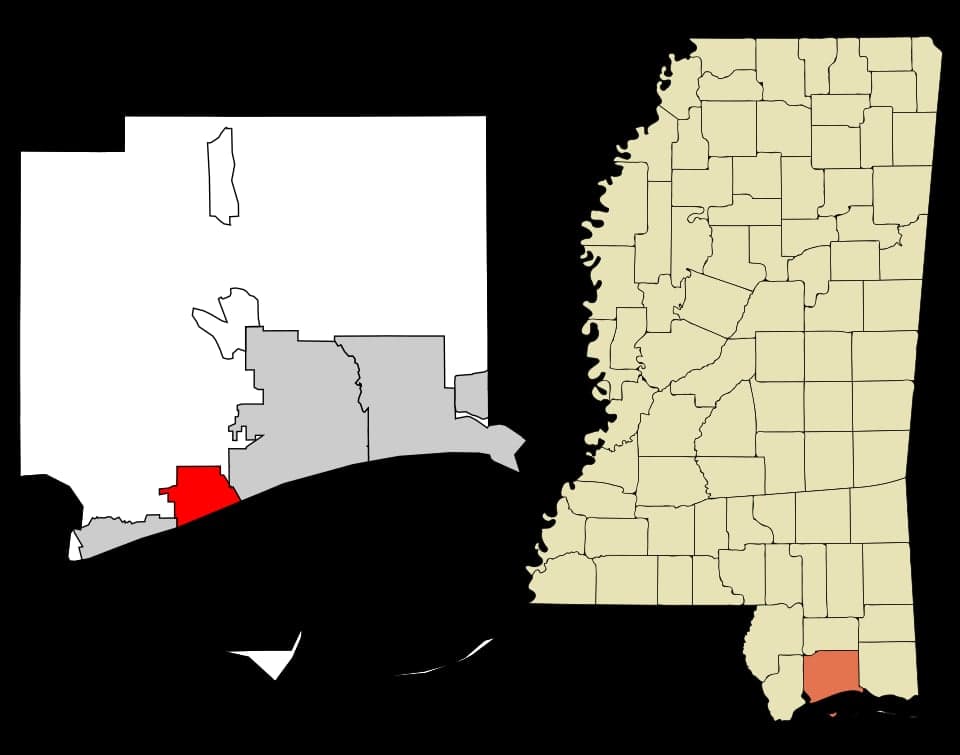
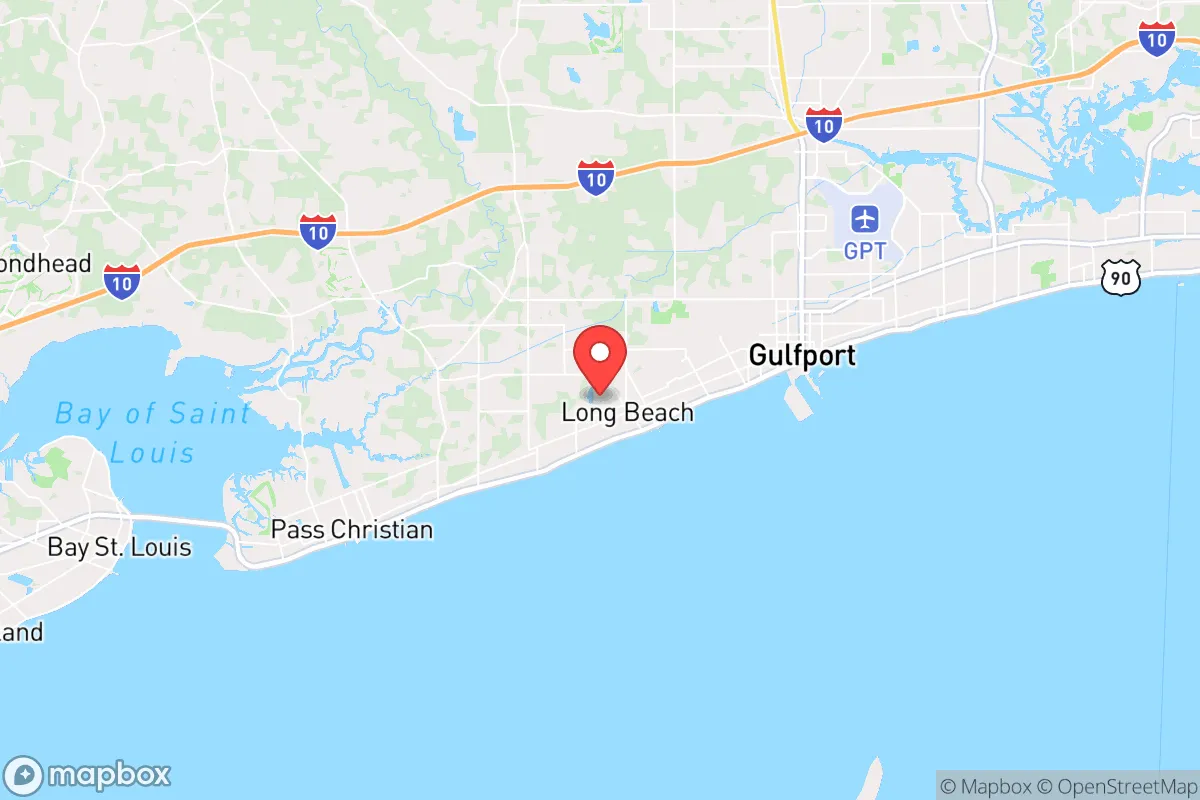
Photo: Wikipedia
Demographics of Long Beach, MS
Affluence Level in Long Beach, MS
A middle-class area roughly in line with national averages across income, home values, education, and employment.
People of Long Beach, MS
The people of Long Beach, Mississippi, today form a predominantly white, family-oriented community of 16,876 residents, characterized by a low 0.6% foreign-born share and a notably high 32.9% college-educated rate for the Gulf Coast. The city’s identity is rooted in its historic beachfront cottages and a quiet, suburban feel, with a population that is 79.7% white, 10.1% Black, 3.3% Hispanic, and 1.9% East/Southeast Asian. Distinct from neighboring Gulfport’s larger scale or Pass Christian’s more exclusive enclaves, Long Beach maintains a strong sense of local tradition, centered around its public schools and the University of Southern Mississippi’s Gulf Park campus.
How the city was settled and grew
Long Beach’s human history begins not with colonial settlement but with the post-Civil War timber and railroad boom. The area was originally part of the coastal piney woods, sparsely populated until the late 1800s when the Louisville and Nashville Railroad extended its line along the Mississippi Sound. The first significant wave of settlers were Anglo-American lumber workers and their families, drawn by the region’s vast yellow pine forests and the sawmills that sprang up along the tracks. These early residents built modest homes in what is now the Old Town district, centered around Jeff Davis Avenue and Railroad Street, where the original commercial core still stands. By the early 1900s, the city’s beachfront began attracting wealthier families from New Orleans and inland Mississippi, who built summer cottages and year-round homes along Beach Boulevard (U.S. 90), establishing the area’s reputation as a quiet resort. A second, smaller wave came during the 1920s land boom, when speculators subdivided the Pineville neighborhood (north of the railroad tracks) for working-class families, many of whom were descendants of the original lumber workers. The city incorporated in 1905, and its population remained overwhelmingly white and native-born through the mid-20th century, with a small Black community concentrated in the West Long Beach area, near the current intersection of Menge Avenue and Espy Avenue, where many worked as domestic help or in the seafood industry.
Modern era (post-1965)
The post-1965 era brought gradual demographic change, though Long Beach remained far less diverse than the national average. The 1965 Hart-Cellar Act had minimal direct impact here; the city’s foreign-born population today is just 0.6%, one of the lowest rates in coastal Mississippi. Instead, the major shift was domestic: suburbanization from Gulfport and Biloxi accelerated after Hurricane Camille in 1969 and again after Hurricane Katrina in 2005. Middle-class white families moved east from Gulfport into newer subdivisions like Oak Harbor and Northwood, drawn by Long Beach’s reputation for better schools and lower crime. The Black population, which had been a small minority (roughly 5-7% in 1970), grew to 10.1% by the 2020s, largely through natural increase and some in-migration from Gulfport’s older Black neighborhoods. This growth concentrated in the West Long Beach area and parts of the Pineville neighborhood, where housing remained more affordable. The Hispanic share (3.3%) and East/Southeast Asian share (1.9%) are recent and small, with Asian families—many of Vietnamese and Filipino heritage—settling primarily in the Oak Harbor subdivisions near the Gulf Park campus, drawn by tech and healthcare jobs. The Indian subcontinent population (0.1%) is negligible, mostly professionals associated with the university or local hospitals.
The future
Long Beach’s population is likely to continue its slow, steady growth, but with a homogenizing rather than diversifying trend. The city’s low foreign-born share and high college attainment rate suggest it will remain a predominantly white, middle-to-upper-middle-class suburb, attracting families from elsewhere on the Coast and from inland Mississippi. The Hispanic and Asian communities, while growing, are starting from such a small base that they are unlikely to reach double-digit shares in the next decade. The Black population appears stable, with no major in-migration drivers. The biggest demographic wildcard is climate-driven relocation: as sea-level rise and hurricane risk increase, some coastal residents may move inland, but Long Beach’s beachfront appeal could also attract new residents from more vulnerable areas like Louisiana or Florida. The city is not tribalizing into distinct ethnic enclaves; rather, it is becoming a more uniform, family-oriented suburb where the main dividing lines are between older beachfront homes and newer subdivisions, not race or national origin.
For someone moving in now, Long Beach offers a stable, safe, and well-educated community with a strong sense of local history. The population is not changing rapidly, and the city’s character—quiet, traditional, and family-focused—is likely to persist for the next generation. New residents should expect a place where neighbors know each other, schools are a priority, and the pace of life is deliberately slower than the nearby casino corridor.

* Values derived from national, state, county, city and local statistics and may differ in a specific area. Last updated: 2026-04-23T05:32:34.000Z
Narrative content on this page is AI-generated and may contain mistakes. Verify any details that matter before acting on them.
ReloMaps may earn a commission from affiliate links at no extra cost to you.

