Photo: Wikipedia
Demographics of Longview, WA
Affluence Level in Longview, WA
A middle-class area roughly in line with national averages across income, home values, education, and employment.
People of Longview, WA
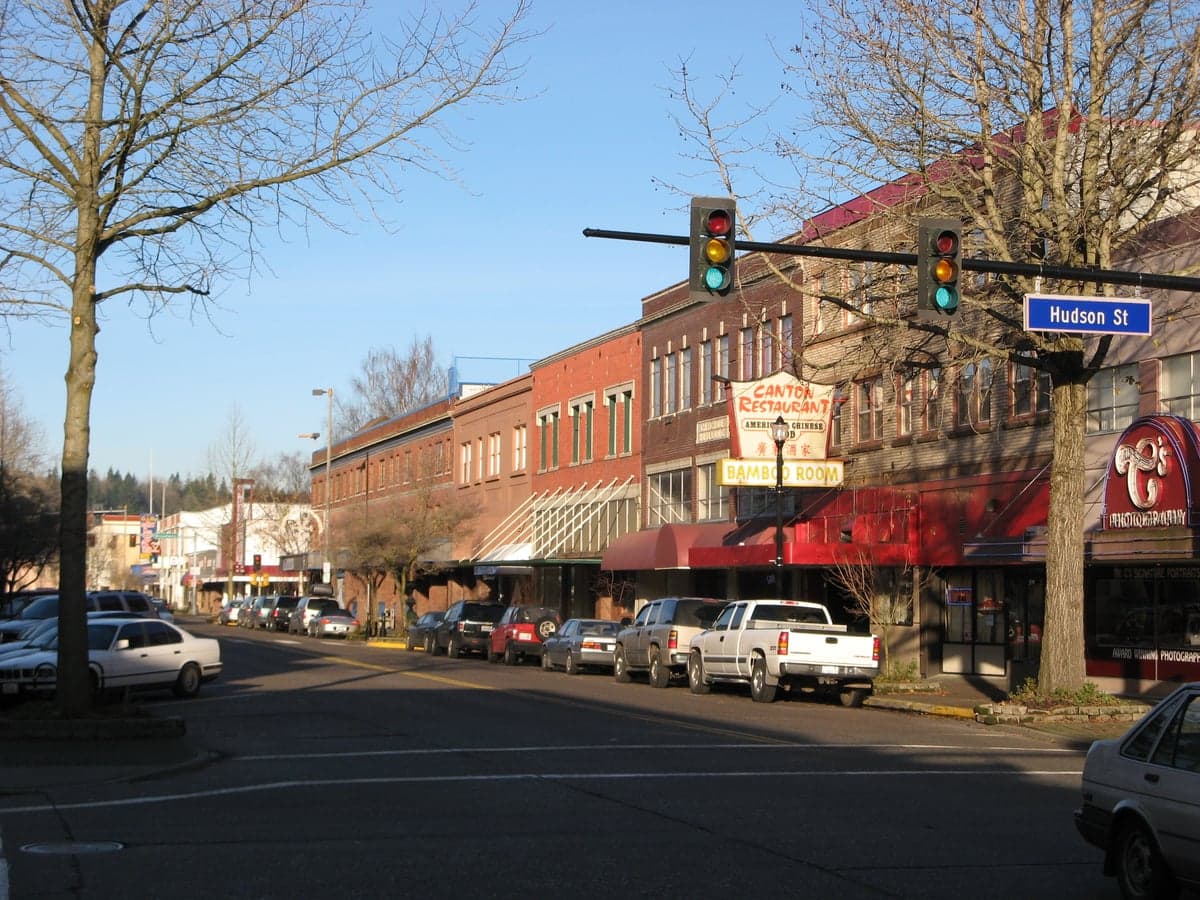
The people of Longview, Washington, today number 37,836 and form a predominantly white, working-class community with a distinct small-city character shaped by its planned origins and industrial roots. With a foreign-born population of just 2.0% and a college attainment rate of 16.7%, Longview is notably less diverse and less educated than the broader Seattle metropolitan area, reflecting its history as a blue-collar timber and manufacturing hub. The city’s identity is rooted in stability and local pride, with a population that is 78.0% white, 11.4% Hispanic, 1.8% East/Southeast Asian, and 0.9% Black, creating a demographic profile that is slowly diversifying but remains overwhelmingly native-born.
How the city was settled and grew
Longview is a rare American city that was deliberately planned and built from scratch in the 1920s, not a gradual settlement. The Long-Bell Lumber Company, led by Robert A. Long, purchased 14,000 acres of timberland and platted the city in 1923 to house its massive new mill. The original population was drawn almost entirely from existing logging communities in the Pacific Northwest and the Upper Midwest, particularly Minnesota and Wisconsin, where Long-Bell had previously operated. These early residents were overwhelmingly white, native-born, and Protestant, with a small number of Scandinavian immigrants who had worked in the timber industry. The first neighborhoods to rise were the Highlands and the Triangle District, both built by the company to house mill workers and their families. The Highlands, located on the hill above the mill, became the primary residential area for managers and skilled tradesmen, while the Triangle District, a flat grid near the industrial core, housed lower-wage laborers. A small Japanese American community formed in the northwest corner of the Triangle District during the 1920s and 1930s, working in the mills and on local farms, but this population was forcibly removed during World War II internment and never fully returned. By 1940, Longview’s population had reached 12,000, nearly all white and native-born, with the city’s growth driven entirely by the timber economy.
Modern era (post-1965)
The post-1965 period brought modest demographic shifts to Longview, but the city remained far less affected by immigration than coastal Washington cities. The 1965 Hart-Cellar Act did not trigger significant non-European migration to Longview because the city lacked the service-sector jobs and ethnic networks that drew immigrants to Seattle or Portland. Instead, the major change was domestic: the decline of the timber industry in the 1980s and 1990s led to out-migration of younger white workers, while a small but steady influx of Hispanic families began filling lower-wage jobs in manufacturing, warehousing, and agriculture. Today, the Hispanic population of 11.4% is concentrated in the northwest neighborhoods near the industrial corridor, including parts of the Triangle District and the area around 30th Avenue, where older, cheaper housing stock and proximity to warehouse jobs created a natural entry point. The East/Southeast Asian population of 1.8% is small and dispersed, with no single ethnic enclave, though a cluster of Filipino and Vietnamese families settled in the Lake Sacajawea area during the 1980s and 1990s, drawn by affordable homes and the city’s reputation for safety. The Black population remains tiny at 0.9%, with most Black residents living in the northwest quadrant near the industrial zone, reflecting the limited economic opportunities that have historically failed to attract significant African American migration. The Indian subcontinent population is effectively zero, and no Arab community of measurable size exists. The college-educated share of 16.7% is low, and these residents are concentrated in the Highlands and newer subdivisions on the city’s eastern edge, such as the Delameter area, where larger homes and better schools attract professionals commuting to Kelso or Portland.
The future
Longview’s population is slowly diversifying, but the pace is glacial compared to the rest of Washington. The Hispanic share is the only segment showing clear growth, projected to reach 14-16% by 2035, driven by natural increase and continued migration for warehouse and manufacturing jobs. The white population is aging and declining slightly, as younger white residents leave for college and urban job markets and do not return. The East/Southeast Asian and Black populations are plateauing, with no new migration streams likely given the city’s limited economic base and lack of ethnic institutions. The city is not tribalizing into distinct ethnic enclaves; rather, it is experiencing a gradual, low-level homogenization where Hispanic families are integrating into historically white working-class neighborhoods, particularly in the Triangle District and northwest areas. The next 10-20 years will likely see Longview become slightly more Hispanic and slightly older, with the white share dropping to around 72-74% and the foreign-born share remaining below 4%. The city will not become a diverse, cosmopolitan hub, but it will continue to be a stable, affordable, and predominantly white working-class community with a growing Hispanic minority.
For someone moving in now, Longview offers a predictable, low-diversity environment where the population is stable and the pace of change is slow. The city is becoming slightly more Hispanic but remains overwhelmingly native-born and white, with a culture rooted in timber-industry pragmatism and local loyalty. New residents will find a community that values stability over dynamism, and where the demographic future looks much like the present—just a little browner and a little older.

* Values derived from national, state, county, city and local statistics and may differ in a specific area. Last updated: 2026-04-21T11:02:09.000Z
Narrative content on this page is AI-generated and may contain mistakes. Verify any details that matter before acting on them.
ReloMaps may earn a commission from affiliate links at no extra cost to you.

