Photo: Wikipedia
Demographics of East Baton Rouge County
Affluence Level in East Baton Rouge County
A below-average socioeconomic profile. Incomes, home values, and educational attainment trail the U.S., with higher poverty and unemployment.
People of East Baton Rouge County
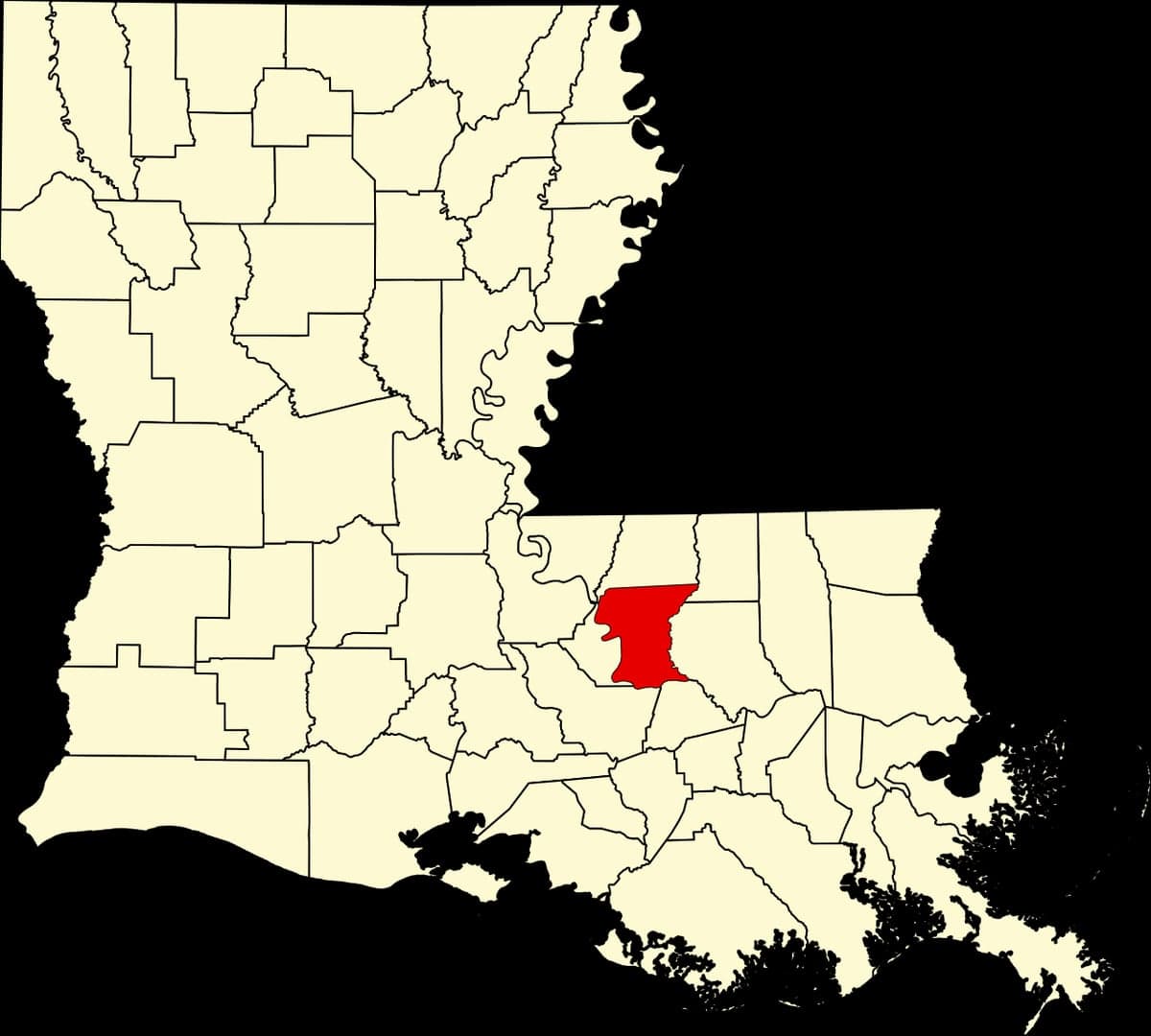
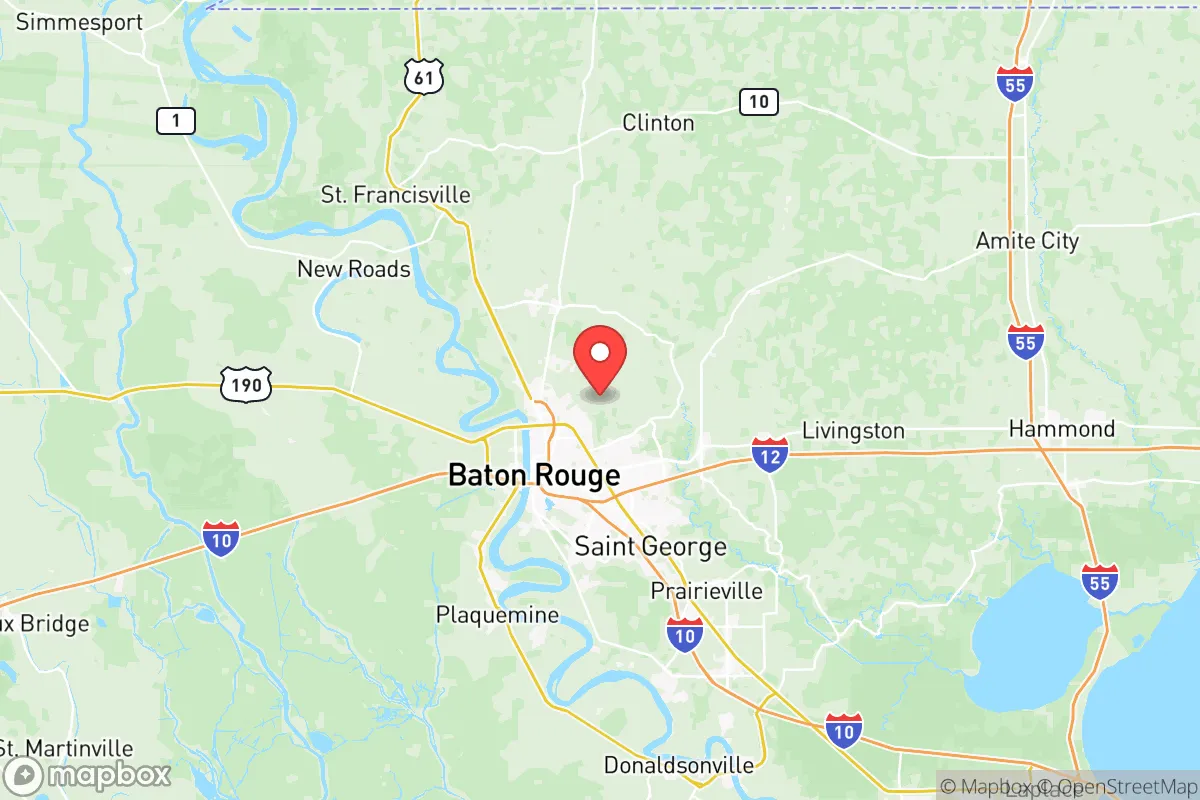
Today, East Baton Rouge Parish holds 452,821 residents, making it Louisiana’s most populous parish and a demographic hinge between Deep South tradition and emerging diversity. The population breaks almost evenly between Black (44.1%) and White (42.0%) residents, with a growing Hispanic share of 6.6%, East/Southeast Asian communities at 2.3%, and a smaller Indian-subcontinent group at 0.9%. Only 4.3% of residents are foreign-born, but college attainment sits well above the national average at 38.2%, reflecting the presence of LSU, the state capital, and a medical-research corridor. Baton Rouge is a majority-minority capital city with a strong African American political and cultural influence, surrounded by predominantly White suburbs that lean conservative—a landscape where the old racial binary is slowly giving way to a more complex ethnic mosaic.
Settlement & growth (pre-1960)
Before European contact, the region along the Mississippi River was home to the Houma and Bayougoula peoples, whose villages lined the bayous. French explorers claimed the area in 1699, and the first permanent European settlement—a French military outpost—was established around what is now downtown Baton Rouge. The 1763 Treaty of Paris transferred the territory to British control briefly, then to Spain in 1779, but the French Creole character persisted. After the U.S. Louisiana Purchase in 1803, Anglo-American planters poured in, bringing enslaved Africans to work cotton and sugar plantations on the rich alluvial soil. By 1819, Baton Rouge had become a river trade hub. The largest antebellum settlement clustered along the present-day Spanish Town neighborhood and the Garden District.
The Civil War and Reconstruction disrupted the plantation economy, but the region rebounded with industrial growth. The arrival of the railroad in the 1850s, followed by the discovery of oil at Jennings in 1901 and the construction of Standard Oil’s Baton Rouge refinery in 1909, transformed the parish from an agricultural backwater into an industrial center. European immigrants—chiefly Italians, Irish, and Germans—arrived in the 1880s–1910s to work on railroad construction, in the refinery, and as merchants. Many Italians settled in the Mid City area and in the community of Baton Rouge’s historic Italian enclave along Government Street. African Americans from rural Louisiana and Mississippi joined the Great Migration stream, moving to Baton Rouge for refinery and riverfront jobs, establishing neighborhoods like Scotlandville and Baker. The founding of Louisiana State University in 1860 (relocated to Baton Rouge in 1869) and the designation of Baton Rouge as the state capital in 1849 anchored a government and education sector that drew educated White professionals to the South Baton Rouge and University Acres areas. By 1950, the parish’s population had swelled past 158,000, still overwhelmingly White (roughly 65%) and Black (roughly 34%), with only a thin scattering of other groups.
Modern era (post-1965)
The 1965 Hart-Cellar Immigration Act opened the door to new flows from Asia and Latin America. Baton Rouge, however, was not a primary destination for most post-1965 immigrants, who favored coastal gateways; the foreign-born share in East Baton Rouge today remains low at 4.3%. Nevertheless, the parish saw a modest but steady arrival of Vietnamese refugees after 1975, many sponsored by LSU and Catholic Charities. They formed a small cluster in the Merrydale and Shenandoah areas along Florida Boulevard, where Vietnamese grocery stores and restaurants appeared. A more recent wave of Indian-subcontinent professionals—doctors, engineers, and IT workers—began arriving in the 1990s, drawn by employment at LSU, the Pennington Biomedical Research Center, and the petrochemical industry; they concentrate in the Oak Hills Place and St. George suburbs. The Hispanic population, now 6.6%, grew rapidly after 2000, fueled by construction, landscaping, and service jobs; the largest enclave is in Gardere, a unincorporated area south of Baton Rouge, where Latino-owned shops and churches line the commercial strip.
Domestic migration reshaped the parish more dramatically than international immigration. The oil bust of the 1980s slowed growth, but by the 2000s, a suburban exodus from Baton Rouge’s inner city accelerated. White families moved north to Zachary and Central, while Black middle-class families headed east to Baker and the new subdivisions of St. George (a de facto incorporated community seeking cityhood). The result is a parish that is both racially diverse and spatially divided: Baton Rouge proper is 54% Black and 36% White, while suburban Zachary is 76% White and Central is 81% White. The post-1965 period also saw the rise of the health care and education sectors, adding a large contingent of White and Asian professionals who live in the Shenandoah and Spanish Town historic district.
The future
East Baton Rouge Parish is trending toward a tri-ethnic future, though the pace is slow. The White share dropped from 50% in 2000 to 42% today, while the Hispanic share doubled during the same period, and the Asian share (East/Southeast) rose from 1.5% to 2.3%. The Indian-subcontinent population, though small, is growing via H‑1B professionals and is likely to double within a decade. The Black population share has held steady near 44%, but internal migration continues—young Black professionals are moving to suburbs like Baker and Central, while White families with school-age children often choose Zachary or private

* Values derived from national, state, county, city and local statistics and may differ in a specific area. Last updated: 2026-05-20T23:57:37.000Z
Narrative content on this page is AI-generated and may contain mistakes. Verify any details that matter before acting on them.
ReloMaps may earn a commission from affiliate links at no extra cost to you.

