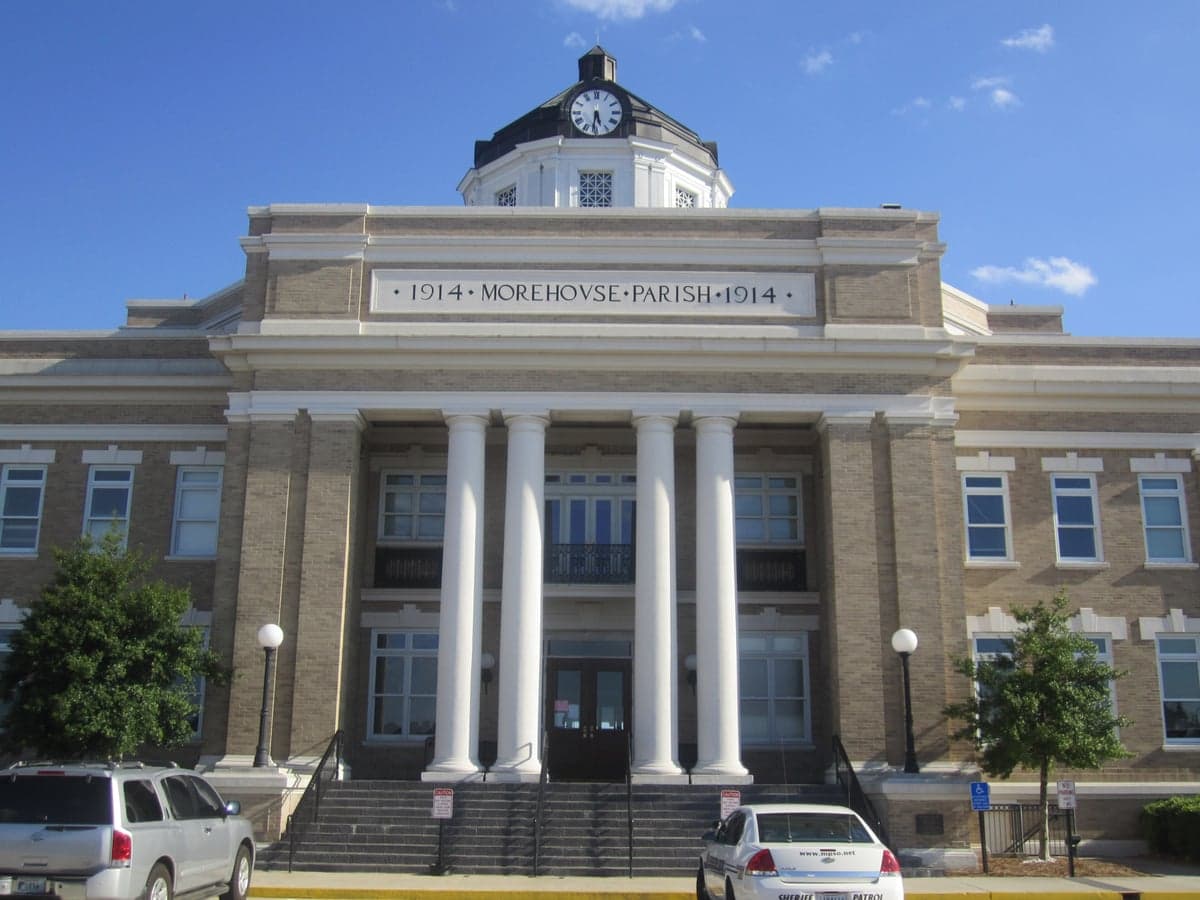
Photo: Wikipedia
Political ClimatePolitical Climate in Morehouse County
Showing district-level results — no local-only data available.
Local Political AnalysisPolitical Analysis of Morehouse County
Morehouse County is a deeply conservative corner of northeast Louisiana, carrying a Cook Partisan Voting Index of R+18 that places it among the most reliably Republican parishes in the state. That R+18 number isn't just a statistic—it means Republican candidates typically win by around 18 points more than the national average here, a margin that has held steady through the last three presidential cycles. The county's political DNA was forged in the post-Civil Rights realignment, and while the shift from yellow-dog Democrat to solid red happened decades ago, the current trajectory is one of consolidation rather than moderation. You can see it in the precinct returns: the city of Bastrop, the county seat and largest town, still shows a Democratic lean in its core wards, but those margins have been shrinking election after election, while the rural precincts around Mer Rouge, Collinston, and Bonita vote 75-80% Republican without fail.
How it compares
Compared to Louisiana as a whole, Morehouse County is noticeably more Republican. The state itself is reliably red—it voted for Trump by 19 points in 2020 and by 12 points in 2024—but that statewide number is pulled down by the heavily Democratic strongholds of New Orleans and Baton Rouge. Morehouse has no such urban counterweight. Bastrop's Black-majority population (roughly 60% of the city) does produce Democratic-leaning precincts, particularly around the historic downtown and the neighborhoods near Morehouse General Hospital, but those votes are swamped by the surrounding rural areas. The swing precincts, if you can call them that, are in the unincorporated areas just outside Bastrop city limits—places like the stretch along Highway 165 south of town—where independent and moderate voters occasionally split tickets in local races. In state-level contests, Morehouse consistently votes 10-15 points more Republican than the statewide average, a pattern that has held since at least 2010.
What this means for residents
For conservative residents, the political climate is comfortable and affirming. Local elected offices—the police jury, the school board, the district attorney—are held by Republicans or conservative Democrats who caucus with the GOP. The county's legislative delegation in Baton Rouge is reliably conservative, and issues like gun rights, oil-and-gas development, and opposition to abortion restrictions get a sympathetic hearing. For liberal residents, the reality is more isolating. There is no organized Democratic Party presence in the county; the local party committee is largely inactive. Progressive viewpoints are rarely voiced in public forums, and residents who lean left often keep their politics private, especially in the smaller towns like Oak Ridge or Mer Rouge. That said, the county's small size (population around 25,000) means that political disagreements rarely escalate into personal animosity—most people know each other, and neighborliness usually trumps partisanship.
Culturally, Morehouse County's conservatism is rooted in a mix of evangelical Christianity, a strong hunting-and-fishing tradition, and a deep skepticism of federal intervention—sentiments that play out in local policy. The county is a Second Amendment sanctuary, and the police jury has passed resolutions opposing state and federal gun restrictions. There's also a noticeable strain of populism: voters here supported Trump's trade policies and his criticism of the "Baton Rouge establishment," even when those positions conflicted with traditional Chamber-of-Commerce Republicanism. The biggest policy distinction from the rest of Louisiana is probably the county's approach to economic development—Morehouse has been slower to embrace industrial incentives and tax breaks than neighboring Ouachita Parish, reflecting a more cautious, small-government ethos. For anyone moving here, the political reality is straightforward: this is a place where conservative values are the baseline, and newcomers who share those values will find an easy fit, while those who don't will need to adjust to being in the minority.

State Political ClimatePolitical Climate in Louisiana
State Political AnalysisPolitical Environment in the State
Louisiana has been a reliably red state in federal elections for decades, but with a uniquely complex political character that sets it apart from the rest of the South. The state hasn't voted for a Democratic presidential candidate since 1996, and in 2024, Donald Trump carried it by roughly 18 points. However, the state's political landscape is far from monolithic: it features a strong Democratic presence in New Orleans and Baton Rouge, a powerful Cajun and Creole cultural influence that often bucks national party lines, and a deep-seated populist streak that can make statewide races surprisingly competitive. Over the last 20 years, the state has shifted rightward on social issues while maintaining a more moderate-to-liberal stance on certain economic and environmental matters, particularly around the oil and gas industry.
Urban vs. rural divide
The political map of Louisiana is a classic story of urban islands in a red sea. New Orleans (Orleans Parish) is the state's Democratic stronghold, consistently delivering 75-80% of its vote to Democratic presidential candidates. Baton Rouge (East Baton Rouge Parish) is more competitive but leans Democratic, especially in the city proper, while the surrounding suburbs like Prairieville and Denham Springs are deeply conservative. Lafayette, the heart of Acadiana, is a fascinating battleground: the city itself is a purple-to-light-blue enclave, but the surrounding parishes (like St. Martin and Vermilion) are solidly red. Shreveport (Caddo Parish) and Monroe (Ouachita Parish) follow a similar pattern—blue-leaning urban cores surrounded by deep-red rural areas. The rural parishes of north Louisiana, such as Bienville and Jackson, are among the most conservative in the nation, often voting 80%+ Republican. The Florida Parishes (north of Lake Pontchartrain), including St. Tammany Parish (home to Covington and Mandeville), have become a Republican stronghold as well, driven by an influx of conservative-leaning transplants from New Orleans and other states.
Policy environment
Louisiana's policy environment is defined by a low-tax, low-service model with a heavy reliance on energy revenue. The state has no personal property tax on vehicles or boats, and the homestead exemption shields the first $75,000 of a home's value from parish property taxes. The state sales tax is 4.45%, but local add-ons can push it to over 10% in some parishes. There is no state-level income tax on Social Security benefits, and the corporate tax rate has been cut in recent years. Education policy is a mixed bag: Louisiana has a robust school choice program, including the Louisiana Scholarship Program and a thriving charter school sector, particularly in New Orleans, which has one of the highest percentages of charter school students in the nation. However, the state consistently ranks near the bottom in K-12 outcomes. Healthcare is a perennial issue: the state expanded Medicaid under the Affordable Care Act in 2016, a move that was initially opposed by many Republicans but has since become broadly accepted. Election laws are relatively straightforward: no-excuse absentee voting is not permitted, but early voting is available for 7 days before an election. Voter ID is required, but a wide range of IDs are accepted.
Recent policy direction
Over the past five years, Louisiana has moved decisively to the right on a range of cultural and legal issues. In 2024, the state passed a near-total abortion ban with no exceptions for rape or incest, only for the life of the mother. Gun laws have been loosened: in 2021, Louisiana became a permitless carry state, allowing any adult who can legally possess a firearm to carry it concealed without a permit. The state has also passed a "Second Amendment Sanctuary" resolution. On education, the 2023 "Parents' Bill of Rights" (Act 476) requires schools to notify parents of any changes to a student's health or well-being, including mental health services, and prohibits instruction on sexual orientation or gender identity in K-12 classrooms. Property rights are generally strong, with no statewide rent control and a relatively straightforward eviction process. However, the state's unique "code civil" legal system (based on French civil law, not English common law) can make property transactions more complex for newcomers. On privacy and surveillance, Louisiana has no broad data privacy law, but it does have a biometric privacy law that has spurred class-action lawsuits. Voting access has been tightened: in 2024, the state passed a law requiring a government-issued ID to vote (previously, a utility bill or other document could suffice) and banned the use of private funding for election administration.
Civil unrest & political movements
Louisiana has a long history of political activism, from the civil rights movement to the more recent "Justice for All" protests in New Orleans and Baton Rouge. The 2016 shooting of Alton Sterling in Baton Rouge sparked weeks of protests and a national conversation about police reform. In 2020, the murder of George Floyd led to large demonstrations in New Orleans, Baton Rouge, and Lafayette, with some turning violent. On the right, the "Cajun Navy" (a volunteer rescue group) has become a symbol of community self-reliance and has occasionally been involved in political activism, including during the 2020 election. Immigration politics are less heated than in border states, but there is a vocal minority pushing for stricter enforcement. There is no sanctuary city policy in Louisiana; in fact, the state passed a law in 2024 requiring local law enforcement to cooperate with federal immigration authorities. Secessionist rhetoric is rare but not unheard of, usually tied to the state's unique cultural identity. Election integrity controversies have been relatively muted compared to other states, though there was some debate over the use of electronic voting machines and the 2020 presidential results.
Projection
Over the next 5-10 years, Louisiana is likely to remain a solidly red state, but with some interesting shifts. The continued growth of the Northshore (St. Tammany Parish) and the Baton Rouge suburbs will reinforce the Republican base. However, the urbanization of New Orleans and Baton Rouge, along with an influx of younger, more diverse residents to those cities, could make the state's two largest metros more Democratic. The state's population is aging and slowly declining, which could lead to a more conservative electorate overall. The energy transition away from oil and gas could reshape the state's economy and, by extension, its politics. If carbon capture and hydrogen hubs (which Louisiana is actively pursuing) take off, the state could see a new wave of investment that might attract a more moderate, tech-oriented workforce. For a new resident, the practical takeaway is that Louisiana will continue to be a culturally conservative state with a strong libertarian streak, but with pockets of deep-blue urbanism. The state's politics are likely to remain a fascinating, often contradictory mix of Southern tradition, Cajun independence, and urban progressivism.
For someone moving to Louisiana, the bottom line is this: you'll find a state that is broadly conservative on social issues and taxes, but with a live-and-let-live attitude that can be refreshing. The political climate is not as polarized as in many other states—you can have a beer with someone who voted differently than you. The biggest practical considerations are the state's low tax burden (especially on property) and its strong protections for gun owners and parents. However, be prepared for a state that ranks low in healthcare outcomes and education, and where the legal system (based on French civil law) can be confusing for newcomers. If you're conservative, you'll feel at home in most of the state. If you're liberal, you'll find your community in New Orleans, Baton Rouge, or Lafayette, but you'll be in the minority statewide. Either way, the politics here are as unique as the food and music—and that's saying something.
* Values derived from national, state, county, city and local statistics and may differ in a specific area. Last updated: 2026-08-05T00:04:23.000Z
Narrative content on this page is AI-generated and may contain mistakes. Verify any details that matter before acting on them.
ReloMaps may earn a commission from affiliate links at no extra cost to you.

