Photo: Wikipedia
Demographics of Lusk, WY
Affluence Level in Lusk, WY
A low-income area with significant economic hardship. Household wealth and educational attainment are well below national averages.
People of Lusk, WY
The people of Lusk, Wyoming, today number just 1,482, forming a tight-knit, predominantly White (83.0%) community with a small but notable Hispanic population (8.2%) and a Black population (2.3%). The city is characterized by its low population density, a strong ranching and energy-sector identity, and a foreign-born population of 0.0%, making it one of the most ethnically homogeneous small towns in the state. Lusk’s population is older than the national median, with a college education rate of 22.1%, reflecting a community rooted in agricultural and industrial trades rather than a knowledge economy.
How the city was settled and grew
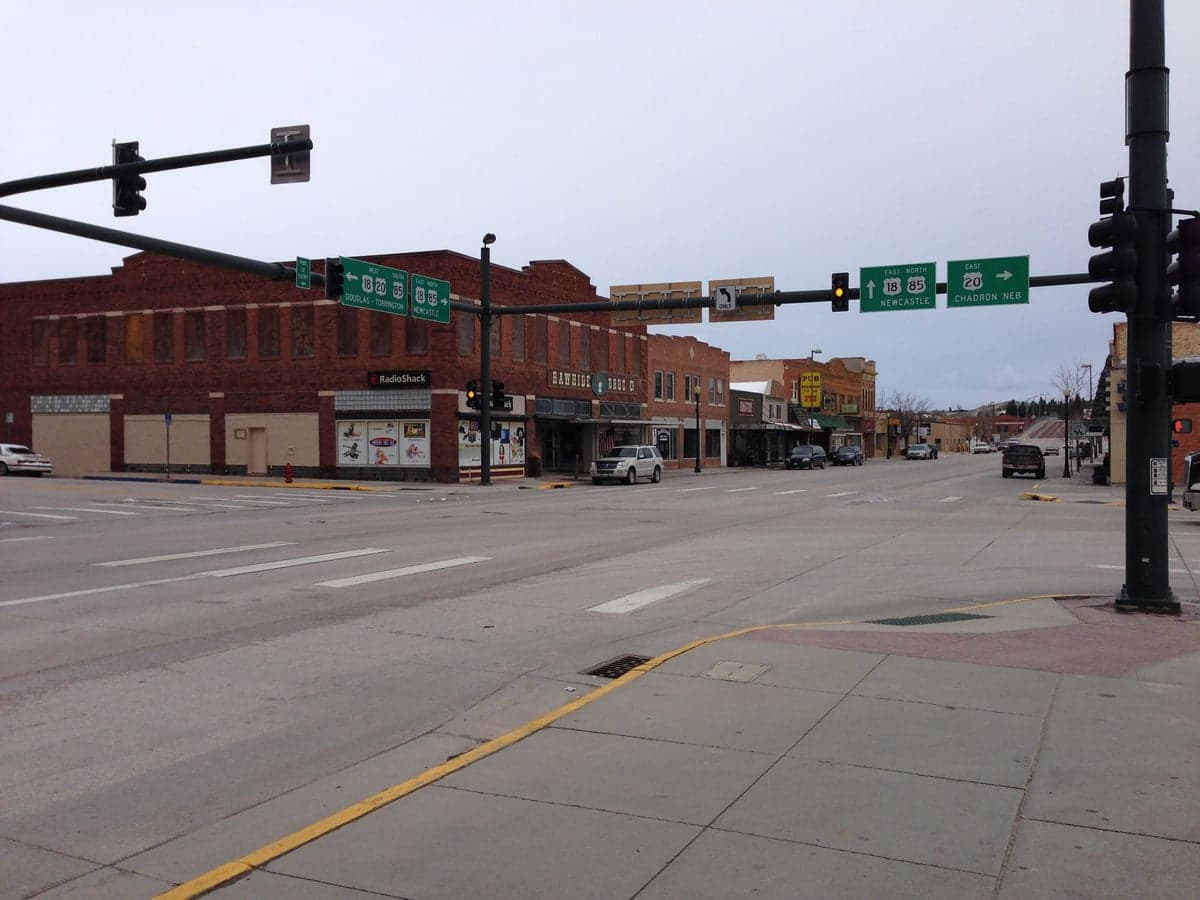
Lusk was founded in 1886 as a railroad town on the Fremont, Elkhorn & Missouri Valley line, named after Frank Lusk, a local rancher. The original population was drawn by the promise of open range for cattle ranching and the railroad’s need for station agents, section hands, and freight handlers. The first wave of settlers were predominantly Anglo-American homesteaders from the Midwest and Great Plains, who built the Original Townsite around the depot, now the core of downtown Lusk. A second wave arrived in the early 1900s with the expansion of the Wyoming Hereford Ranch and the discovery of oil in the nearby Lance Creek Field, bringing a small number of Italian and German immigrant laborers who settled in the South Side district, near the stockyards and rail yards. By 1930, the population had reached roughly 1,200, with the West Lusk area developing as a residential enclave for ranchers and oil field workers. The town’s growth plateaued after World War II, as the railroad declined and the ranching economy mechanized, leaving Lusk as a stable, slow-growing service center for Niobrara County.
Modern era (post-1965)
After the 1965 Hart-Cellar Act, Lusk saw virtually no new immigration, with the foreign-born share remaining at 0.0% through 2024. Domestic in-migration has been minimal, consisting mostly of retirees from Colorado and the Front Range seeking lower property taxes and a slower pace. These newcomers have concentrated in the Lusk Heights subdivision, a small development of newer homes built in the 1990s and 2000s on the town’s eastern edge. The Hispanic population, now 8.2%, grew primarily through natural increase and the arrival of a few families working in the oil and gas fields during the 2010s boom, settling in the North Lusk area near the highway. The Black population (2.3%) is largely tied to the Wyoming Department of Corrections’ minimum-security facility just outside town, with a small number of staff and their families living in the East Side neighborhood. No East/Southeast Asian or Indian subcontinent populations are recorded, reflecting the town’s lack of professional or academic sectors that typically attract such groups. The overall population has declined from a peak of 1,567 in 2010 to 1,482 in 2024, driven by out-migration of young adults seeking jobs in Casper or Cheyenne.
The future
Lusk’s population is projected to continue a slow decline, with the median age rising as younger residents leave for urban centers. The Hispanic share may grow modestly through higher birth rates, but the foreign-born population will likely remain near zero, as there are no industries or refugee resettlement programs to attract immigrants. The town is not tribalizing into distinct enclaves; rather, it is homogenizing into an older, predominantly White community with a small Hispanic minority. The Original Townsite and South Side are aging, with many homes vacant or sold to out-of-state buyers as second properties. The Lusk Heights subdivision may see a slight uptick if Wyoming’s energy sector revives, but no major demographic shift is expected in the next 10–20 years.
For someone moving in now, Lusk offers a stable, low-crime, and culturally homogeneous environment where community ties are strong and change is slow. It is becoming a retirement and remote-work haven for those seeking isolation and low costs, but it offers little economic opportunity for younger families or professionals outside of ranching, energy, or government work. The population is not diversifying, and the town’s future depends on retaining its remaining youth and attracting a few newcomers willing to embrace a quiet, rural lifestyle.

* Values derived from national, state, county, city and local statistics and may differ in a specific area. Last updated: 2026-04-30T13:36:24.000Z
Narrative content on this page is AI-generated and may contain mistakes. Verify any details that matter before acting on them.
ReloMaps may earn a commission from affiliate links at no extra cost to you.

