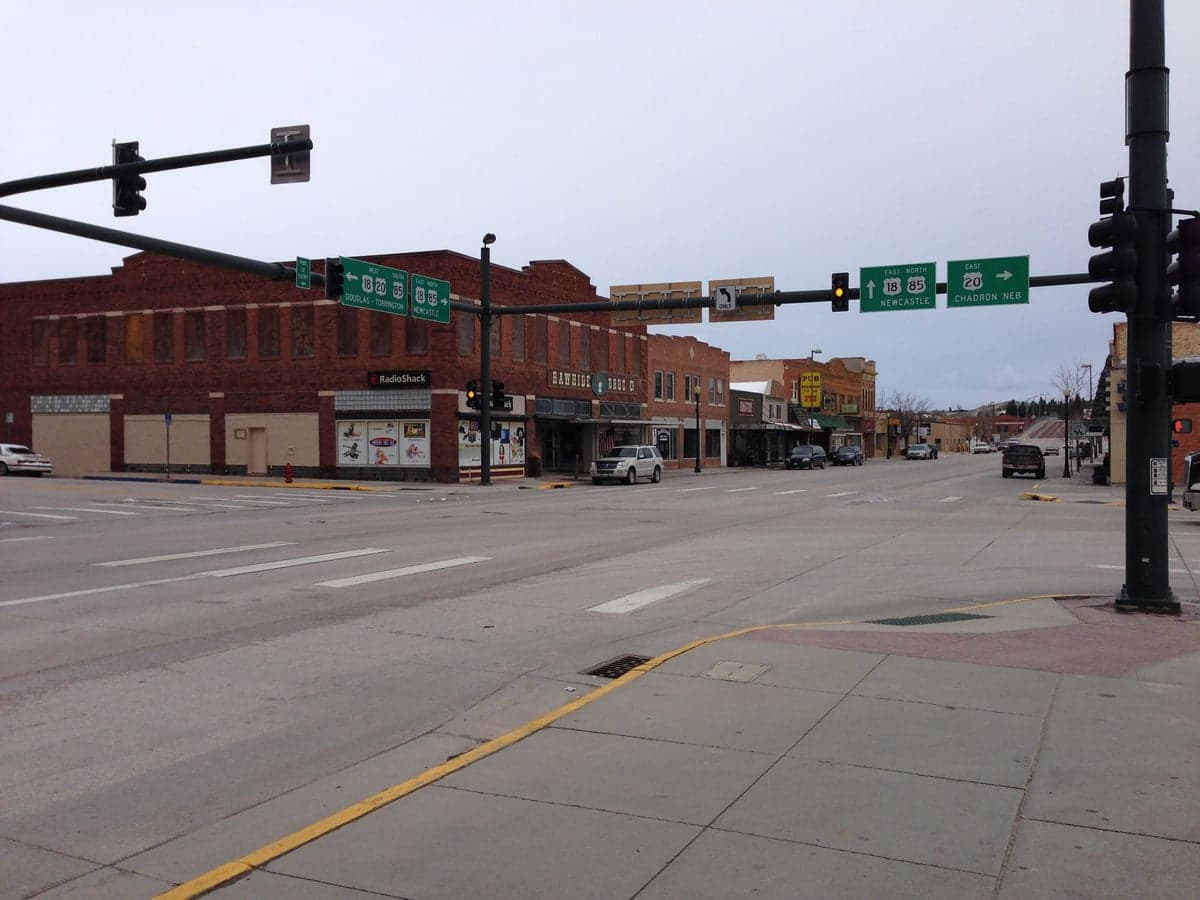
Photo: Wikipedia
Personal Sovereignty in Lusk, WY
Viable for self-reliance. Generally workable, though some barriers may limit total independence.
What does Personal Sovereignty tell us?
Personal Sovereignty measures your capacity for self-reliance and independence with minimal government friction. Higher scores mean fewer barriers between you and the way you want to live... but it assumes you have the space you need and good neighbors.
What does this tell us?
Personal Sovereignty measures your capacity for self-reliance and independence with minimal government friction. Higher scores mean fewer barriers between you and the way you want to live... but it assumes you have the space you need and good neighbors.
State Policy
Energy independence: Net exporter (800% of energy produced in-state)
Personal Liberty
Homesteading

Personal Liberty Analysis
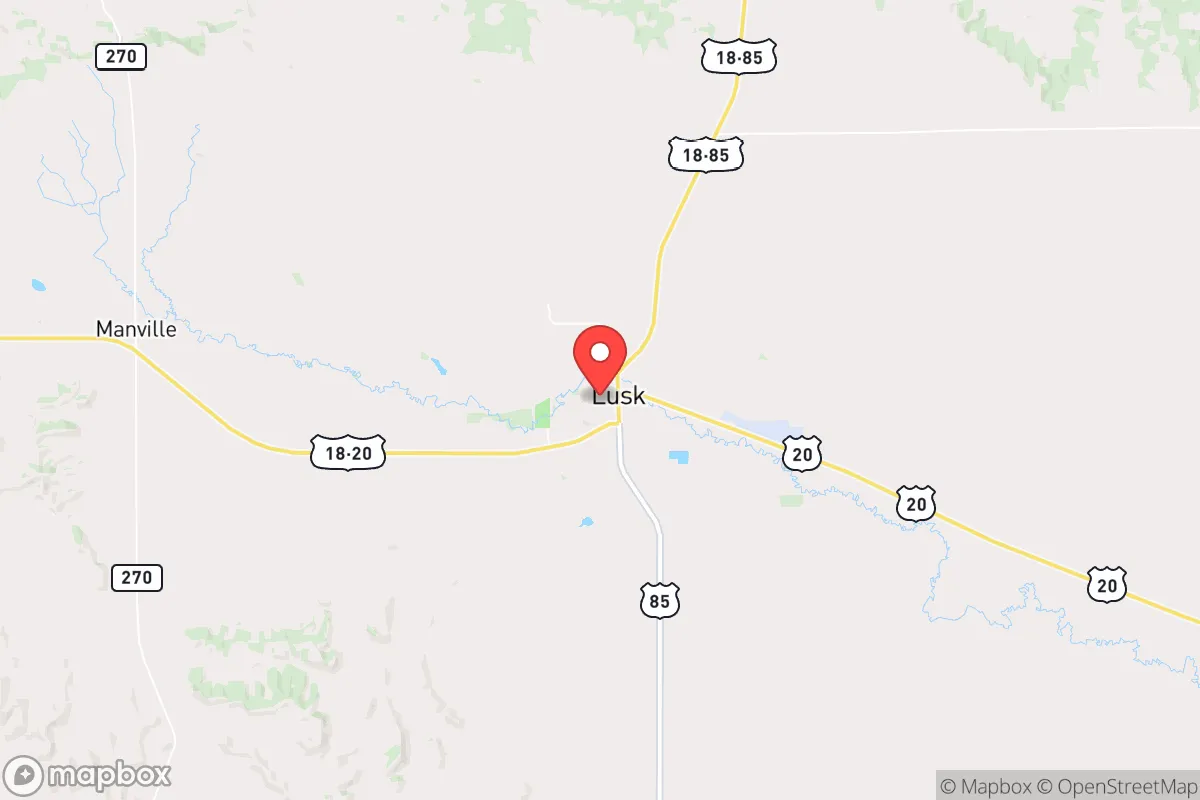
Lusk, Wyoming, offers one of the strongest personal sovereignty environments in the lower 48, functioning as a practical stronghold for those seeking to minimize government overreach in daily life. The town’s isolation—over 100 miles from Cheyenne and 50 miles from the nearest interstate—creates a natural buffer against federal and state-level intrusions, while Wyoming’s constitutional protections and low population density (roughly 1,500 residents in the town, with Niobrara County at under 2,500 total) mean local governance is thin and hands-off. For a single individual or parent operating from a survivalist or prepper mindset, Lusk represents a place where the default assumption is personal responsibility, not state intervention. The key trade-off is that this autonomy comes with limited services and a harsh climate, but for those prioritizing freedom over convenience, the calculus is straightforward.
Tax burden and regulatory posture in Niobrara County
Wyoming’s tax structure is among the most favorable in the nation for those seeking to retain their earnings and property without government confiscation. There is no state income tax, no corporate income tax, and no personal property tax on vehicles or household goods. The state sales tax is 4%, with Niobrara County adding a 1% optional tax, bringing the total to 5%—well below the national average. Property taxes are based on a low assessment ratio (9.5% of market value for residential) and a mill levy that typically runs around 65-70 mills, meaning a $200,000 home would incur roughly $1,200-$1,400 in annual property taxes. Regulatory posture is equally light: Wyoming has no state-level building code in most rural counties (Niobrara County does not enforce the International Building Code), no state-level zoning outside incorporated towns, and minimal environmental permitting for private land use. The state’s right-to-farm laws protect agricultural operations from nuisance lawsuits, and there are no state-level red flag laws or firearm-specific business licensing requirements. For a prepper, this means you can build a workshop, store supplies, or raise livestock on your own land without navigating a bureaucratic maze—a stark contrast to states like Colorado or Oregon.
Self-defense rights and gun law specifics in Wyoming
Wyoming is a constitutional carry state, meaning no permit is required to carry a concealed firearm for any law-abiding adult 21 or older (18 for open carry). The state preempts all local firearm ordinances, so Lusk’s town council cannot impose magazine bans, waiting periods, or registration schemes. There is no state-level background check requirement for private sales, no firearm owner licensing, and no restrictions on standard-capacity magazines or so-called “assault weapons.” Stand-your-ground laws are in effect, with no duty to retreat in any place where a person has a legal right to be. Castle doctrine protections extend to occupied vehicles and workplaces, not just homes. For parents, Wyoming law explicitly allows the use of deadly force to protect a child from imminent unlawful force, and there is no state law prohibiting firearms on school grounds with a valid permit (though federal Gun-Free School Zones Act restrictions apply). The practical reality in Lusk is that gun ownership is near-universal, and law enforcement—the Niobrara County Sheriff’s Office, with about 8 deputies—is stretched thin, meaning self-defense is understood as a personal responsibility, not a government service. Response times in rural parts of the county can exceed 30 minutes, reinforcing the need for armed preparedness.
Self-reliance and homesteading viability: lot sizes, zoning, and off-grid feasibility
Lusk and surrounding Niobrara County offer exceptional conditions for self-reliant living, particularly for those seeking to reduce dependence on centralized infrastructure. Within the town limits, residential lots typically range from 0.25 to 1 acre, with many older properties having alley-access garages and space for gardens or small livestock. The town’s zoning code is minimal—no setback requirements for accessory structures like sheds or greenhouses, no restrictions on keeping chickens or rabbits, and no noise ordinances that would interfere with generators or power tools. Outside town, unincorporated county land is essentially unzoned: you can purchase parcels from 5 to 160 acres (often via BLM or state land auctions) with no building permit required for owner-built dwellings, no septic system inspection beyond basic health department approval, and no requirement to connect to any utility grid. Off-grid feasibility is high: solar insolation averages 5.5 kWh/m²/day (comparable to Denver), well water is typically found at 100-300 feet depth with good quality, and wood heating is practical given the Ponderosa pine forests in the nearby Laramie Range. The county allows composting toilets and greywater systems without special permits, and there are no restrictions on rainwater catchment. For a prepper family, this means you can establish a fully independent homestead—solar panels, well, septic, wood stove, food storage—without any government inspector approving your setup. The main constraint is climate: winter lows average -10°F, growing season is only 110-120 days, and annual precipitation is just 14 inches, so serious homesteading requires cold-hardy crops, greenhouse investment, or a focus on livestock like cattle or bison.
Personal liberties: parental rights, medical autonomy, speech, and property
Wyoming’s legal framework strongly protects individual liberties across multiple domains relevant to conservative and survivalist families. Parental rights are codified in state statute, with a presumption that parents have the fundamental right to direct their children’s upbringing, education, and healthcare. Homeschooling is deregulated: no notification requirement, no curriculum approval, no standardized testing, and no teacher qualifications. The state has no vaccine mandate for school attendance (only the standard CDC-recommended schedule is suggested, with easy opt-out via philosophical exemption), and there is no state-level mask or quarantine authority that can override parental decisions. Medical autonomy is similarly robust: Wyoming has no state-level vaccine passport law, no mandatory reporting of alternative treatments, and no restrictions on purchasing raw milk, herbal remedies, or medical supplies without a prescription. The state’s constitution explicitly protects the right to “speak, write or print freely on any subject,” and there are no hate speech laws or social media content restrictions that would apply to private citizens. Property rights are reinforced by Wyoming’s strong eminent domain protections—the state constitution requires “just compensation” and prohibits taking property for economic development purposes (a direct response to the Kelo decision). For a prepper, this means you can stockpile supplies, build fortifications, or restrict access to your land without fear of HOA-style interference or government condemnation. The only notable limitation is that Wyoming does not have a state-level religious freedom restoration act (RFRA), though the federal RFRA still applies, and local practice in Lusk is overwhelmingly accommodating of Christian and conservative values.
Overall, Lusk offers a level of personal sovereignty that is increasingly rare in the United States, particularly when compared to coastal states or even neighboring Colorado. The combination of no income tax, constitutional carry, unzoned rural land, deregulated homeschooling, and minimal building codes creates an environment where an individual or family can operate with near-total autonomy from government oversight. The trade-offs—extreme isolation, harsh winters, limited healthcare access (the nearest hospital is 50 miles away in Torrington), and a population that skews older and more conservative—are precisely what make it attractive to those seeking to escape the encroachments of federal and state power. For a survivalist or prepper evaluating relocation options, Lusk ranks among the top-tier destinations in the Mountain West, comparable to places like Hysham, Montana, or Eureka, Nevada, but with better access to the Black Hills and Front Range for resupply. It is not a place for those who want convenience or community services; it is a place for those who want to be left alone to live by their own rules.

* Values derived from national, state, county, city and local statistics and may differ in a specific area. Last updated: 2026-04-30T13:36:24.000Z
Narrative content on this page is AI-generated and may contain mistakes. Verify any details that matter before acting on them.
ReloMaps may earn a commission from affiliate links at no extra cost to you.

