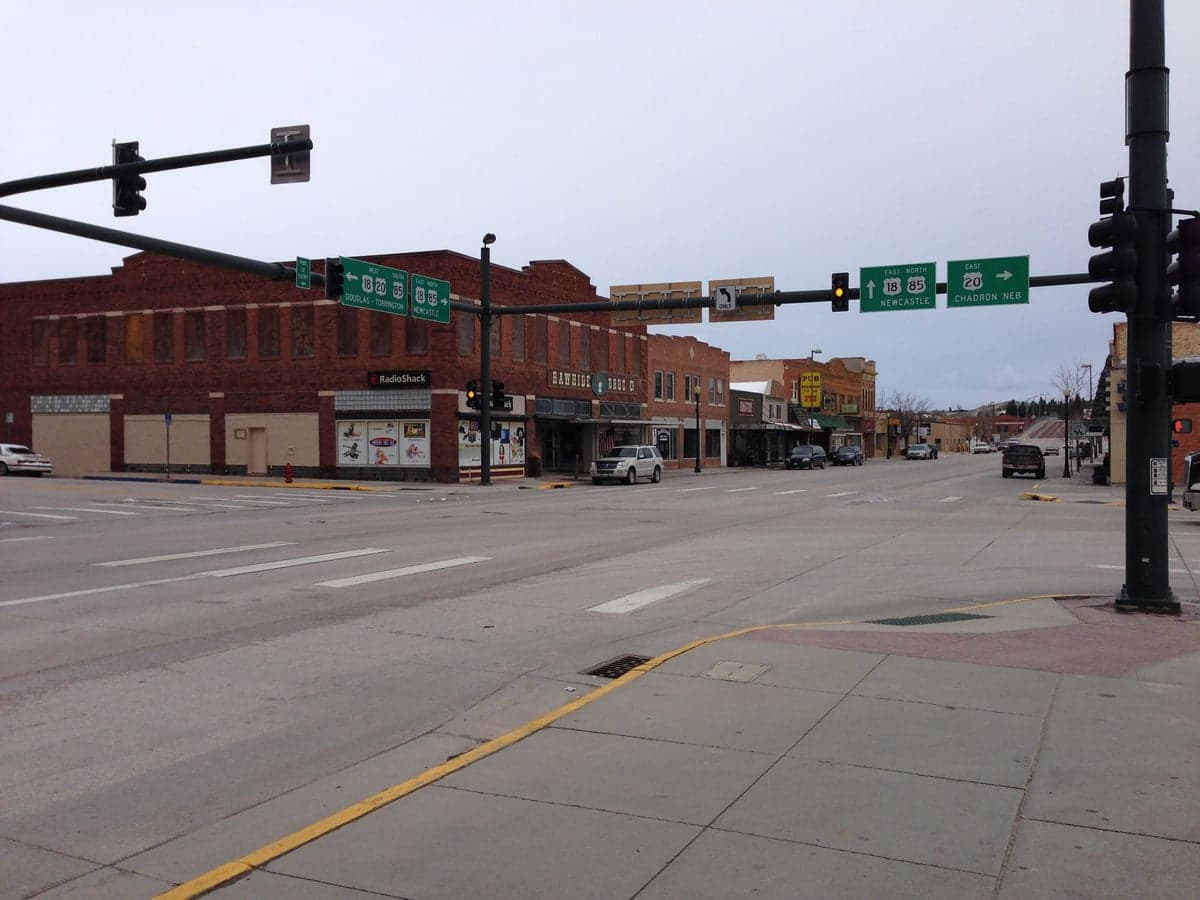
Photo: Wikipedia
Political ClimatePolitical Climate in Lusk, WY
District shown is the primary district for this city’s centroid. Cities may span multiple districts.
Inherited from parent state — no local data available.
Local Political AnalysisPolitical Analysis of Lusk, WY
Lusk, Wyoming, is about as rock-ribbed conservative as it gets, and it’s been that way for as long as anyone can remember. The Cook PVI of R+23 tells you the math, but it doesn’t capture the feel—this is a place where folks still believe the government that governs least governs best, and they vote like it. The trajectory here hasn’t budged much in decades, and if anything, the recent waves of folks fleeing blue states have only reinforced that stance. You don’t see the political drift you might catch in places like Laramie or even parts of Cheyenne; Lusk stays steady, and that’s exactly how most people here want it.
How it compares
Drive an hour west to Douglas, and you’ll find a similar conservative bent, but it’s a little more tempered by energy industry politics and union ties. Head south to Torrington, and you’re in farm country that leans red but has a quieter, less vocal brand of it. The real contrast is with towns like Lander or Pinedale, where you start to see more environmentalist influence and a younger, outdoorsy crowd that sometimes votes against resource extraction. Lusk doesn’t have that tension. The county commission, the school board, the local judges—they’re all folks who believe in low taxes, minimal regulation, and keeping the federal government out of your business. When you hear about some new mandate coming out of D.C. or Denver, the reaction here isn’t “let’s see how we can comply”—it’s “let’s see how we can resist.”
What this means for residents
For someone living in Lusk, the political climate means you’re not constantly fighting over zoning laws, mask mandates, or land-use restrictions that tie up your property rights. The local government is small, accessible, and generally stays out of the way. You can run a business, build a fence, or hunt on your land without a dozen permits and a year of hearings. That’s a big deal, and it’s why people who move here from places like California or Colorado often say they feel like they can finally breathe. The downside? If you’re hoping for progressive policies—say, expanded public transit, diversity initiatives, or strict environmental regulations—you’re going to be disappointed. But for the vast majority of residents, that’s not a downside; it’s the whole point. The concern is always about keeping it that way, especially as outside money and outside ideas creep into Wyoming through tourism and remote workers.
Culturally, Lusk is a place where the Fourth of July parade still means something, where the high school football game is the big event on Friday night, and where people don’t lock their doors. There’s a strong sense of personal responsibility and community self-reliance—if someone’s barn burns down, neighbors show up with lumber and a hammer before the insurance adjuster even calls. The policy distinctions are subtle but real: Lusk has pushed back on federal land grabs, opposed gun control measures at the state level, and generally supported candidates who promise to shrink government rather than grow it. The long-term worry here isn’t about losing an election—it’s about losing the culture that makes the place worth living in. As long as the people here keep voting their values and raising their kids the same way, Lusk will stay exactly what it is: a quiet, free corner of the country where you’re left alone to live your life.

State Political ClimatePolitical Climate in Wyoming
State Political AnalysisPolitical Environment in the State
Wyoming is, and has long been, one of the most reliably Republican states in the Union, with a partisan lean that is both deep and broad. The state hasn’t voted for a Democratic presidential candidate since 1964, and in 2024, Donald Trump carried the state by a margin of roughly 40 points. The dominant coalition is a mix of ranchers, energy-sector workers, and a growing number of remote workers and retirees fleeing blue states, all united by a fierce commitment to limited government, gun rights, and energy independence. Over the last 10-20 years, the trajectory has been one of steady, if slow, consolidation—the Democratic Party has all but collapsed in rural counties, while the growing conservative suburbs of Casper and Laramie have only reinforced the state’s red hue. The real story, however, is the internal tension between the traditional, resource-extraction-based conservatism of places like Gillette and Rock Springs and the newer, more ideologically rigid libertarian-conservative wave arriving in Jackson and Teton County.
Urban vs. rural divide
The political map of Wyoming is not a simple city-versus-country story—it’s a story of which cities and which rural areas. The only reliably blue county is Teton County (home to Jackson Hole), which voted for Joe Biden in 2020 and Kamala Harris in 2024, driven by a wealthy, amenity-focused population that leans progressive on environmental and social issues. But Teton County is an outlier; its politics are more akin to Aspen or Park City than the rest of Wyoming. The state’s largest city, Cheyenne, is solidly Republican but with a moderate, establishment flavor—think Chamber of Commerce conservatism. Casper, the second-largest city, is more populist and culturally conservative, with a strong energy-industry base. The real divide is between the energy-rich, heavily Republican counties like Campbell County (Gillette) and Sweetwater County (Rock Springs), which vote 75-80% Republican, and the more mixed, college-town atmosphere of Albany County (Laramie, home to the University of Wyoming), which is still red but with a noticeable 35-40% Democratic vote. The rural areas—places like Sublette County and Johnson County—are among the most conservative in the nation, with Republican margins exceeding 85%.
Policy environment
Wyoming’s policy environment is a dream for those seeking minimal government interference. There is no state income tax, and the sales tax is a low 4% (with local options pushing it to around 6% in some towns). Property taxes are among the lowest in the nation, though they have been creeping up in high-demand areas like Teton County. The regulatory posture is aggressively pro-business and pro-energy: the state has actively fought federal land-use restrictions and methane rules, and it has a right-to-work law. On education, Wyoming funds its schools generously through a mineral trust fund, but the curriculum leans traditional, and there is strong parental-rights sentiment—the state passed a Parents’ Bill of Rights in 2023. Healthcare is a mixed bag: the state did not expand Medicaid under the ACA, and rural hospital closures are a concern, but there is a growing network of direct-primary-care clinics. Election laws are among the most secure in the nation: voter ID is required, same-day registration is not allowed, and the state uses paper ballots. There is no mail-in voting unless you have a valid excuse. This is a state that takes election integrity seriously.
Trajectory & freedom
Wyoming is becoming more free, not less, and recent legislation proves it. In 2021, the state passed a constitutional carry law, allowing any adult who can legally possess a firearm to carry it concealed without a permit. In 2023, the legislature passed a law prohibiting the enforcement of federal gun laws that violate the Second Amendment—a direct nullification-style move. On medical autonomy, Wyoming has banned nearly all abortions (trigger law after Dobbs) and has a strong conscience-protection law for healthcare providers. Parental rights were expanded in 2023 with a law requiring schools to notify parents of any medical or mental health services offered to minors. On property rights, the state passed a law in 2022 limiting the use of eminent domain for carbon pipelines. The only area where freedom has arguably contracted is in the realm of land use: the state has tightened restrictions on wind and solar development in certain areas to protect viewsheds and wildlife, which some see as a NIMBY overreach. But overall, the trajectory is toward greater personal liberty, especially for gun owners, parents, and taxpayers.
Civil unrest & political movements
Wyoming is not a hotbed of civil unrest, but there are visible political movements. The most prominent is the “Freedom Caucus” wing of the state legislature, which has pushed for more aggressive nullification of federal laws, including a 2023 bill that would have blocked federal vaccine mandates. There have been small but vocal protests in Cheyenne over federal land management, particularly around the use of public lands for grazing and energy extraction. Immigration politics are relatively quiet, as Wyoming has a very small foreign-born population (around 3%), but the state has passed a law requiring all employers to use E-Verify. There is no sanctuary city movement. Election integrity controversies have been minimal, though some activists have called for an audit of the 2020 election (the state’s Republican secretary of state has resisted). The most visible flashpoint for a new resident would likely be the tension between the growing libertarian-conservative population and the older, more establishment Republican machine—this plays out in primary elections and local party meetings, not in street protests.
Projection
Over the next 5-10 years, Wyoming will likely become even more conservative, but with a sharper libertarian edge. The in-migration of remote workers and retirees from California, Colorado, and Washington is accelerating, and these newcomers tend to be culturally conservative but fiscally libertarian—they want low taxes, gun rights, and school choice, but they also want high-speed internet and craft breweries. This will push the state toward more school-choice expansion (possibly a universal ESA program) and further deregulation of housing and business. The energy transition will be a wildcard: if federal policy shifts against fossil fuels, Wyoming’s coal and oil towns could face economic hardship, which might fuel more radical anti-federal sentiment. The Democratic Party will continue to shrink, confined to Teton County and a few pockets in Laramie. A new resident moving in now should expect to find a state that is fiercely independent, increasingly skeptical of federal authority, and deeply committed to personal liberty—but also one that is grappling with how to balance growth with its traditional rural character.
For a new resident, the bottom line is this: Wyoming offers a level of personal freedom that is increasingly rare in the United States. You will not be taxed on your income, you can carry a concealed firearm without a permit, your children’s education will be free from radical gender ideology, and your vote will be counted on a paper ballot. The trade-offs are real: limited healthcare access in rural areas, harsh winters, and a job market that still revolves heavily around energy and government. But if you value liberty over convenience, and you’re willing to drive an hour for a good grocery store, Wyoming is one of the last places in America where the government truly stays out of your way.
* Values derived from national, state, county, city and local statistics and may differ in a specific area. Last updated: 2026-04-30T13:36:24.000Z
Narrative content on this page is AI-generated and may contain mistakes. Verify any details that matter before acting on them.
ReloMaps may earn a commission from affiliate links at no extra cost to you.

