Photo: Wikipedia
Demographics of Lyndon, KY
Affluence Level in Lyndon, KY
A middle-class area roughly in line with national averages across income, home values, education, and employment.
People of Lyndon, KY
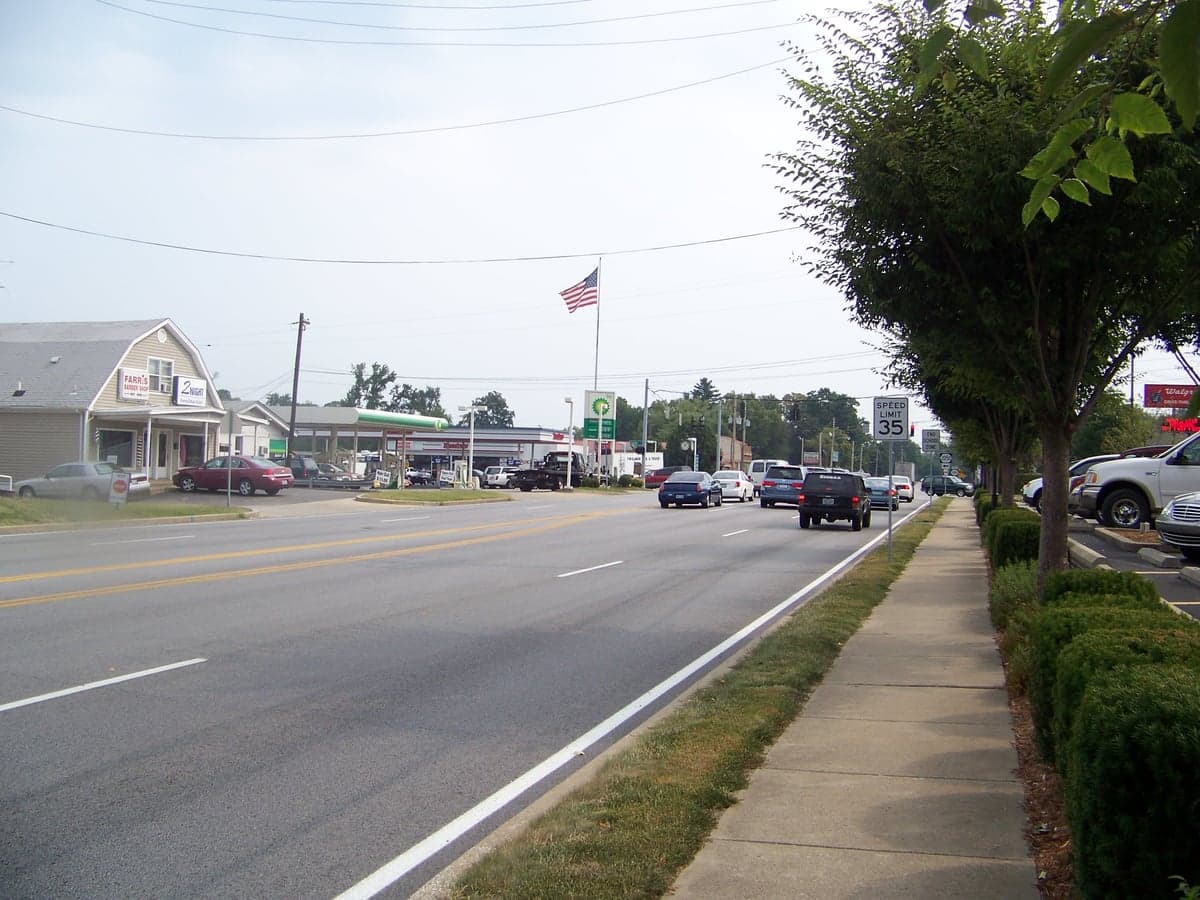
Lyndon, Kentucky, is a compact, majority-white inner-ring suburb of Louisville with a population of 10,956 that is notably more diverse than its Jefferson County neighbors. The city is characterized by a high proportion of college-educated residents (44.5%), a stable family-oriented housing stock, and a growing Black and East/Southeast Asian presence that is reshaping its historic identity. Lyndon feels less transient than newer exurbs, with a dense, walkable core around the Lyndon Square area that attracts both young professionals and long-term homeowners.
How the city was settled and grew
Lyndon’s human history begins not with colonial settlement but with the post-Civil War expansion of Louisville’s streetcar suburbs. The area was originally farmland, part of the Beargrass Creek watershed, and was first platted in the 1870s as a rural crossroads called "Lyndon Station" along the Louisville and Nashville Railroad. The original population was almost entirely white, drawn by cheap land and the promise of commuter rail access to downtown Louisville jobs. The first wave of residents—German and Irish Catholic families—built modest frame houses along what is now Lyndon Lane and New La Grange Road, forming the core of the Lyndon Station Historic District, a neighborhood of late-19th-century cottages and shotgun houses that still anchors the city’s identity. A second wave of white, middle-class families arrived in the 1920s and 1930s, drawn by the construction of US 60 (Shelbyville Road) and the opening of the Lyndon School (now the Lyndon Community Center). These families built the bungalow-and-ranch homes of the Lyndon Hills and Lyndon Park neighborhoods, which remain predominantly white and owner-occupied today. Lyndon was formally incorporated in 1965, a late date that reflects its character as a post-war bedroom suburb rather than an historic town.
Modern era (post-1965)
Lyndon’s demographic transformation began in earnest after the 1965 Hart-Cellar Act and accelerated with Louisville’s white flight in the 1970s and 1980s. The city absorbed a significant wave of Black families moving from Louisville’s West End, seeking better schools and newer housing stock. These families concentrated in the Lyndon Gardens and Lyndon Village apartment complexes and the ranch-style subdivisions east of New La Grange Road, areas that today have the highest Black population share in the city (roughly 25-30% in those census tracts). The 1990s and 2000s brought a smaller but visible wave of East/Southeast Asian immigrants—primarily Vietnamese and Korean families—who opened small businesses along Shelbyville Road and settled in the Lyndon Square condominiums and the Hurstbourne Parkway corridor. Today, Lyndon’s Black population stands at 15.9%, its East/Southeast Asian population at 2.0%, and its Hispanic population at 3.9%, with a foreign-born share of 7.5%—roughly double the Jefferson County average. The Indian-subcontinent population remains negligible at 0.2%, concentrated in a handful of professional households near the Lyndon Medical Center. The white population, at 72.5%, is older and more rooted, with many families having lived in Lyndon for two or three generations.
The future
Lyndon’s population is slowly diversifying but not rapidly. The city is not experiencing the kind of immigrant-driven growth seen in Louisville’s South End or in suburban Shelby County. The Black population share has plateaued since 2010, and the East/Southeast Asian share is growing only modestly, driven by a few new Vietnamese-owned nail salons and Korean-owned restaurants along Shelbyville Road. The white population is aging in place, with limited new construction attracting younger white families to the Lyndon Station infill townhomes. The city’s future is likely one of gradual homogenization within a stable, middle-class framework: the Black and Asian populations will grow slowly through natural increase and in-migration from Louisville, but Lyndon will remain majority-white and majority-native-born for the foreseeable future. The biggest demographic shift may be generational rather than racial—the city is seeing a slow influx of childless professionals and empty-nesters replacing families, which could reduce the school-age population and shift the political character of the city toward more pro-development, pro-density policies.
For a mover considering Lyndon, the city offers a stable, safe, and increasingly diverse suburban environment with strong schools and a walkable core. It is not a place of rapid demographic change or ethnic enclaves, but rather a quiet, middle-class suburb where the population is slowly becoming more varied while retaining its historic white, family-oriented character. The bottom line: Lyndon is a solid, predictable choice for conservative-leaning families who want diversity without instability, and for singles who want a dense, convenient suburb with a small-town feel.

* Values derived from national, state, county, city and local statistics and may differ in a specific area. Last updated: 2026-04-21T09:09:29.000Z
Narrative content on this page is AI-generated and may contain mistakes. Verify any details that matter before acting on them.
ReloMaps may earn a commission from affiliate links at no extra cost to you.

