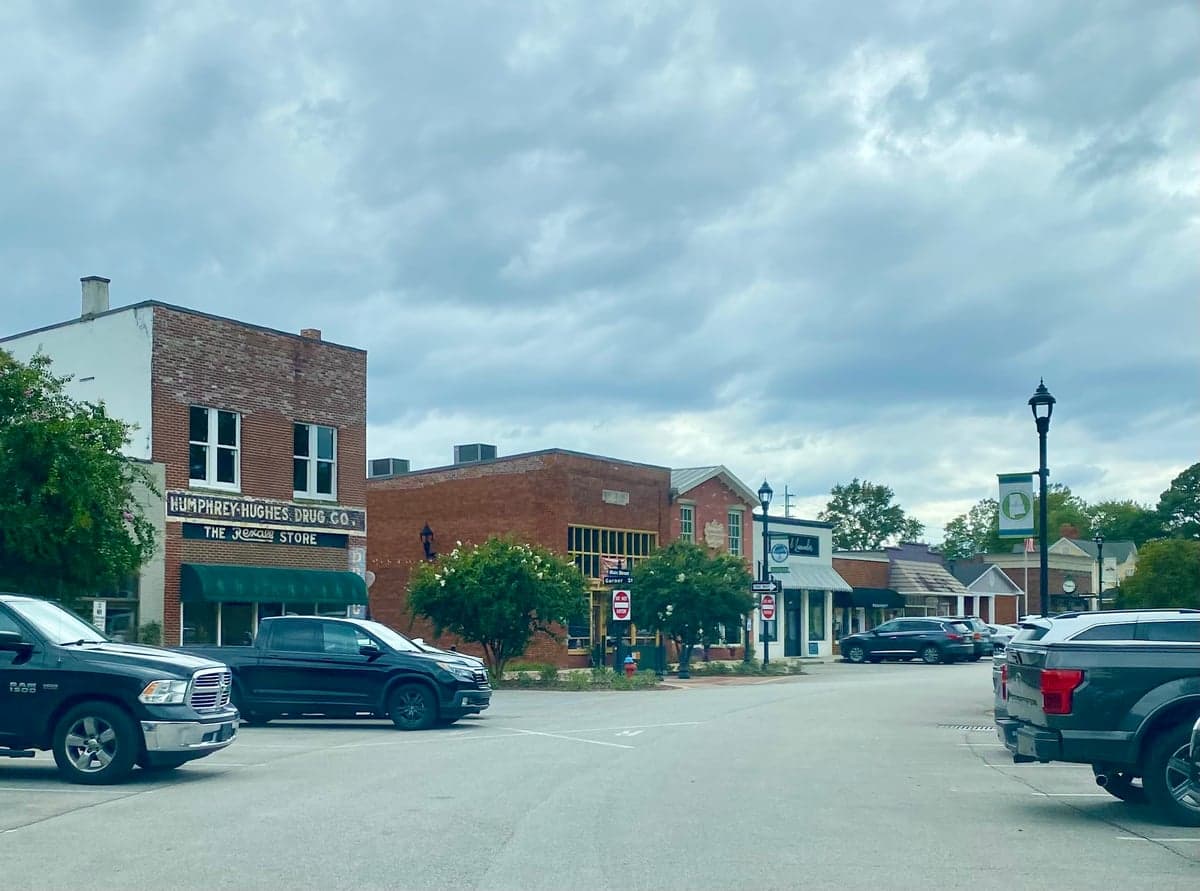
Photo: Wikipedia
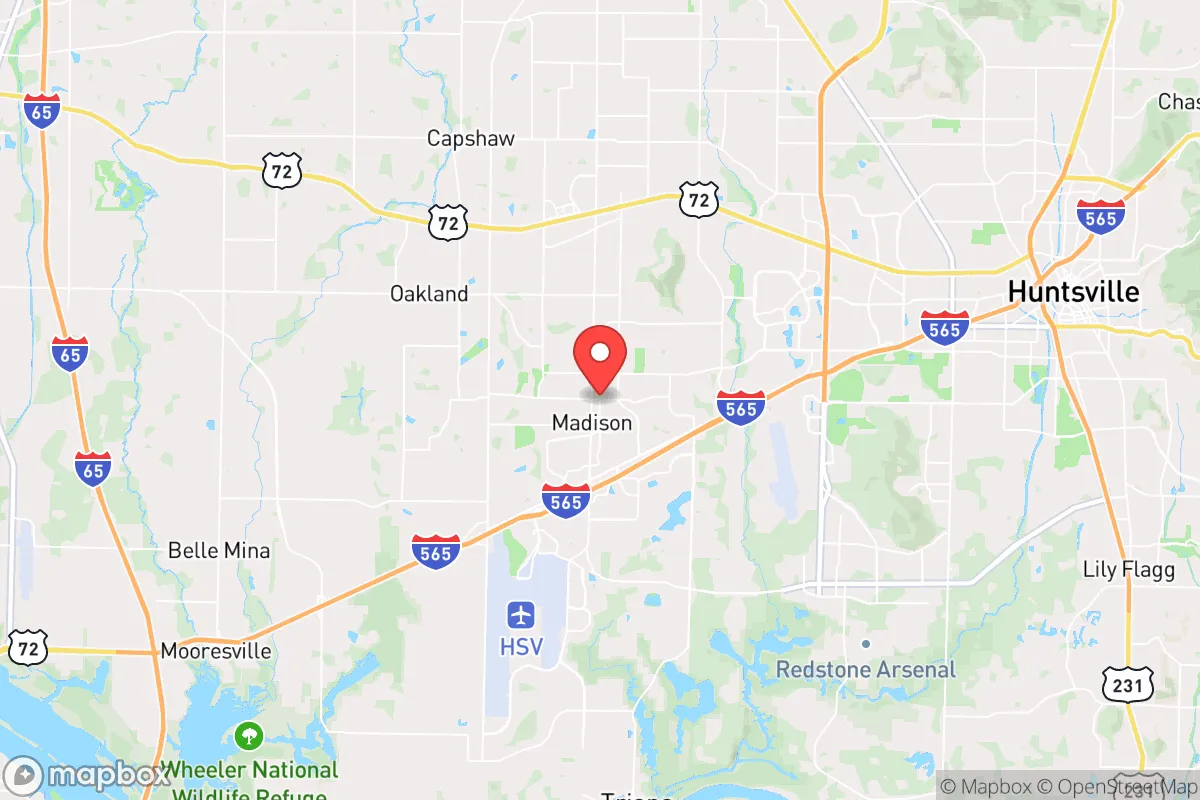
Strategic Assessment of Madison, AL
Meaningful friction. Expect exposure to either population pressure, blast zones, or natural disaster risk. Consider buying a retreat property.
What does the Strategic Assessment tell us?
Our Strategic Assessment grades tactical survivability of an area. Major population centers, military targets, fallout zones, natural disasters, and border exposure all drive risk — lower exposure means a more defensible position in a crisis.
This is heavily inspired by Joel Skousen's Strategic Relocation book. Highly recommended you checkout the book ($)What does this tell us?
Our Strategic Assessment grades tactical survivability of an area. Major population centers, military targets, fallout zones, natural disasters, and border exposure all drive risk — lower exposure means a more defensible position in a crisis.
This is heavily inspired by Joel Skousen's Strategic Relocation book. Highly recommended you checkout the book ($)Strategic Pillars

Key Distances
Regional Safe Places
Below is our recommended "safe zones" in Alabama and the surrounding area based on our strategic heuristics. For most people, it's unrealistic to live in a “safe zone” full-time due to work, family or other personal reasons. They tend to be more rural. However, many of these areas are perfect for second homes and retreat properties that double as a vacation home or even a short-term rental.
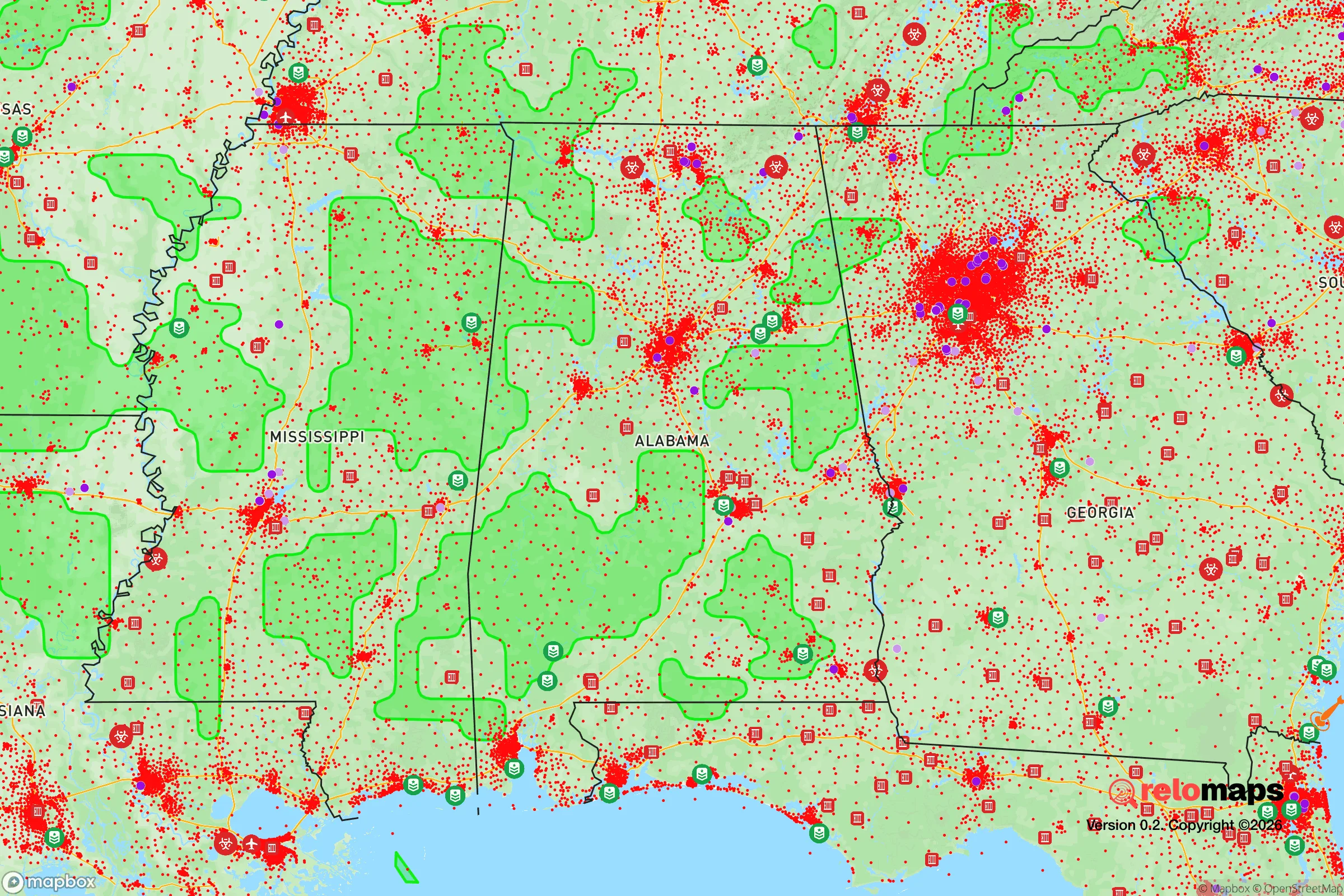
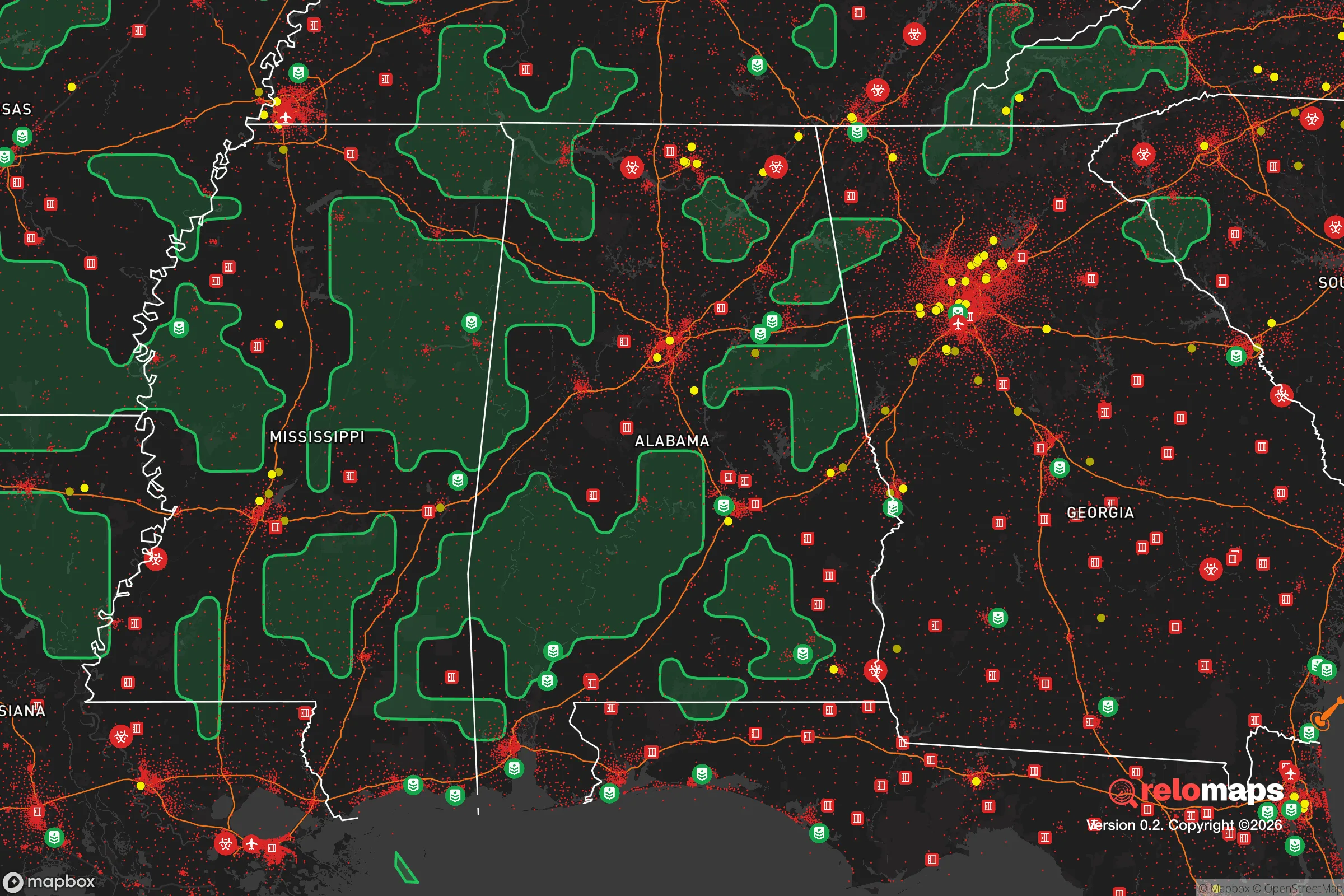


Important Note: For informational purposes only. This does not mean nothing bad ever happens in the green zones. Please use common sense. This is based on public data and modeled with AI. We tried to take a conservative approach but mistakes happen. We update this regularly as new information becomes available.
Solar Generator Recommendations
Backup power matters more here than in safer locations. We've picked three solar generators across budgets and capacity tiers — start with the budget unit if you only need a few essentials, or step up if you want to run a fridge and HVAC for days at a time.

Jackery Portable Power Station Explorer 300
Budget OptionPower on the Go: Weighing only 11 lbs, it's convenient to set up and store with book-sized foldable solar panels

BLUETTI Portable Power Station AC180
Designed for both indoor and outdoor scenarios, AC180 is highly capable as it has a robost capacity and continuous output power.

EF ECOFLOW DELTA Pro Ultra Power Station
Upgraded PickEcoFlow DELTA Pro Ultra is a whole-home energy system designed to grow with your family. Integrated with the Smart Home Panel 2, it scales to meet your evolving energy needs — keeping your home powered, intelligent, and secure through every stage of life.
We earn a commission, at no additional cost to you.
Strategic Assessment Analysis
Madison, Alabama, sits in a deceptive pocket of the Tennessee Valley that offers genuine strategic depth for those thinking through long-term resilience, but it’s not without serious trade-offs. The city’s position on the southern edge of the Huntsville metro gives it access to a robust defense and aerospace economy—Redstone Arsenal, NASA’s Marshall Space Flight Center, and Cummings Research Park are all within a 15-minute drive—which means the local population is disproportionately composed of engineers, military personnel, and security-cleared professionals. That demographic reality creates a community that is, on the whole, more self-reliant, better organized, and less prone to the kind of civic unraveling you’d see in a typical Sun Belt sprawl suburb. For a relocator with a prepper or survivalist mindset, Madison offers a rare combination: a place where the local economy is tied to national security infrastructure, where the population is armed and competent, and where the physical geography provides meaningful natural buffers. But the same proximity to high-value federal assets that makes the area economically stable also makes it a potential target in a major conflict, and that tension is the central strategic question anyone considering this move needs to weigh.
Geographic position and natural advantages for long-term security
Madison’s location at the intersection of I-565 and I-65 places it roughly 90 miles from the Tennessee state line and 100 miles from the Georgia border, giving you multiple evacuation corridors in three directions if you need to move. The Tennessee River runs just south of the city, and the Wheeler Lake and Wilson Lake reservoirs provide a massive freshwater resource that is less vulnerable to drought than the shallower aquifers further west. The area sits on the Cumberland Plateau’s southern fringe, with rolling hills and limestone bedrock that offer decent groundwater potential if you’re drilling a well—typical yields in Madison County run 10 to 30 gallons per minute, which is workable for a household with careful management. The local topography is not mountainous, but it’s not flat either; the gentle ridges and creek valleys provide enough cover to make a rural homestead defensible without being so rugged that travel becomes a problem. The climate is humid subtropical, with hot summers and mild winters, which means you can grow food year-round with season extension techniques—the average growing season is about 220 days, from late March through early November. That’s a real advantage for anyone serious about food independence. The area is also far enough inland that hurricane storm surge is not a concern, and tornado risk, while real, is lower than in the Plains or the Deep South’s “Dixie Alley” corridor further west.
Risks, exposures, and proximity to fallout-relevant landmarks
The single biggest strategic liability for Madison is its proximity to Redstone Arsenal, which is a primary center for U.S. Army aviation, missile defense, and space command operations. In a major conventional conflict or a nuclear exchange, Redstone is a high-priority target. The arsenal’s chemical demilitarization facility and its stockpile of rocket propellants and munitions also create a secondary hazard—an accidental explosion or a deliberate strike could produce toxic plumes that would affect Madison depending on wind direction. The city is roughly 10 miles from the arsenal’s main gate, which puts it inside the moderate damage zone for a ground-level nuclear detonation of a moderate-yield weapon. That’s not a comfortable distance. Additionally, Huntsville International Airport, which shares a runway with the arsenal, is a dual-use facility that could become a military logistics hub in a crisis, increasing the area’s target profile. On the civil unrest front, Huntsville itself is a growing city of over 220,000, and while it’s not a high-crime urban center, the typical risks of a mid-sized Southern city apply—property crime, occasional protests, and the potential for supply chain disruptions that hit the metro area harder than the rural periphery. Madison’s suburban character means you’re not in the direct line of fire for most urban problems, but you’re close enough that a major event in Huntsville would spill over. The Tennessee River crossings (I-565 bridge, US-72 bridge) are chokepoints that could become impassable in a mass evacuation scenario, so your route planning needs to account for secondary crossings like the Mooresville Road bridge or the Triana bridge to the west.
Practical resilience for a relocator: food, water, energy, and defensibility
For a relocator looking to set up a resilient household, Madison offers a mixed bag. The city itself is a standard suburban grid with HOA neighborhoods, strip malls, and a downtown that’s more boutique than functional. That means most residential lots are small—quarter-acre to half-acre—which limits your ability to garden, raise livestock, or store supplies discreetly. If you want serious self-sufficiency, you need to look at the unincorporated areas north of Madison along County Road 53 or west toward the Limestone County line, where you can find 5- to 20-acre parcels with fewer restrictions. Water is the strongest local resource: the Tennessee River is a massive, reliable surface water source, and the local utility (Madison Utilities) draws from the river and treats it to high standards. For off-grid backup, a well is the best bet, but you’ll need to budget $5,000 to $10,000 for drilling and pump installation, and you should test for the region’s common issues—hardness, iron, and occasional radon. Rainwater catchment is viable here, with average annual rainfall of about 54 inches, so a 1,000-square-foot roof can yield roughly 30,000 gallons per year. Energy is less favorable: the grid is served by Huntsville Utilities and TVA, which is a stable provider but heavily reliant on natural gas and nuclear (Browns Ferry is about 30 miles west). Solar is workable—the area gets about 4.5 peak sun hours per day—but the tree cover in many neighborhoods reduces panel efficiency. Battery backup and a generator are essential if you want to maintain power through the occasional ice storms and summer thunderstorms that knock out lines. Defensibility is moderate: the suburban layout means you have neighbors close by, which is a double-edged sword. In a breakdown scenario, that density makes it hard to secure a perimeter, but it also means you have potential allies if you’ve built relationships. The local gun culture is strong—Madison County has a high rate of concealed carry permits—and the sheriff’s office is generally pro-Second Amendment, which matters for legal context. The biggest practical gap is food storage: the area has no major grain elevators or food processing hubs, so you’re dependent on the supply chain that runs through Huntsville’s distribution centers. A three-month supply of staples is the minimum anyone should consider here.
Overall, Madison is a solid B+ for a strategic relocation if your primary concern is economic stability and community competence, but it’s a C+ if you’re planning for a long-term collapse scenario where proximity to a military target becomes a fatal liability. The best play for a prepper-minded relocator is to buy land in the rural fringe—north of Madison toward Athens or west toward Rogersville—while maintaining a job or business connection to the Huntsville economy. That gives you the income stability of the defense sector without being in the blast radius. The local population is generally conservative, educated, and armed, which creates a social environment that’s more resilient than most. But don’t kid yourself: if the balloon goes up, Madison is close enough to ground zero that you’ll want to have a bug-out plan that puts you 50 miles north or east within the first hour. The Tennessee River is your friend for water and your enemy for mobility—know your crossing points, keep your tank full, and don’t assume the interstate will be open. If you can live with that tension, Madison is a viable base of operations. If you can’t, look further into the Appalachian foothills.

* Values derived from national, state, county, city and local statistics and may differ in a specific area. Last updated: 2026-04-19T18:56:38.000Z
Narrative content on this page is AI-generated and may contain mistakes. Verify any details that matter before acting on them.
ReloMaps may earn a commission from affiliate links at no extra cost to you.

