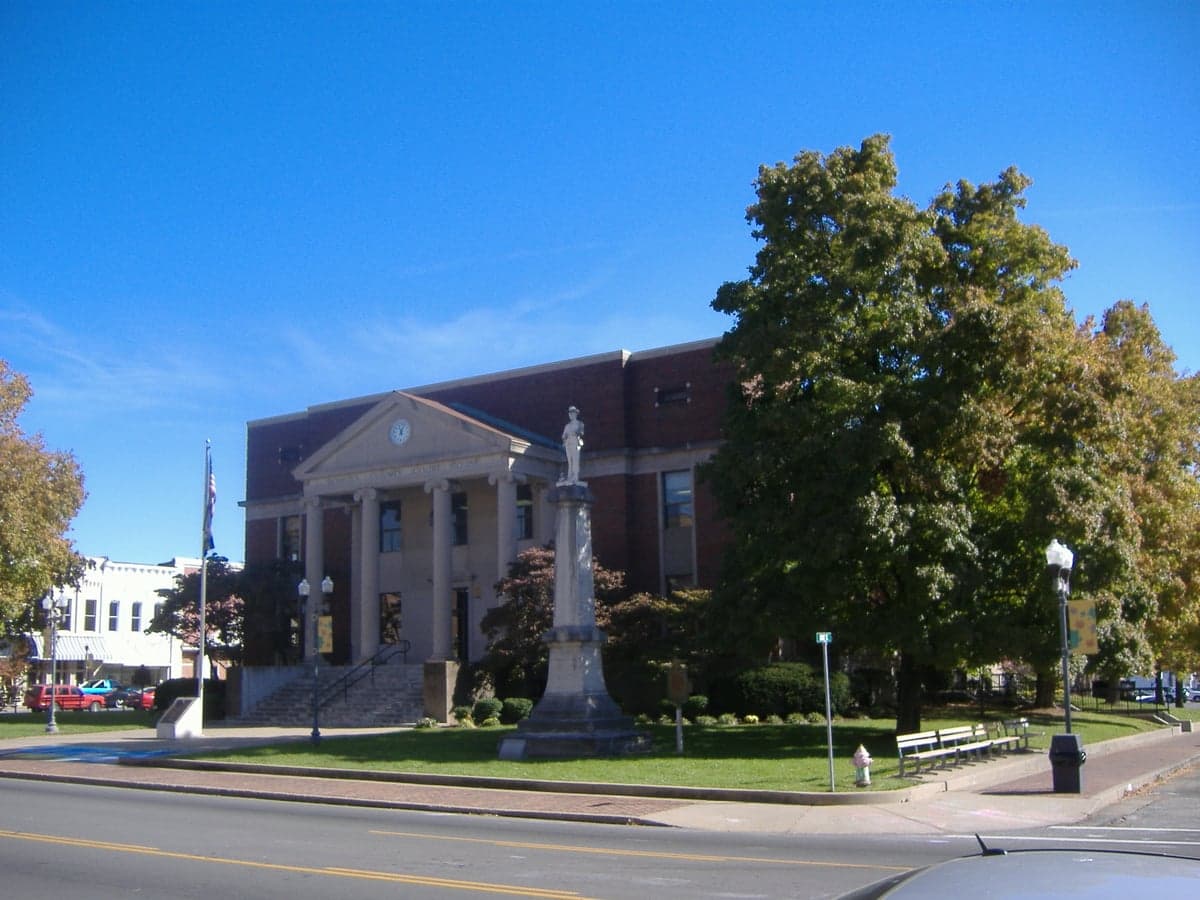
Photo: Wikipedia
Demographics of Madisonville, KY
Affluence Level in Madisonville, KY
A below-average socioeconomic profile. Incomes, home values, and educational attainment trail the U.S., with higher poverty and unemployment.
People of Madisonville, KY
Madisonville, Kentucky, is a city of 19,442 residents where the population is predominantly white (77.3%) and native-born, with a foreign-born share of just 2.5%. The city’s character is shaped by its history as a coal and railroad hub, a regional medical and retail center, and a community that has experienced modest diversification in recent decades. Its identity is rooted in a stable, family-oriented culture with a strong sense of local tradition, reflected in its relatively low college attainment rate of 22.3% and a demographic profile that remains overwhelmingly non-Hispanic white.
How the city was settled and grew
Madisonville’s population history begins with its founding in 1807 as the seat of Hopkins County, named for early settler James Madison. The original population was drawn by land grants and the fertile soil of the Western Kentucky coalfields. The arrival of the railroad in the late 19th century transformed the town into a commercial and transportation hub, attracting a wave of European immigrants—primarily Irish and German laborers—who built the rail lines and settled in the West End and South Main Street areas. These neighborhoods, characterized by modest frame houses and proximity to the tracks, became the city’s first ethnic enclaves. By the early 20th century, coal mining booms drew additional white migrants from rural Appalachia and the Upper South, who established themselves in the North Side and East End districts, where company-built housing and union halls anchored working-class life. The African American population, which has historically hovered around 11-12%, traces its roots to the post-Civil War era, when freedmen moved to the area for work in agriculture and later in the mines. They concentrated in the Briarwood and West Broadway corridors, where churches and small businesses formed the backbone of a tight-knit community. Through the mid-20th century, Madisonville remained a predominantly white, native-born town, with its growth tied to coal, the railroad, and the expansion of regional retail and healthcare.
Modern era (post-1965)
After the 1965 Hart-Cellar Act, Madisonville saw minimal direct immigration, as the city’s economy—centered on coal, manufacturing, and healthcare—did not attract the large-scale foreign-born flows seen in larger metros. The foreign-born share remains at just 2.5%, with the largest group being Hispanic (4.2% of the total population), many of whom arrived in the 1990s and 2000s for work in construction, poultry processing, and agriculture. These families have settled primarily in the South Side and West End neighborhoods, where affordable housing and proximity to industrial employers are available. The East/Southeast Asian community (0.9%) is small and largely composed of Vietnamese and Filipino families, many connected to the regional healthcare system or local manufacturing plants; they are scattered across the North Side and newer subdivisions near the bypass. The Black population (11.6%) has remained stable, with families concentrated in the historic Briarwood and West Broadway areas, though some have moved into newer developments in the East End. The Indian subcontinent population is effectively zero (0.0%), reflecting the absence of a tech or academic sector that typically draws that group. Domestic in-migration has been modest, with most new residents coming from other parts of western Kentucky or neighboring states, drawn by the lower cost of living and jobs at Baptist Health Madisonville and the local industrial base. Suburbanization has been limited, but newer subdivisions like Lakeview Estates and Woodland Hills have attracted middle-class white families seeking newer housing, while older neighborhoods like the West End have seen some white flight and aging populations.
The future
Madisonville’s population is likely to remain stable or experience slight decline, mirroring trends across much of rural western Kentucky. The city is not homogenizing into a single enclave but rather tribalizing along income and housing age lines, with newer subdivisions drawing younger families and older neighborhoods aging in place. The Hispanic community is the only immigrant group showing growth, though from a very small base, and is likely to continue expanding slowly as families reunite and new workers arrive for agricultural and service jobs. The Black population is expected to remain steady, with some movement into newer housing as older neighborhoods age. The East/Southeast Asian community is likely to remain tiny, as the city lacks the professional job base that attracts larger Asian populations. The white population will continue to dominate, but with an aging demographic profile, as younger adults often leave for college or jobs in larger cities. The next 10-20 years will likely see Madisonville become slightly more Hispanic, slightly older, and slightly more suburban in its housing patterns, but it will remain a predominantly white, native-born, and culturally conservative community.
For someone moving in now, Madisonville offers a stable, low-cost environment with a strong sense of local identity and minimal demographic change. The city is becoming a quieter, more residential version of itself, with growth concentrated in a few newer subdivisions and the Hispanic community slowly expanding. It is not a place of rapid diversification or cultural flux, but rather a community where tradition and continuity remain the dominant themes.

* Values derived from national, state, county, city and local statistics and may differ in a specific area. Last updated: 2026-04-21T09:22:06.000Z
Narrative content on this page is AI-generated and may contain mistakes. Verify any details that matter before acting on them.
ReloMaps may earn a commission from affiliate links at no extra cost to you.

