
Photo: Wikipedia
Political ClimatePolitical Climate in Madisonville, KY
District shown is the primary district for this city’s centroid. Cities may span multiple districts.
Local Political AnalysisPolitical Analysis of Madisonville, KY
Madisonville, Kentucky, sits solidly in the red, with a Cook PVI of R+23, meaning the area votes about 23 points more Republican than the national average. That’s not just a number on a map—it’s a reflection of a community that has long valued local control, personal responsibility, and a government that stays out of your business. Over the past decade, the political lean here has only hardened, as folks have watched neighboring towns like Bowling Green or even Owensboro drift a little more purple. Madisonville, by contrast, has held the line, with most local elections decided in the primary and national candidates rarely bothering to campaign here because the outcome is a foregone conclusion.
How it compares
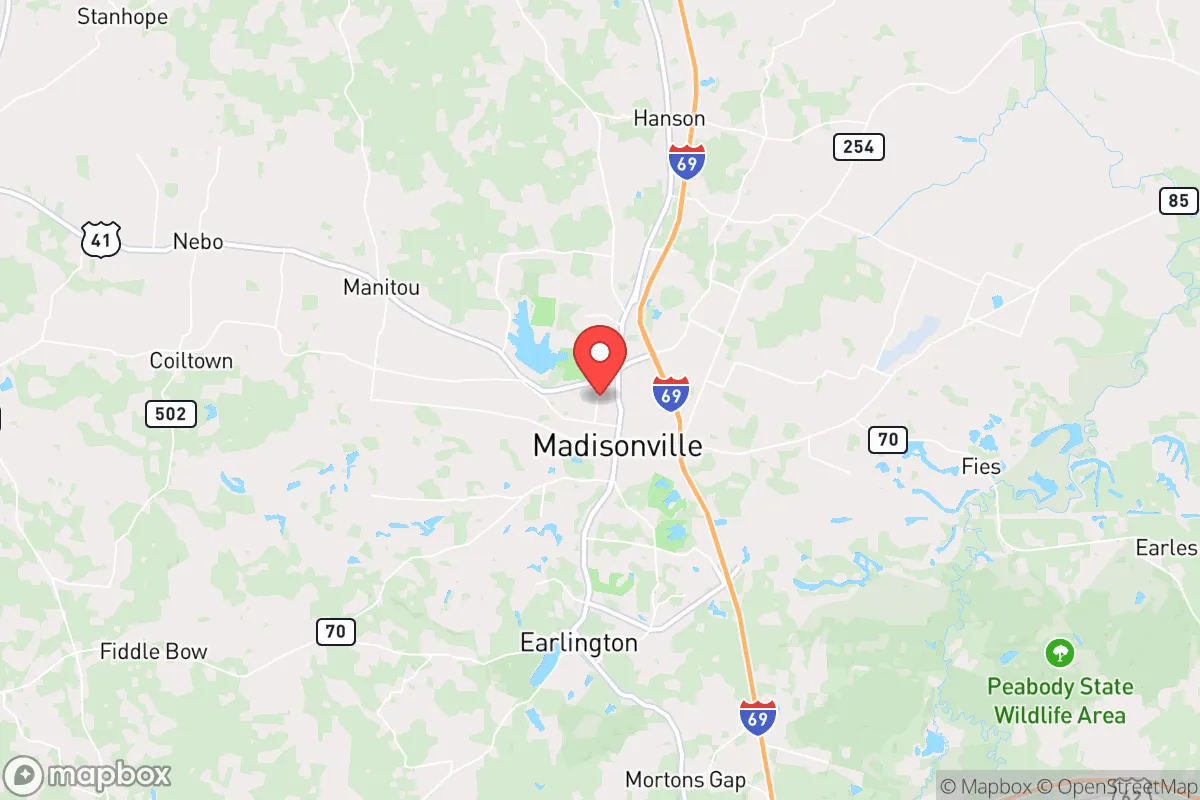
Drive 30 minutes east to Hopkinsville, and you’ll feel a slight shift—still conservative, but with a more moderate, military-influenced vibe thanks to Fort Campbell. Head north to Evansville, Indiana, and you’re in a blue-collar city that’s trended bluer in recent years, especially in the urban core. But Madisonville? It’s surrounded by small towns like Earlington and Mortons Gap that share the same values: low taxes, minimal zoning, and a general distrust of state or federal mandates. The contrast is sharpest when you look at school board races or county commission decisions—Madisonville consistently votes against tax hikes and new regulations, while nearby cities have occasionally flirted with progressive policies like diversity initiatives or climate action plans. That’s not happening here, and most residents aim to keep it that way.
What this means for residents
For someone moving here, the political climate translates directly into daily life. You won’t see mask mandates or business shutdowns from the city council—they learned that lesson during COVID and aren’t eager to repeat it. Property taxes stay low, and there’s no city income tax, which is a big deal compared to states like Illinois or even parts of Indiana. The downside? If you’re hoping for big government-funded projects—like a new public transit system or a massive downtown renovation—you’ll be waiting a while. The prevailing attitude is that your money is yours, not the government’s, and that extends to everything from school funding to road repairs. Most residents prefer a slower, more organic approach to growth, even if it means fewer amenities, because it keeps outside interference at bay.
What sets Madisonville apart culturally
Culturally, Madisonville still feels like the old Kentucky—church potlucks, Friday night football, and a general wariness of anything that smells like “social engineering.” You’ll find a strong Second Amendment presence, with gun shops and shooting ranges doing steady business, and the local paper still runs editorials defending traditional values. That said, there’s a quiet concern among long-time residents about the long-term trajectory. As younger people leave for college and don’t always return, the population is aging, and some worry that outside transplants—especially those from more liberal states—could slowly shift the needle. For now, though, Madisonville remains a place where you can live your life without the government breathing down your neck, and that’s exactly how most folks here want it to stay.

State Political ClimatePolitical Climate in Kentucky
State Political AnalysisPolitical Environment in the State
Kentucky has long been a reliably red state in federal elections, but its political climate is more complex than a simple partisan label suggests. The state has voted for the Republican presidential candidate in every election since 2000, often by double-digit margins, with Donald Trump carrying it by 26 points in 2020 and 30 points in 2024. However, the state’s political trajectory over the past 20 years has been defined by a dramatic realignment: rural and suburban areas have shifted hard right, while the urban core of Louisville and Lexington have moved sharply left, creating a polarized landscape that feels like two different states under one capitol dome.
Urban vs. rural divide
The political map of Kentucky is a study in contrasts. The state’s two major metros—Louisville (Jefferson County) and Lexington (Fayette County)—are Democratic strongholds that have only grown bluer. In 2024, Jefferson County voted for Kamala Harris by roughly 18 points, while Fayette County went for her by about 15 points. These cities are home to the University of Louisville, the University of Kentucky, and a growing professional class that leans progressive on social issues. Drive 30 minutes outside either city, however, and the landscape flips completely. Rural counties like Pike, Floyd, and Harlan in the eastern coalfields, once reliably Democratic due to union ties, have swung hard Republican over the past decade. In 2024, Pike County voted for Trump by 70 points. The suburban ring counties around Louisville—Oldham, Shelby, and Bullitt—are also deeply red, with Oldham County voting +40 for Trump. The western part of the state, including the Purchase area around Paducah and the Pennyrile region around Hopkinsville, is solidly Republican, though the Jackson Purchase area has a few pockets of Democratic strength in majority-Black precincts. The Bluegrass region, outside Lexington, is a mix of horse-farm wealth and small towns that lean conservative, with counties like Woodford and Bourbon voting Republican but by narrower margins than their rural neighbors.
Policy environment
Kentucky’s policy environment has shifted decisively rightward over the past decade, driven by a Republican supermajority in the state legislature that has been in place since 2017. The state has a flat income tax rate that was cut from 5% to 4% in 2023, with a scheduled phase-down to 3.5% by 2026, and the legislature has signaled a goal of eventually eliminating the income tax entirely. Property taxes remain low, with no state-level property tax and local rates averaging around 0.8% of assessed value. The regulatory posture is business-friendly, with right-to-work laws on the books since 2017 and a tort reform system that caps non-economic damages in medical malpractice cases. On education, Kentucky has expanded school choice through charter school legislation passed in 2022, though implementation has been slow due to local opposition in Louisville and Lexington. The state also passed a universal school choice tax credit program in 2024, allowing families to use state funds for private school tuition or homeschooling expenses. Healthcare policy is a mixed bag: Kentucky expanded Medicaid under the Affordable Care Act in 2014, but the state has since imposed work requirements for able-bodied adults (currently tied up in court). Election laws have tightened, with voter ID requirements enacted in 2020 and a 2021 law that reduced early voting days and limited absentee voting. The state does not have a state-level mask or vaccine mandate, and the legislature passed a 2023 law prohibiting local governments from imposing such mandates in the future.
Trajectory & freedom
On the freedom front, Kentucky has been moving in a decidedly libertarian-leaning direction over the past five years, though not without some concerning backsliding. The state passed constitutional carry (permitless concealed carry) in 2019, and in 2024 expanded gun rights by preempting local ordinances that attempted to regulate firearms in public parks and government buildings. Parental rights were strengthened with a 2022 law requiring schools to notify parents of any curriculum involving human sexuality, and a 2023 law banning gender transition procedures for minors. Medical autonomy has seen a mixed record: the state banned nearly all abortions in 2022 with a trigger law that took effect after Dobbs, with no exceptions for rape or incest, which has been a flashpoint. On the other hand, Kentucky has not imposed any COVID-19 vaccine mandates on private businesses or schools, and the legislature passed a 2023 law prohibiting employers from requiring vaccines as a condition of employment. Property rights remain strong, with no state-level zoning mandates and a 2022 law limiting the ability of local governments to impose rent control. The biggest red flag for freedom-minded residents is the state’s heavy reliance on federal funding—Kentucky receives about 45% of its state budget from Washington, which creates vulnerability to federal policy shifts. Additionally, the state’s alcohol control laws remain among the most restrictive in the nation, with 40 of 120 counties still dry or partially dry as of 2024.
Civil unrest & political movements
Kentucky has seen its share of political turbulence, most notably the 2020 protests in Louisville following the death of Breonna Taylor, which resulted in several nights of unrest, property damage, and the eventual passage of a statewide police reform bill (Breonna’s Law) that banned no-knock warrants. The state has a small but vocal progressive activist network centered in Louisville and Lexington, focused on criminal justice reform and environmental issues, particularly opposition to the Mountain Valley Pipeline. On the right, the Kentucky Freedom Coalition and local Tea Party groups remain active, pushing for further tax cuts, school choice expansion, and election integrity measures. Immigration politics are relatively muted in Kentucky, as the state has a foreign-born population of only about 4%, but there have been flashpoints over refugee resettlement in Louisville, which has a sizable Burmese and Somali community. There is no serious secession or nullification movement, though some rural counties have passed symbolic resolutions asserting local control over federal land management. Election integrity has been a persistent issue since 2020, with the state’s Republican secretary of state, Michael Adams, drawing criticism from both sides for expanding early voting while also implementing voter ID. The most visible political flashpoint for a new resident would likely be the ongoing debate over abortion, with the state’s near-total ban creating a stark divide between urban and rural attitudes.
Projection
Over the next 5-10 years, Kentucky is likely to continue its rightward drift on fiscal and cultural issues, but with growing tension between the urban and rural populations. In-migration patterns are modest—Kentucky gains about 10,000 net new residents per year, mostly from neighboring states like Ohio, Indiana, and Tennessee—and these newcomers tend to be conservative-leaning families seeking lower taxes and a slower pace of life. The Louisville and Lexington metros will continue to attract younger, more progressive residents, but the state legislature’s Republican supermajority is likely to remain intact due to gerrymandering and the rural tilt of the state senate. Expect further income tax cuts, expanded school choice, and continued resistance to federal mandates on climate, healthcare, and education. The wild card is the state’s aging population—Kentucky has one of the oldest median ages in the country at 39.5—which could slow the pace of cultural change. A new resident moving in now should expect a state that is broadly conservative in policy but with two liberal islands that dominate media coverage and cultural conversation. The practical takeaway: if you want low taxes, strong gun rights, and minimal government interference in your personal life, Kentucky is a solid bet, but you’ll need to be comfortable with the fact that the state’s urban centers will feel like a different country politically.
For a new resident, the bottom line is that Kentucky offers a high degree of personal freedom on most fronts—taxes are low and falling, gun rights are robust, and the state government is actively pushing back against federal overreach. However, the trade-off is a state that is deeply divided between its two major cities and everything else, with the urban areas pushing progressive policies that the rural majority resists. If you’re looking for a place where your values are reflected in state law and where you can live largely unbothered by government mandates, Kentucky is a strong choice—just be prepared to drive past a lot of “Let’s Go Brandon” flags on the way to the grocery store.
* Values derived from national, state, county, city and local statistics and may differ in a specific area. Last updated: 2026-04-21T09:22:06.000Z
Narrative content on this page is AI-generated and may contain mistakes. Verify any details that matter before acting on them.
ReloMaps may earn a commission from affiliate links at no extra cost to you.

