
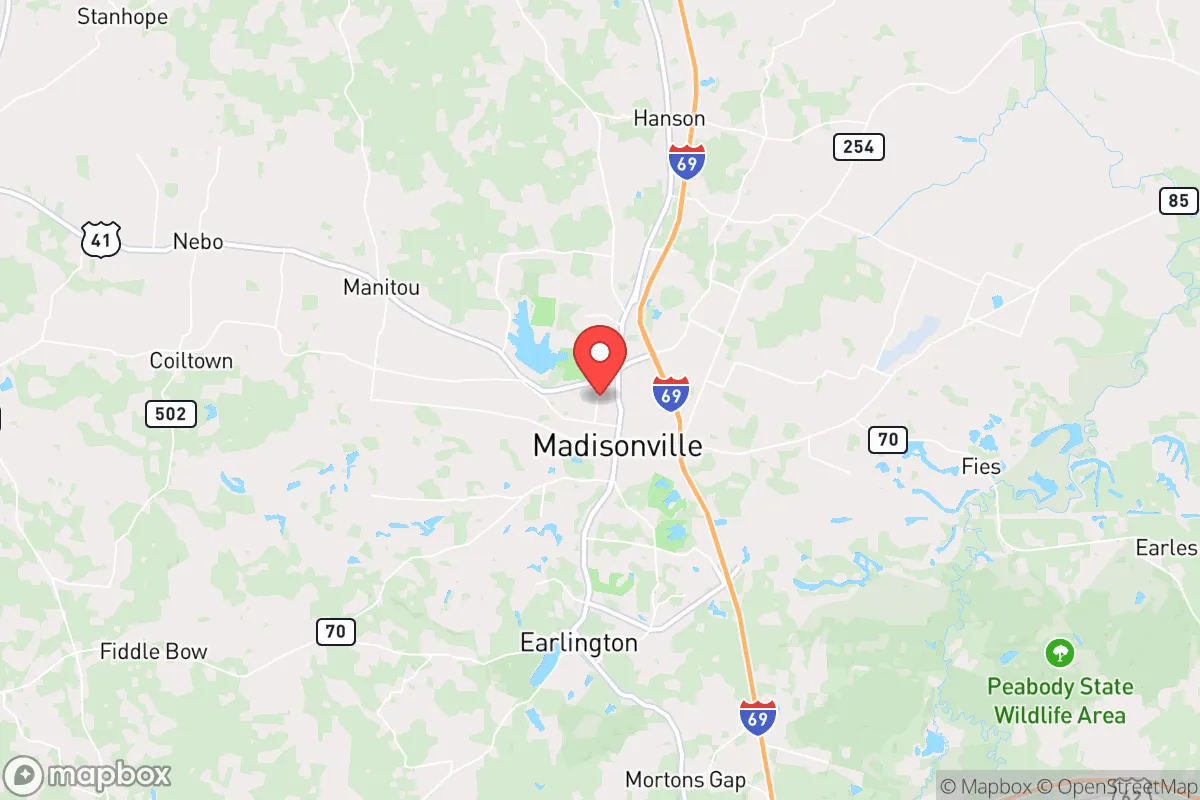
Photo: Wikipedia
Personal Sovereignty in Madisonville, KY
Viable for self-reliance. Generally workable, though some barriers may limit total independence.
What does Personal Sovereignty tell us?
Personal Sovereignty measures your capacity for self-reliance and independence with minimal government friction. Higher scores mean fewer barriers between you and the way you want to live... but it assumes you have the space you need and good neighbors.
What does this tell us?
Personal Sovereignty measures your capacity for self-reliance and independence with minimal government friction. Higher scores mean fewer barriers between you and the way you want to live... but it assumes you have the space you need and good neighbors.
State Policy
Energy independence: Importer (60% of energy produced in-state)
Personal Liberty
Homesteading

Personal Liberty Analysis
Madisonville, Kentucky offers a notably high degree of personal sovereignty, particularly for those seeking to minimize government entanglement in daily life. As a strategic relocation point for conservative-minded individuals and families, the city sits within a state that has consistently pushed back against federal overreach, maintaining strong protections for gun rights, parental authority, and property use. While no location is a perfect libertarian enclave, Hopkins County provides a legal and cultural environment where self-reliance is not just tolerated but expected, making it a serious consideration for preppers and those prioritizing autonomy.
Tax burden and regulatory posture: How Kentucky compares to high-tax states
Kentucky’s tax structure is a major draw for those fleeing high-tax states like California, Illinois, or New York. The state has been on a deliberate path to reduce income tax, with a flat rate of 4.5% in 2026 and a scheduled phase-down to 4.0% by 2028. There is no state tax on Social Security benefits, and military pensions are fully exempt, which matters for retirees or those planning a long-term independent lifestyle. Property taxes in Hopkins County are among the lowest in the nation, with an effective rate around 0.72% of assessed value—meaning a $200,000 home carries an annual tax bill of roughly $1,440. Sales tax is a flat 6%, with no local add-ons, and groceries are exempt. On the regulatory side, Kentucky is a right-to-work state with minimal business licensing hurdles. The state’s building codes are less restrictive than many coastal areas, and there is no state-level rent control or energy mandate that would interfere with off-grid setups. For a prepper, the key takeaway is that the state government generally stays out of your wallet and your property decisions, though local zoning in Madisonville proper can impose some limits on things like livestock or accessory structures—more on that below.
Self-defense and gun law specifics: Constitutional carry and castle doctrine
Kentucky is a gold standard for gun rights, and Madisonville reflects that reality. The state has permitless constitutional carry for both open and concealed carry for anyone 21 or older who can legally possess a firearm. There is no state-level waiting period, no magazine capacity ban, and no firearm registration. The Castle Doctrine is codified in Kentucky law, meaning you have no duty to retreat in your home, vehicle, or place of business before using deadly force if you reasonably believe it’s necessary to prevent death, great bodily harm, or a felony. Stand Your Ground protections extend to any place you are lawfully present. For preppers, this means you can keep a defensive rifle in your truck or a sidearm on your hip without jumping through bureaucratic hoops. Hopkins County Sheriff’s Office is known for a pro-2A stance, and local gun ranges like the Western Kentucky Gun Club are active. The only practical limitation is that Kentucky does not honor all out-of-state permits for non-residents, but if you establish residency, you’re covered. For those concerned about federal overreach, Kentucky passed a Second Amendment Sanctuary resolution in 2020, signaling local resistance to any future federal gun bans.
Self-reliance and homesteading viability: Lot sizes, zoning, and off-grid feasibility
Madisonville itself is a small city of about 19,000, but the surrounding Hopkins County offers significant opportunities for self-reliance. Inside city limits, zoning is more restrictive: residential lots typically require at least 6,000 square feet, and keeping chickens or goats may require a permit or be limited to certain zones. However, the real opportunity lies just outside town. Unincorporated Hopkins County has no county-wide zoning, meaning you can buy a 1- to 5-acre parcel and do what you want with it—raise livestock, build a workshop, install solar panels, or drill a well. The county’s agricultural exemption makes it easy to classify land as a farm for tax purposes with as little as 5 acres in active use. Off-grid feasibility is high: Kentucky has no state law prohibiting rainwater collection, and solar panel installation is straightforward with no punitive net metering policies. The local climate supports year-round gardening, and the soil in the region is decent for row crops. For a prepper, the biggest hurdle is finding a property with a reliable well and septic system already in place, but many rural listings include both. The county’s building permit process is minimal for owner-built structures, though you’ll need to comply with basic electrical and septic codes for insurance purposes. Overall, the area is a strong candidate for a homesteading lifestyle if you avoid the city’s more regulated zones.
Personal liberties: Parental rights, medical autonomy, speech, and property
Kentucky has been a battleground for parental rights, and the current legal environment is favorable. The state’s 2022 “Parents’ Bill of Rights” (HB 563) requires schools to notify parents of any medical or mental health services offered to students and prohibits schools from withholding information about a child’s well-being. This is a concrete protection for parents who want to stay informed about what their children are exposed to. Medical autonomy is more mixed: Kentucky has strict vaccine mandates for school attendance (though religious exemptions exist), and the state has not passed broad medical freedom laws like some western states. However, there is no state-level mandate for COVID-19 vaccines, and the state legislature has pushed back against federal health mandates. On speech, Kentucky is a solid First Amendment state with no notable prior restraint laws, and local government in Hopkins County tends to be hands-off regarding public expression. Property rights are strongly protected under Kentucky’s eminent domain laws, which require a public purpose and just compensation, and the state has no statewide rent control or landlord licensing schemes. For the survivalist mindset, the key concern is that Kentucky does have a state income tax (though declining) and a sales tax, but these are low relative to the services received. The state’s legal framework generally respects the individual’s right to make decisions about their health, their children, and their land without excessive interference from Frankfort or Washington.
In the broader landscape of American personal sovereignty, Madisonville and Hopkins County rank well above average. Compared to states like Oregon, New York, or Colorado, where zoning, gun laws, and tax burdens can crush self-reliance, Kentucky offers a refreshingly hands-off approach. The combination of constitutional carry, low property taxes, minimal zoning outside city limits, and strong parental rights creates a legal environment where a determined individual can live largely on their own terms. The trade-offs are real—Kentucky’s infrastructure is less developed, and the state’s reliance on coal and manufacturing means economic volatility—but for those prioritizing freedom over convenience, Madisonville is a serious contender. If you’re looking to escape the creeping control of federal and state overreach, this corner of western Kentucky deserves a hard look.

* Values derived from national, state, county, city and local statistics and may differ in a specific area. Last updated: 2026-04-21T09:22:06.000Z
Narrative content on this page is AI-generated and may contain mistakes. Verify any details that matter before acting on them.
ReloMaps may earn a commission from affiliate links at no extra cost to you.

