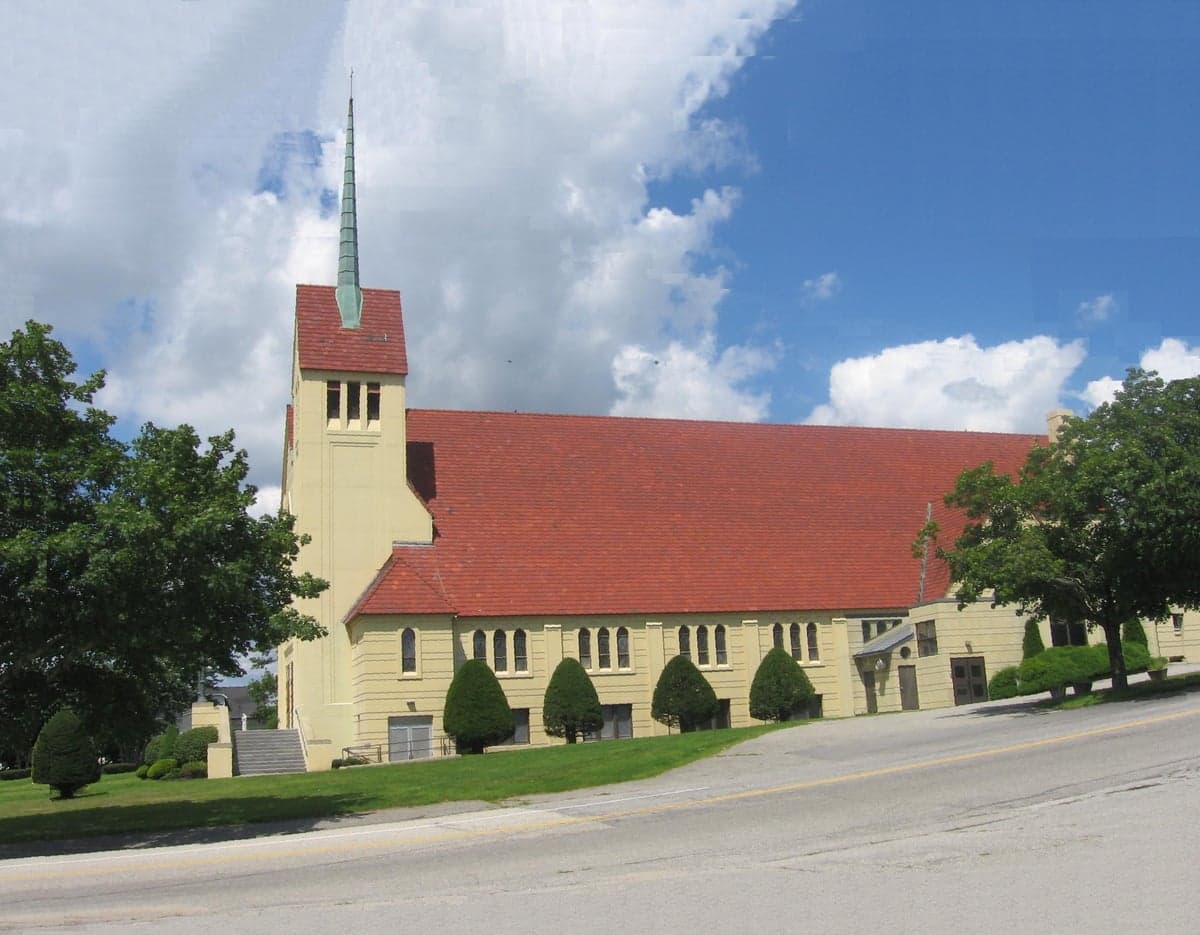
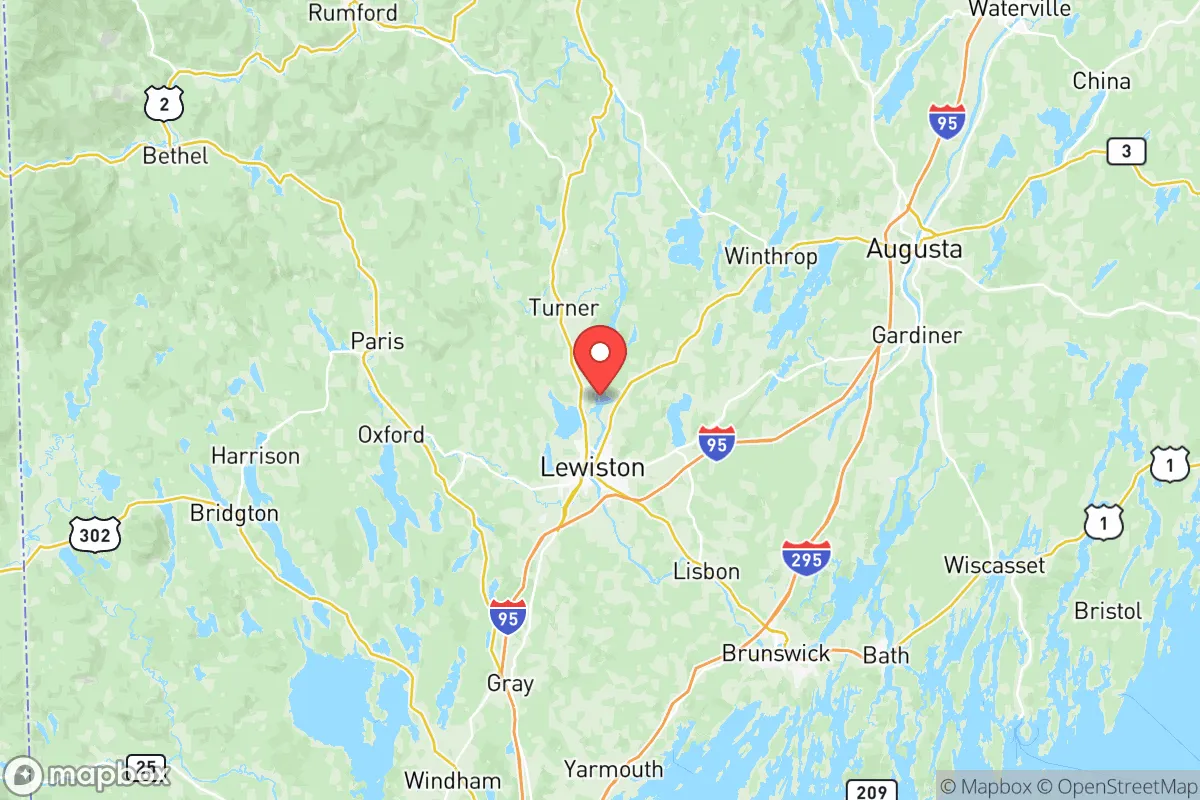
Photo: Wikipedia
Demographics of Androscoggin County
Affluence Level in Androscoggin County
A middle-class area roughly in line with national averages across income, home values, education, and employment.
People of Androscoggin County
The people of Androscoggin County, Maine today number 112,323, forming a predominantly white (88.2%) population that is notably less diverse than the national average, with a foreign-born share of just 2.5%. The county's identity remains rooted in its Franco-American heritage, a legacy of 19th-century mill migration, and a working-class character shaped by the textile and shoe industries that once dominated the Androscoggin River valley. Lewiston, the county seat and largest city, is the demographic anchor, while Auburn, Lisbon, and Sabattus form the surrounding communities where descendants of the original waves still concentrate. This is a region where the population has been stable to slightly declining in recent decades, and where the cultural markers — from French surnames to Catholic parishes to the annual Festival de Joie — remain visibly tied to the mill-era settlement patterns of the 1800s.
Settlement & growth (pre-1960)
Before European settlement, the area now known as Androscoggin County was the homeland of the Androscoggin people, an Eastern Abenaki tribe whose name means "river of rock shelters." They lived along the Androscoggin River, fishing for salmon and sturgeon and maintaining seasonal villages near present-day Lewiston and Auburn. The tribe was decimated by disease and warfare with English colonists in the 17th and early 18th centuries, and by 1725 the surviving Androscoggin had largely retreated to Canada, joining other Abenaki bands at Odanak and Bécancour in Quebec. The land was effectively depopulated of its original inhabitants by the time Anglo-American settlers began arriving after the French and Indian War.
The first permanent English-speaking settlers arrived in the 1770s and 1780s, primarily farmers of English and Scots-Irish stock from southern Maine and Massachusetts. They established the towns of Lewiston (incorporated 1795), Auburn (1842), and Lisbon (1799), building small agricultural communities along the river. For the first half-century, the population remained thin and rural — the entire county had fewer than 10,000 residents as late as 1820. The turning point came in the 1830s and 1840s, when the Androscoggin River's water power began attracting industrial capital. The Lewiston Falls were dammed, and the first textile mills opened, drawing a new population entirely different from the Yankee farmers.
The single most transformative migration in Androscoggin County's history was the arrival of French Canadians from Quebec, beginning in the 1840s and accelerating through the 1880s. These were primarily rural Quebecois families — farmers and laborers from the parishes of Beauce, Lotbinière, and Kamouraska — who crossed the border seeking mill work. They settled in dense, self-contained neighborhoods in Lewiston's "Little Canada" district, around the Bates Mill complex, and in Auburn's New Auburn neighborhood. By 1900, French Canadians and their descendants made up roughly 60% of Lewiston's population, making it one of the most concentrated Franco-American communities in New England. The immigrants built their own Catholic parishes — Saints Peter and Paul in Lewiston, St. Louis in Auburn — and maintained French-language schools and newspapers well into the 20th century. The textile mills of Lewiston and the shoe factories of Auburn and Lisbon employed generations of these families, creating a distinct Franco-American working-class culture that still defines the county's character.
A smaller but significant wave of Irish immigrants arrived in the 1850s and 1860s, also drawn by mill and railroad construction jobs. They settled primarily in Lewiston's "Irish Hill" neighborhood and in Auburn, establishing St. Joseph's Parish. Unlike the French Canadians, who arrived as families and maintained their language, the Irish assimilated more quickly into English-speaking society. By 1900, the Irish population was a visible minority within the county's Catholic community, which was overwhelmingly Franco-American. Other immigrant groups were minimal — a handful of German and Polish families, some Swedish woodworkers — but never formed the kind of concentrated enclaves seen in other New England mill cities. The county's population peaked at roughly 115,000 in the 1960s, just as the textile industry began its long decline.
Modern era (post-1965)
The post-1965 period in Androscoggin County is defined not by the arrival of new immigrant groups, as in much of the United States, but by the departure of the old. The Hart-Cellar Act of 1965, which reshaped immigration nationwide, had minimal impact here: the county's foreign-born population today is just 2.5%, compared to 13.7% nationally. The mill closures of the 1970s and 1980s — the Bates Mill in Lewiston shut down in 2001, the last of the major textile operations — triggered a slow population bleed, particularly among younger Franco-Americans who left for Boston, Portland, or southern states. The county's population has been essentially flat for 50 years, hovering between 105,000 and 112,000.
The most notable demographic shift of the modern era has been the arrival of a small but visible Somali refugee community in Lewiston, beginning in the early 2000s. Resettled through Catholic Charities and other refugee agencies, the Somali population grew to an estimated 3,000-5,000 people by 2010, concentrated in Lewiston's downtown and Tree Street neighborhoods. This migration was controversial locally — then-Mayor Laurier Raymond published an open letter in 2002 asking Somalis to discourage further relocation, citing strain on city services — and the community has faced integration challenges. The Somali population is the primary reason the county's Black share now stands at 4.6%, up from near zero in 1990. However, the community remains small and geographically concentrated in Lewiston; Auburn, Lisbon, and Sabattus have seen virtually no non-white population growth.
Domestic migration patterns have been modest. Some retirees from southern Maine have moved to the Lewiston-Auburn area for lower housing costs, and a small number of remote workers from Boston and New York have purchased homes in the county since 2020, drawn by the region's affordability relative to Portland. But these are trickles, not waves. The county's Hispanic population is just 2.1%, and East/Southeast Asian communities are 1.0%, with Indian-subcontinent residents at 0.1% — all well below national averages. The county's college-educated share is 23.4%, significantly below the Maine state average of 33%, reflecting the legacy of a manufacturing economy that never required a university degree.
The future
Androscoggin County is likely to remain one of Maine's least diverse counties for the foreseeable future. The population is aging — the median age is 43, several years above the national median — and the county is not attracting the kind of international migration that is diversifying other parts of the United States. The Somali community in Lewiston is stable but not rapidly growing; refugee resettlement numbers have declined nationally, and Maine's other refugee communities (in Portland and Bangor) are drawing more newcomers. The county's white share, currently 88.2%, is projected to decline slowly through natural attrition rather than through in-migration of other groups.
The most significant demographic trend is the continued out-migration of young adults. Androscoggin County loses a disproportionate share of its 18- to 34-year-old population to Portland, Boston, and other urban centers, a pattern common across rural and post-industrial New England. Those who stay or move in tend to be older, whiter, and less educated than the national average. The county's cultural identity — Franco-American, Catholic, working-class, politically moderate to conservative by Maine standards — is likely to persist but gradually thin as the older generation passes and younger Franco-Americans assimilate into a more generic New England identity. For someone moving in now, Androscoggin County offers a stable, low-cost, culturally homogeneous environment where the population is neither growing nor diversifying rapidly, and where the defining story remains the rise and fall of the mills that brought the French Canadians here in the first place.

* Values derived from national, state, county, city and local statistics and may differ in a specific area. Last updated: 2026-08-23T18:55:46.000Z
Narrative content on this page is AI-generated and may contain mistakes. Verify any details that matter before acting on them.
ReloMaps may earn a commission from affiliate links at no extra cost to you.

