Photo: Wikipedia
Demographics of Malta, MT
Affluence Level in Malta, MT
A below-average socioeconomic profile. Incomes, home values, and educational attainment trail the U.S., with higher poverty and unemployment.
People of Malta, MT
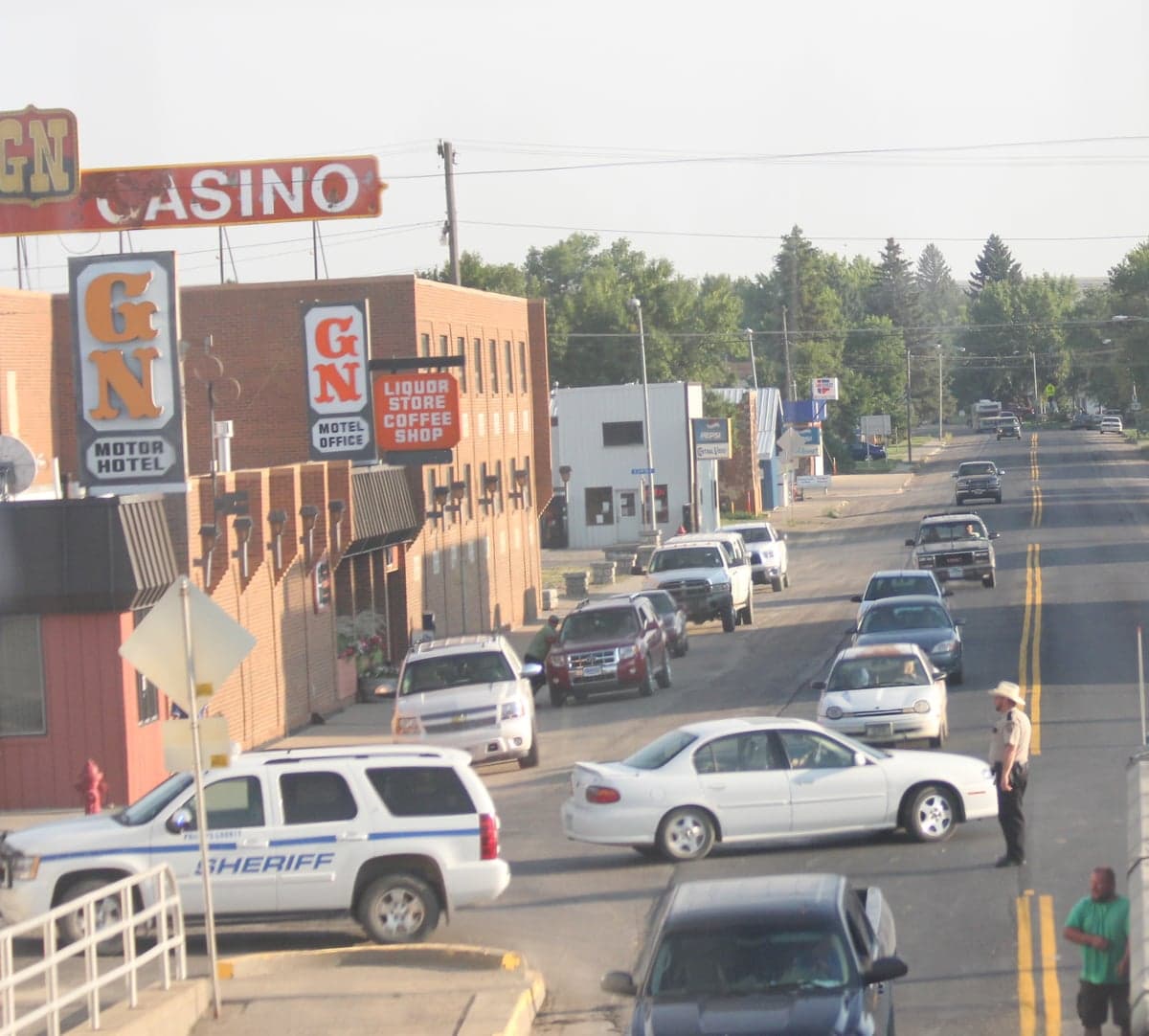
The people of Malta, Montana, today number roughly 1,900 residents, forming a tight-knit, predominantly white community with a strong agricultural and railroad heritage. The city’s character is defined by its role as the Phillips County seat, a service hub for surrounding ranches, and a place where generational roots run deep. With a foreign-born population of just 1.6% and a Hispanic share of 2.7%, Malta remains one of Montana’s most ethnically homogeneous small towns, where community identity is closely tied to the land and local institutions like the Malta High School Mustangs.
How the city was settled and grew
Malta was founded in 1890 as a division point on the Great Northern Railway, which drove the town’s initial population wave. The railroad brought Irish, German, and Scandinavian laborers who built the early infrastructure and settled in what is now the Railroad Addition neighborhood, just south of the tracks. The Homestead Act of 1909 and the Enlarged Homestead Act of 1916 drew a second wave of settlers—primarily farmers and ranchers of Northern European descent—who claimed land in the surrounding Phillips County. These homesteaders established the West Side neighborhood, where many of the original Craftsman and bungalow homes still stand. By the 1920s, Malta’s population had peaked near 2,400, supported by wheat farming and cattle ranching. The Great Depression and the Dust Bowl caused a significant exodus, but the town stabilized as a regional trade center, with the East Side neighborhood growing in the 1940s and 1950s to house workers at the nearby Bowdoin National Wildlife Refuge and the expanding county government.
Modern era (post-1965)
After the 1965 Immigration and Nationality Act, Malta saw virtually no new immigration from outside the United States. The foreign-born share has remained below 2% for decades, and the Asian and Indian-subcontinent populations are both recorded at 0.0%. Domestic in-migration has been modest, driven primarily by retirees and remote workers seeking a low-cost, rural lifestyle. The South Hill neighborhood, developed in the 1970s and 1980s, absorbed most of these newcomers, offering newer ranch-style homes on larger lots. The North Central district, near the courthouse and hospital, has seen some infill construction but remains dominated by long-time residents. The Hispanic population, though small at 2.7%, has grown slightly since 2000, with families working in agricultural support services and the local meatpacking plant. No significant ethnic enclaves have formed; the community remains highly integrated, with social life centered on churches, the county fair, and high school sports.
The future
Malta’s population is projected to remain stable or decline slightly over the next decade, mirroring trends across rural Montana. The city is not homogenizing further—it is already as homogeneous as a small Plains town can be—but it is aging, with a median age above 40. Young adults frequently leave for college or jobs in Billings or Great Falls, and the school district has seen enrollment drop by roughly 10% since 2010. The Hispanic community is expected to grow slowly, possibly reaching 4-5% by 2035, as agricultural labor demand persists. No significant immigrant or refugee resettlement is anticipated. The Airport Road area, on the town’s southern edge, is the only zone seeing new residential construction, mostly single-family homes for commuters and remote workers. The Downtown Historic District, with its brick storefronts and the iconic Phillips County Courthouse, is likely to remain the civic and commercial heart, though retail vacancies are a concern.
For someone moving in now, Malta offers a stable, safe, and deeply rooted community where neighbors know each other and the pace of life is slow. The population is not diversifying rapidly, nor is it shrinking fast—it is holding steady, with the same cultural and demographic character it has had for generations. New arrivals will find a welcoming but insular town where integration requires active participation in local institutions like the volunteer fire department, the library board, or the rodeo association.

* Values derived from national, state, county, city and local statistics and may differ in a specific area. Last updated: 2026-05-03T05:02:06.000Z
Narrative content on this page is AI-generated and may contain mistakes. Verify any details that matter before acting on them.
ReloMaps may earn a commission from affiliate links at no extra cost to you.

