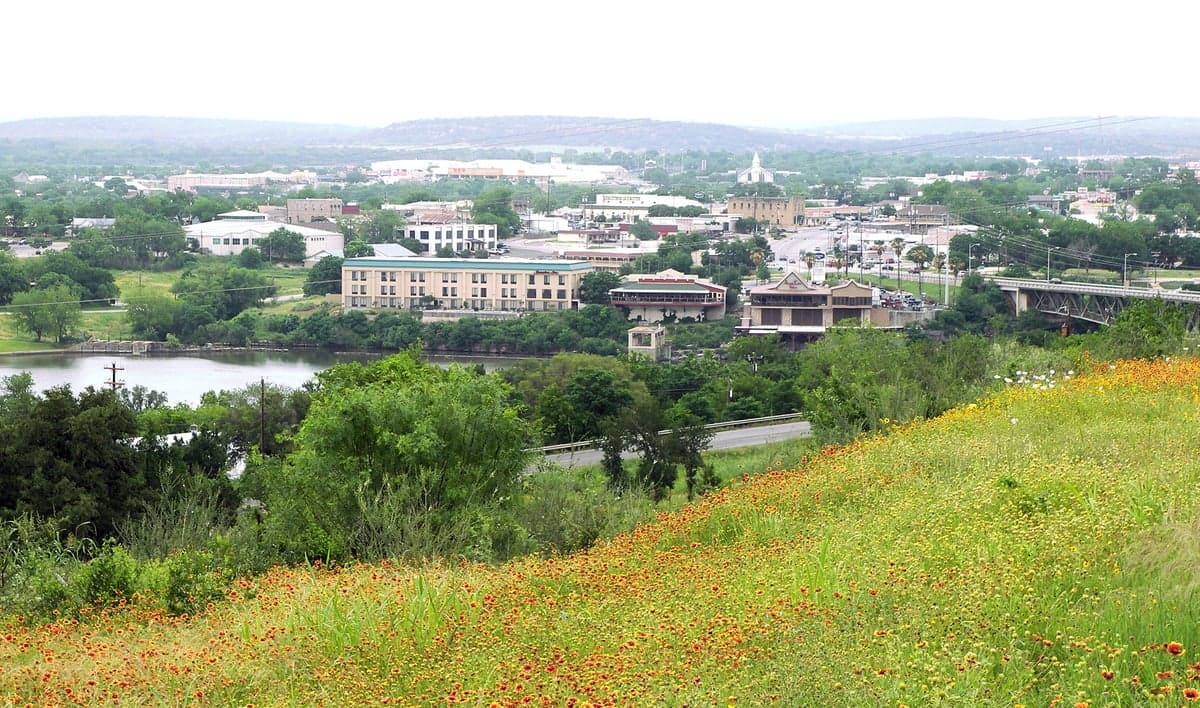
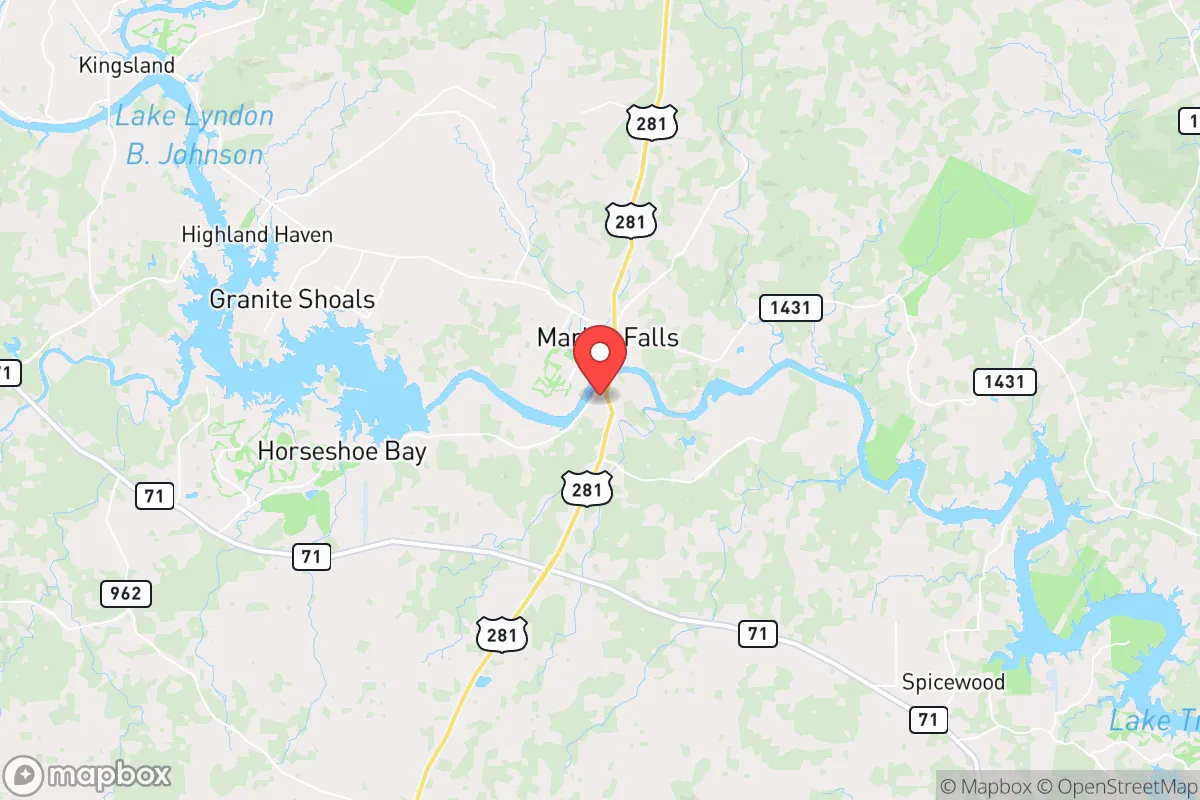
Photo: Wikipedia
Demographics of Marble Falls, TX
Affluence Level in Marble Falls, TX
A middle-class area roughly in line with national averages across income, home values, education, and employment.
People of Marble Falls, TX
Marble Falls, Texas, is a small city of 7,255 residents that serves as the commercial and governmental hub of the Highland Lakes region. Its population is predominantly White (69.5%) with a substantial Hispanic minority (28.0%), and it has a notably low foreign-born share of just 2.1%—roughly one-third the national average. The city’s character is defined by its blend of longtime ranching families, descendants of dam-era construction workers, and a growing number of retirees and remote workers drawn to the lake lifestyle, giving it a distinctly conservative, family-oriented identity.
How the city was settled and grew
Marble Falls was founded in 1887 by Adam Rankin Johnson, a former Confederate general who recognized the economic potential of the Colorado River’s waterfalls for milling and power generation. The original settlers were Anglo-American ranchers and farmers who took advantage of the 1882 land grants that opened the Hill Country to homesteading. The town’s first wave of growth came with the arrival of the Austin and Northwestern Railroad in 1892, which connected Marble Falls to regional markets and spurred a granite quarrying industry. The historic Downtown Marble Falls district, centered on Main Street, was built by these early Anglo settlers and remains the city’s commercial and civic core. A second wave arrived during the construction of the Highland Lakes dams (1937–1951), when the Lower Colorado River Authority brought in a transient workforce of mostly White laborers and engineers. Many of these workers settled permanently in the Lake Marble Falls neighborhood, a residential area that grew up along the newly created shoreline. By 1950, the population had reached roughly 2,000, and the city’s demographic base was overwhelmingly White, with a small number of Hispanic families who had worked on area ranches for generations.
Modern era (post-1965)
The post-1965 period saw Marble Falls evolve from a sleepy ranching town into a regional retirement and tourism destination. The completion of the Highland Lakes chain made the area attractive to domestic migrants from the Midwest and Northeast, particularly retirees seeking a lower cost of living and warmer climate. This wave settled primarily in newer subdivisions like Meadowlakes (a gated golf-course community incorporated in 1972) and Sunset Point, a lakefront neighborhood that grew rapidly in the 1980s and 1990s. The Hispanic population, which had been a small but stable presence since the early 1900s, began to grow more noticeably after 1990, driven by domestic migration from South Texas and Mexico for construction and service jobs tied to the tourism economy. Today, Hispanic residents are concentrated in the Eastside neighborhood, an area east of U.S. 281 that developed as a working-class enclave with older housing stock and closer proximity to the city’s industrial and service sectors. The city’s foreign-born share remains very low (2.1%), and the Indian subcontinent population (0.9%) and East/Southeast Asian population (0.0%) are negligible, reflecting Marble Falls’ limited draw for immigrant communities compared to larger Texas cities. The Black population is also minimal at 0.2%, a figure that has remained essentially unchanged for decades.
The future
Marble Falls’ population is projected to grow modestly, driven by continued domestic in-migration of retirees and remote workers from higher-cost states like California and Colorado. The city’s demographic trajectory points toward gradual homogenization rather than tribalization into distinct ethnic enclaves. The Hispanic share is likely to increase slowly as second- and third-generation families remain in the area and assimilate into the broader community, but the city’s low housing inventory and lack of large-scale employment centers will limit rapid growth. The Northridge subdivision, a master-planned community developed after 2010, is attracting younger families and professionals, but its residents are overwhelmingly White and college-educated (31.9% of the city holds a bachelor’s degree or higher). The immigrant population is expected to remain flat or decline slightly, as Marble Falls offers few of the ethnic networks or entry-level job opportunities that drive foreign-born settlement in larger metros. Over the next 10–20 years, the city will likely become slightly more Hispanic and slightly older, but its core identity as a predominantly White, conservative, lake-oriented community will persist.
For someone moving to Marble Falls now, the city offers a stable, family-friendly environment with a clear cultural identity and limited demographic flux. The low crime rate, strong public schools, and active outdoor lifestyle appeal to those seeking a predictable, community-oriented setting. However, the city’s demographic homogeneity and low foreign-born share mean that newcomers from diverse backgrounds may find fewer co-ethnic networks or cultural institutions than in larger Texas cities. Marble Falls is becoming a more polished version of its historic self—a place where tradition and growth coexist, but where the pace of change remains deliberately slow.

* Values derived from national, state, county, city and local statistics and may differ in a specific area. Last updated: 2026-04-26T19:47:23.000Z
Narrative content on this page is AI-generated and may contain mistakes. Verify any details that matter before acting on them.
ReloMaps may earn a commission from affiliate links at no extra cost to you.

