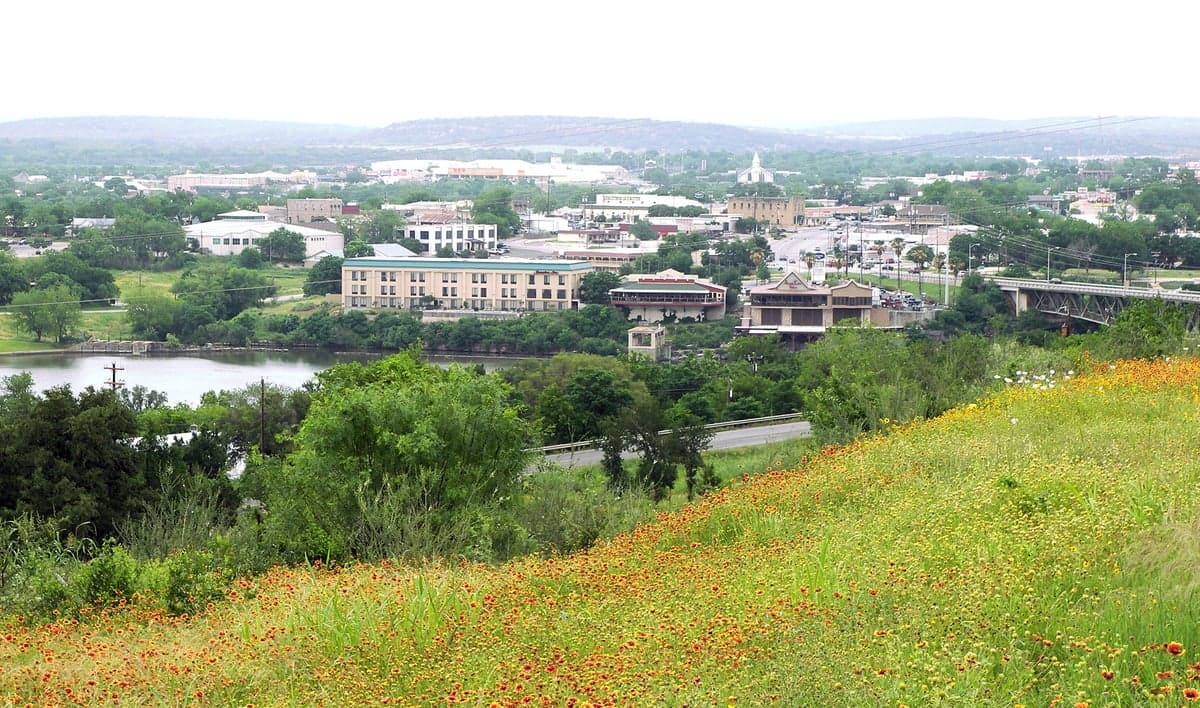
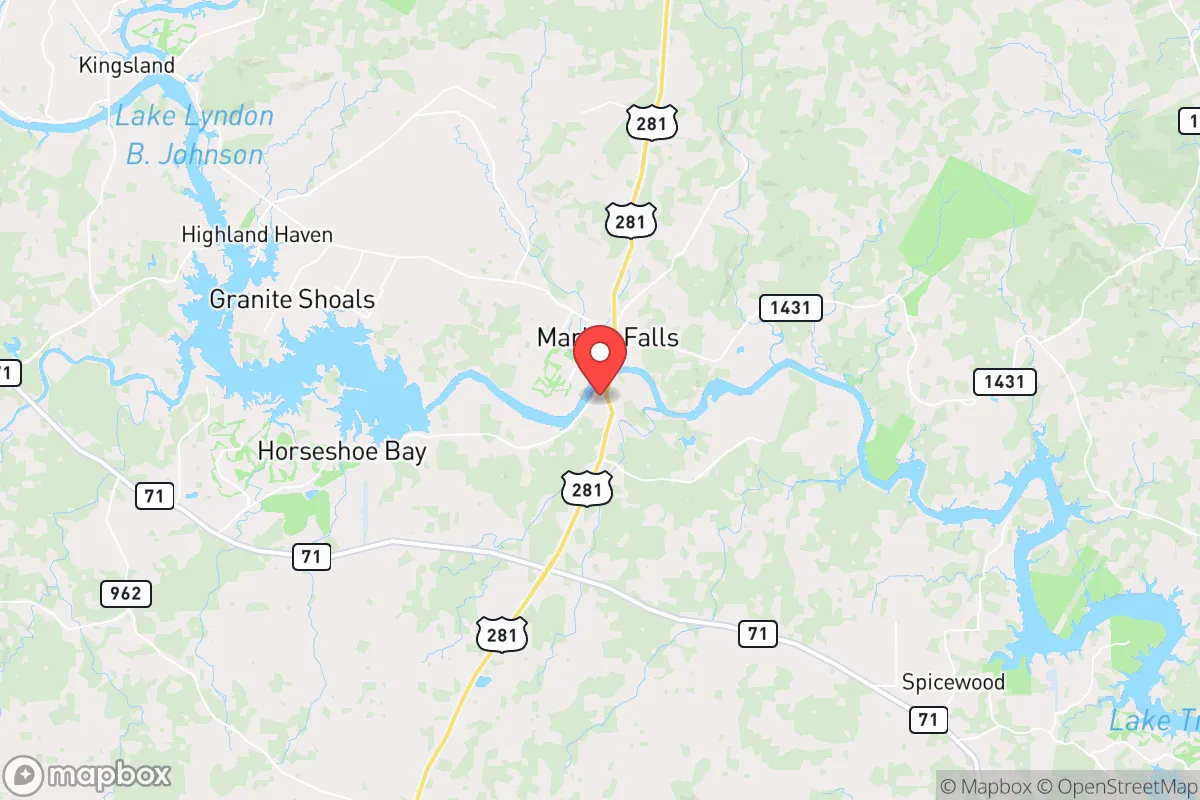
Photo: Wikipedia
Political ClimatePolitical Climate in Marble Falls, TX
District shown is the primary district for this city’s centroid. Cities may span multiple districts.
Local Political AnalysisPolitical Analysis of Marble Falls, TX
Marble Falls leans solidly Republican, with the area carrying a Cook PVI of R+11, meaning it votes about 11 points more conservative than the national average. That’s not just a number on a map—it reflects a community where folks have long valued personal responsibility, limited government, and the right to live life without a bunch of bureaucratic red tape. Over the last decade, the political trajectory has held steady, but there’s a quiet unease as the Austin sprawl creeps closer, bringing with it a wave of progressive transplants who see government as the solution to every problem.
How it compares
Drive 45 minutes south to Austin, and you’re in a completely different world—a deep-blue city where the city council is constantly dreaming up new regulations on everything from short-term rentals to what kind of straw you can use. Head west to Llano or north to Burnet, and you’ll find communities that share Marble Falls’ conservative instincts, but they’re smaller and less exposed to the cultural pressure from the metro. The real contrast is with places like Round Rock or Georgetown, which have seen their politics shift noticeably as they’ve grown. Marble Falls, so far, has held the line, but the warning signs are there: new housing developments are bringing in folks who think the answer to higher property taxes is more government spending, not less.
What this means for residents
For the people who’ve been here a while, the political climate means you can still have a conversation about personal freedoms without being called a bigot. It means the local school board isn’t pushing critical race theory or gender ideology on your kids—at least not yet. But you’d better believe there are groups trying to change that, and they’re well-funded. The real concern is government overreach: the county commissioners have been relatively hands-off, but as the tax base grows, there’s always a risk they’ll start thinking they know better than you how to run your life. Property taxes are already a sore spot, and any shift toward progressive policies would only make that worse, funding programs you never asked for.
Daily life here still feels like Texas should: people wave at each other, the Fourth of July parade is a big deal, and nobody’s apologizing for flying the American flag. But you can feel the change coming. The city council elections are starting to draw more attention, and the quiet majority needs to stay engaged. If you’re thinking of moving here, understand that the political culture is a big part of what makes Marble Falls worth the drive. It’s not perfect—no place is—but it’s a place where your voice still matters, and where the government hasn’t yet decided it knows better than you.

State Political ClimatePolitical Climate in Texas
State Political AnalysisPolitical Environment in the State
Texas has been a reliably Republican state for decades, with the GOP holding every statewide office and both chambers of the legislature since the mid-1990s. The dominant coalition is a mix of suburban conservatives, rural traditionalists, and a growing number of Hispanic voters who lean right on economic and social issues. Over the last 10-20 years, the state has shifted from a solid +12-point GOP margin in presidential races to a narrower +5-6 point lean, driven by explosive growth in the blue-leaning metros of Austin, Dallas, Houston, and San Antonio. However, the GOP has held the line by picking up ground in the Rio Grande Valley and exurban counties, making Texas a fascinating battleground where the old guard is still firmly in control but the future is uncertain.
Urban vs. rural divide
The political map of Texas is a tale of two worlds. The major metros — Austin (Travis County), Dallas (Dallas County), Houston (Harris County), and San Antonio (Bexar County) — have become deep blue strongholds, with Democrats routinely winning these counties by 20-40 points. Austin is the epicenter of progressive activism, with its "Keep Austin Weird" ethos translating into a city council that has pushed defund-the-police rhetoric and sanctuary city policies. Meanwhile, the vast rural expanse — from the Panhandle down to the Hill Country — votes Republican by margins of 70-80%. The real story is in the suburbs and exurbs. Places like Collin County (north of Dallas) and Fort Bend County (southwest of Houston) were once reliably red but have flipped or become competitive as diverse, college-educated populations move in. Conversely, the Rio Grande Valley, including Hidalgo County (McAllen), has shifted rightward, with many Hispanic voters rejecting the Democratic Party's progressive turn on social issues and the economy. This urban-rural chasm means that statewide elections are won or lost in the fast-growing suburban ring counties like Montgomery, Denton, and Comal — places that still lean red but are under constant demographic pressure.
Policy environment
Texas maintains a low-tax, low-regulation posture that is a major draw for conservatives. There is no state income tax, and property taxes are high but capped by a 2023 law (Proposition 4) that raised the homestead exemption to $100,000 and compressed school tax rates. The regulatory climate is business-friendly, with no state-level minimum wage above the federal $7.25 and a right-to-work law that weakens union power. On education, the state has championed school choice — the 2023 legislative session saw a near-pass of a universal Education Savings Account program, though it stalled in the House. The Texas Education Agency has also pushed for stricter curriculum standards and banned Critical Race Theory in public schools. Healthcare policy is a mixed bag: Texas refused Medicaid expansion under Obamacare, leaving 1.5 million uninsured, but has expanded telehealth and loosened scope-of-practice laws for nurses. Election laws have tightened significantly — Senate Bill 1 (2021) banned 24-hour and drive-through voting, added ID requirements for mail ballots, and empowered partisan poll watchers. The state also passed a near-total abortion ban (SB 8, 2021) and a trigger law that took effect after Dobbs, making abortion illegal from conception with narrow exceptions. For conservatives, this is a state that actively protects life, gun rights, and parental authority — but the lack of Medicaid expansion and rising property taxes are persistent concerns.
Trajectory & freedom
On balance, Texas has become more free on several key fronts over the last five years, but with some worrying signs. The 2021 legislative session was a landmark for personal liberty: permitless carry (HB 1927) went into effect, allowing any law-abiding adult to carry a handgun without a license. Parental rights were strengthened with the passage of the "Save Women's Sports Act" (SB 29, 2021) and a ban on gender transition procedures for minors (SB 14, 2023). The state also passed a law (HB 20, 2023) that prohibits social media companies from de-platforming users based on political viewpoints — a direct challenge to Big Tech censorship. On the negative side, the state has seen a troubling expansion of government overreach in the name of public health. During COVID, Governor Abbott issued a statewide mask mandate and business closures, though he later reversed course and banned vaccine mandates. More recently, the state has cracked down on medical freedom by requiring doctors to report "adverse events" from COVID vaccines — a move that critics say is a backdoor to surveillance. Property rights have been eroded by the use of eminent domain for the border wall and transmission lines, though the 2023 session did pass a bill (HB 3691) to strengthen compensation for landowners. The trajectory is mixed: Texas is expanding freedom on guns, speech, and parental rights, but the state's willingness to use government power during emergencies and on border security is a double-edged sword for liberty-minded residents.
Civil unrest & political movements
Texas has seen its share of political flashpoints. The 2020 Black Lives Matter protests in Austin were among the most intense in the nation, with the city council cutting the police budget by $150 million — a decision that was later partially reversed after a surge in violent crime. On the right, the "Texas Nationalist Movement" has gained some traction, with a 2022 poll showing 18% support for secession, though it remains a fringe idea. Immigration politics are a constant source of tension. Governor Abbott's Operation Lone Star has deployed state troopers and National Guard to the border, bused migrants to sanctuary cities like New York and Chicago, and installed razor wire along the Rio Grande. This has led to legal battles with the Biden administration and a standoff with the federal government over border enforcement. The state has also seen a rise in "constitutional sheriff" movements in rural counties, where sheriffs refuse to enforce certain state or federal laws. Election integrity remains a hot-button issue: the 2020 election saw lawsuits over drive-through voting in Harris County, and the 2022 primaries were marred by a "ballot harvesting" scandal in the Rio Grande Valley. A new resident will notice the heavy police presence at the border, the "Don't Mess with Texas" bumper stickers, and the occasional protest at the state capitol in Austin — but overall, political violence is rare, and most Texans coexist peacefully despite deep divisions.
Projection
Over the next 5-10 years, Texas is likely to remain a Republican-controlled state, but the margin of control will narrow. The in-migration of 1,000+ people per day, many from blue states like California and New York, is slowly shifting the electorate. The suburbs of Dallas and Houston are trending left, while the Rio Grande Valley and exurbs are trending right. The GOP will need to hold onto its Hispanic gains and turn out rural voters to stay competitive. The 2026 gubernatorial election will be a bellwether: if a Democrat can get within 5 points, the state will be considered a true swing state by 2030. On policy, expect continued fights over school choice, property tax reform, and water rights. The state's grid (ERCOT) will remain a vulnerability, with the 2021 winter storm still fresh in voters' minds. For a conservative moving in now, the next decade will bring more political competition, but the fundamental character of Texas — low taxes, gun rights, and a pro-business climate — is unlikely to change dramatically. The biggest risk is that the state's growing diversity and urban population will eventually flip the legislature, but that is at least 10-15 years away.
Bottom line for a new resident: If you're moving to Texas for conservative values, you're arriving at a time of peak influence. The state is as red as it's ever been on social and economic policy, but the demographic winds are shifting. You'll find a welcoming environment for traditional families, strong gun rights, and a government that mostly stays out of your business — but keep an eye on the suburbs. The political future of Texas will be decided in places like Collin County, Fort Bend County, and the Rio Grande Valley, not in Austin or the Panhandle. If you want to preserve the Texas you're moving for, get involved locally.
* Values derived from national, state, county, city and local statistics and may differ in a specific area. Last updated: 2026-04-26T19:47:23.000Z
Narrative content on this page is AI-generated and may contain mistakes. Verify any details that matter before acting on them.
ReloMaps may earn a commission from affiliate links at no extra cost to you.

