
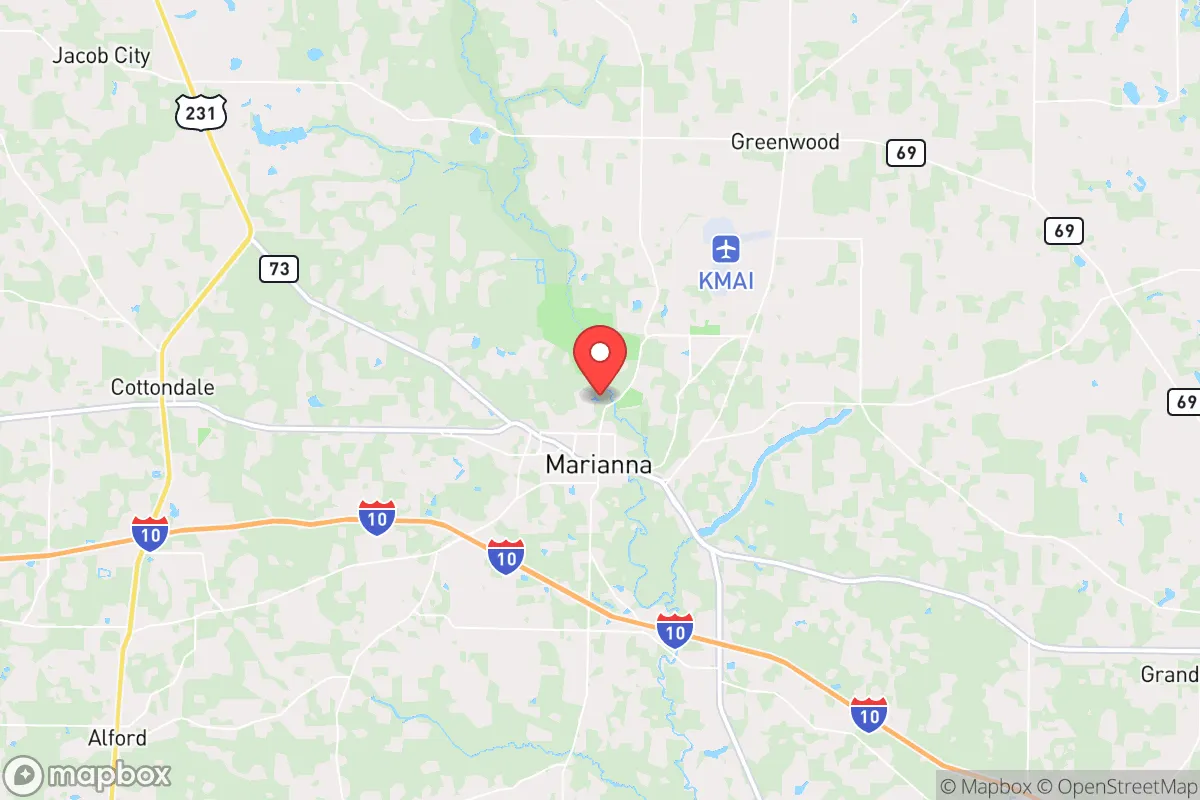
Photo by Alla Kemelmakher on Unsplash
Demographics of Marianna, FL
Affluence Level in Marianna, FL
A below-average socioeconomic profile. Incomes, home values, and educational attainment trail the U.S., with higher poverty and unemployment.
People of Marianna, FL
Marianna, Florida, is a small, deeply rooted city of 6,815 residents where the population is almost evenly split between White (49.5%) and Black (42.6%) communities, a demographic legacy of its plantation-era founding and post-Reconstruction settlement patterns. The city’s character is distinctly rural and traditional, with a very low foreign-born share of just 0.8% and a college-educated rate of 12.7%, reflecting its role as a regional agricultural and government hub rather than a destination for new immigrants or professionals. Marianna’s identity is shaped by its history as a cotton and timber center, its status as the Jackson County seat, and the enduring presence of families whose roots stretch back to the 19th century.
How the city was settled and grew
Marianna was founded in 1828 on land ceded by the Creek Nation, and its early population was driven by wealthy planters from Georgia and the Carolinas who established cotton plantations along the Chipola River. These families built the Greenwood and Riverside neighborhoods, where antebellum homes still stand, and they relied on enslaved African labor to clear land and work the fields. After the Civil War, many freed Black families remained in Marianna, settling in the Southside district near the railroad tracks, where they established churches, schools, and small farms. A second wave of White settlers arrived in the late 1800s as the timber industry boomed, drawn by the region’s longleaf pine forests; these workers clustered in the Northside area around the sawmills and the Chipola River landing. By 1900, Marianna’s population was roughly 60% Black and 40% White, a ratio that held through the early 20th century as the city became a trading center for cotton, timber, and naval stores.
Modern era (post-1965)
The post-1965 period brought significant demographic change as the Civil Rights movement and the mechanization of agriculture reshaped Marianna’s economy and population. The Black population, which had been the majority in the early 1900s, began a slow decline as many families left for industrial jobs in the North and Southeast during the Great Migration’s later waves. Meanwhile, White families from rural Jackson County moved into Marianna for government and service jobs, expanding the Westside subdivision and the Oakwood area near the new hospital and courthouse. The city’s Hispanic population, now at 4.0%, began arriving in the 1990s, primarily as migrant farmworkers in the surrounding peanut and cotton fields; they settled in small rental clusters along Highway 90 and in the Southside neighborhood, though no distinct ethnic enclave formed. The East/Southeast Asian community (0.6%) is tiny and consists mainly of a few families associated with the local medical center and Chipola College. The Indian-subcontinent population is effectively zero, and the foreign-born share remains negligible at 0.8%, making Marianna one of the least diverse cities in Florida by immigrant status.
The future
Marianna’s population is slowly homogenizing along racial lines, with the Black share declining from roughly 50% in 2000 to 42.6% today, while the White share has held steady near 49.5%. The Hispanic share is growing gradually, driven by natural increase and a small number of permanent farmworker families settling in the Southside and Westside areas, but the city’s low college attainment rate (12.7%) and limited job growth outside of government and agriculture suggest this trend will remain modest. The city is not tribalizing into distinct enclaves—neighborhoods remain largely mixed by income and race, with the main divide being between the older historic core (Greenwood, Riverside) and newer subdivisions (Oakwood, Westside). Over the next 10–20 years, Marianna will likely continue as a stable, slow-growing rural county seat, with a slight uptick in Hispanic residents and a continued gradual decline in the Black share as younger families move to larger cities like Tallahassee or Panama City for education and employment.
For someone moving in now, Marianna offers a deeply traditional, low-immigration environment where the population is stable and the pace of change is slow. The city’s demographic future points toward a modestly more Hispanic but still majority-White-and-Black community, with little influx of foreign-born or highly educated residents. This is a place for those seeking a quiet, affordable, and historically grounded small-town life in the Florida Panhandle, not for those expecting rapid growth or cultural diversity.

* Values derived from national, state, county, city and local statistics and may differ in a specific area. Last updated: 2026-05-14T17:57:44.000Z
Narrative content on this page is AI-generated and may contain mistakes. Verify any details that matter before acting on them.
ReloMaps may earn a commission from affiliate links at no extra cost to you.

