
Photo by Alla Kemelmakher on Unsplash
Strategic Assessment of Marianna, FL
Workable tactical position. Some exposure to population density or targets, but generally defensible in a crisis.
What does the Strategic Assessment tell us?
Our Strategic Assessment grades tactical survivability of an area. Major population centers, military targets, fallout zones, natural disasters, and border exposure all drive risk — lower exposure means a more defensible position in a crisis.
This is heavily inspired by Joel Skousen's Strategic Relocation book. Highly recommended you checkout the book ($)What does this tell us?
Our Strategic Assessment grades tactical survivability of an area. Major population centers, military targets, fallout zones, natural disasters, and border exposure all drive risk — lower exposure means a more defensible position in a crisis.
This is heavily inspired by Joel Skousen's Strategic Relocation book. Highly recommended you checkout the book ($)Strategic Pillars

Key Distances
Regional Safe Places
Below is our recommended "safe zones" in Florida and the surrounding area based on our strategic heuristics. For most people, it's unrealistic to live in a “safe zone” full-time due to work, family or other personal reasons. They tend to be more rural. However, many of these areas are perfect for second homes and retreat properties that double as a vacation home or even a short-term rental.

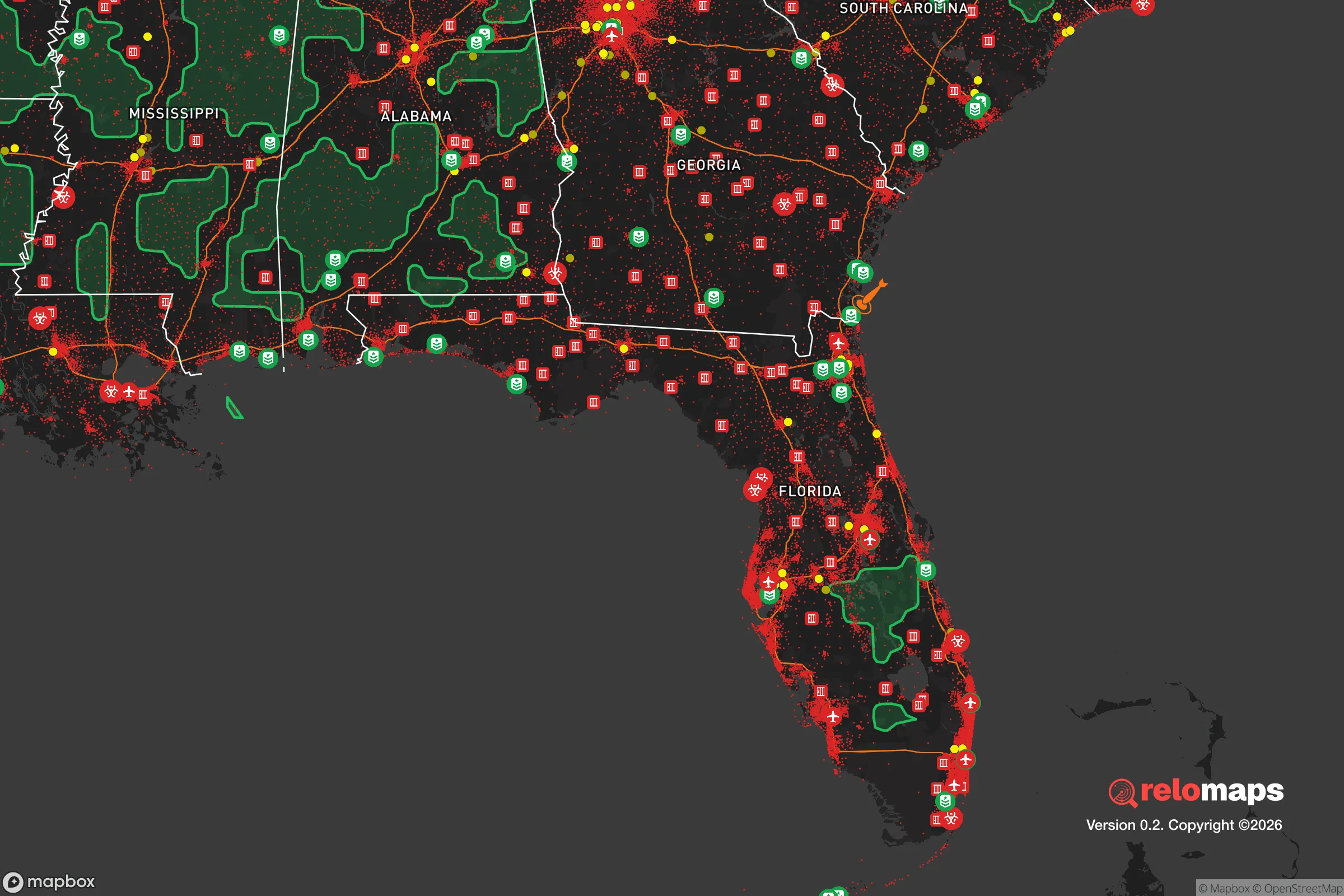


Important Note: For informational purposes only. This does not mean nothing bad ever happens in the green zones. Please use common sense. This is based on public data and modeled with AI. We tried to take a conservative approach but mistakes happen. We update this regularly as new information becomes available.
Solar Generator Recommendations
Backup power matters more here than in safer locations. We've picked three solar generators across budgets and capacity tiers — start with the budget unit if you only need a few essentials, or step up if you want to run a fridge and HVAC for days at a time.

Jackery Portable Power Station Explorer 300
Budget OptionPower on the Go: Weighing only 11 lbs, it's convenient to set up and store with book-sized foldable solar panels

BLUETTI Portable Power Station AC180
Designed for both indoor and outdoor scenarios, AC180 is highly capable as it has a robost capacity and continuous output power.

EF ECOFLOW DELTA Pro Ultra Power Station
Upgraded PickEcoFlow DELTA Pro Ultra is a whole-home energy system designed to grow with your family. Integrated with the Smart Home Panel 2, it scales to meet your evolving energy needs — keeping your home powered, intelligent, and secure through every stage of life.
We earn a commission, at no additional cost to you.
Strategic Assessment Analysis
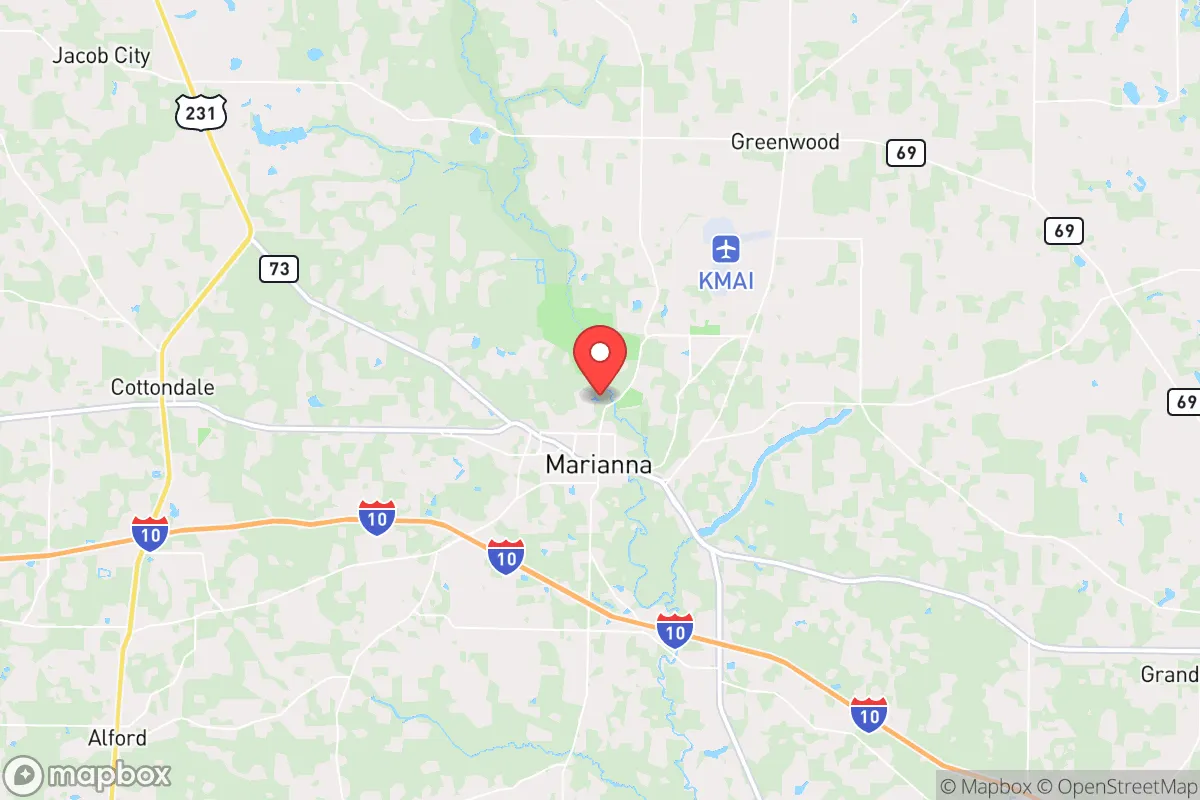
Marianna, Florida, offers a compelling strategic position for those prioritizing resilience and self-sufficiency in an increasingly uncertain national landscape. Located in the Florida Panhandle, roughly 70 miles west of Tallahassee and 30 miles north of the Gulf Coast, this small city of about 7,000 people sits in Jackson County, a region that blends rural agricultural land with the rolling hills of the state’s northern tier. For a relocator with a prepper mindset, Marianna’s key advantage is its relative isolation from major metropolitan centers while still maintaining access to critical infrastructure—a balance that makes it a viable base for weathering civic unrest, natural disasters, or broader societal disruptions.
Geographic position and natural advantages for long-term security
Marianna’s location is defined by its distance from high-risk urban zones. It is over 100 miles from Jacksonville, 150 miles from Atlanta, and 200 miles from Orlando, placing it well outside the immediate fallout zones of major population centers that could become targets during mass casualty events or civil disorder. The city sits atop the Marianna Lowlands, a region of karst topography featuring limestone bedrock, numerous springs, and the Chipola River—a natural water source that flows year-round. This geology provides two distinct advantages: abundant groundwater access for wells and natural cave systems (like the Florida Caverns State Park) that could serve as shelter or storage in extreme scenarios. The area’s elevation, ranging from 100 to 200 feet above sea level, offers a modest defensive buffer against storm surge, which is a critical consideration given the Gulf Coast’s hurricane exposure. The surrounding Jackson County is heavily forested with pine and hardwood, providing cover, timber for construction, and a natural barrier against urban sprawl. For a relocator, this geography means you can secure a property with a well, septic, and solar array without being within a day’s walk of a major city—a rarity in Florida.
Risks, exposures, and proximity to fallout-relevant landmarks
No location is without vulnerabilities, and Marianna has specific exposures that a strategic relocator must account for. The most immediate risk is hurricane impact. While Marianna is inland, it lies in the path of storms that make landfall along the Gulf Coast, particularly those tracking north from the Florida Panhandle. Hurricane Michael in 2018 caused widespread tree damage and power outages in the area, though the city avoided the catastrophic storm surge seen in Mexico Beach. Flooding is a secondary concern—low-lying areas near the Chipola River and its tributaries can flood after heavy rains, so property selection should prioritize higher ground. Regarding fallout-relevant landmarks, Marianna is within 70 miles of Tyndall Air Force Base (near Panama City) and about 100 miles from Naval Air Station Pensacola. These military installations could be targets in a conflict scenario, though their distance reduces direct blast or radiation risk. More concerning is the proximity to Interstate 10, which runs just south of the city. This major east-west corridor could become a chokepoint or evacuation route during a crisis, potentially drawing displaced populations or looters from coastal areas. The city itself has a small police force and a county sheriff’s office, but in a widespread collapse scenario, law enforcement resources would be stretched thin. The presence of the Florida State Prison (a maximum-security facility) in nearby Raiford is not a direct threat, but it does indicate a regional correctional infrastructure that could become unstable during civil unrest.
Practical resilience for a relocator: food, water, energy, and defensibility
For a prepper or survivalist, Marianna offers a workable foundation for self-reliance, but it requires deliberate setup. Water is the strongest asset: the Floridan Aquifer lies beneath the area, and many rural properties already have private wells. The Chipola River and nearby springs (like Blue Spring) provide surface water that can be filtered or treated. Rainfall averages about 55 inches per year, making rainwater catchment viable. Food production is feasible due to the long growing season (March through November) and fertile sandy loam soils. Jackson County is agricultural, with row crops (cotton, peanuts, soybeans) and livestock operations. A relocator can establish a garden, raise chickens or goats, and source bulk grains from local feed stores without raising suspicion. Energy independence is achievable with solar panels, as the region gets about 220 sunny days per year. Battery storage and a backup generator (propane or diesel) are recommended, given that the grid is vulnerable to hurricane-related outages that can last days or weeks. Defensibility depends on property selection. Rural parcels with tree cover, a single access road, and good sightlines are available at reasonable prices—land in Jackson County averages $3,000 to $5,000 per acre, significantly cheaper than coastal Florida. The terrain’s rolling hills and dense vegetation provide natural concealment, but the lack of natural barriers (like mountains) means you’ll need to rely on perimeter fencing, cameras, and a community network. The local population is predominantly conservative, rural, and firearm-friendly, which can be a double-edged sword: it means like-minded neighbors, but also a higher baseline of armed households if things go sideways. Building relationships with nearby farmers and homesteaders is essential for mutual aid.
The overall strategic picture for Marianna is one of moderate resilience with clear trade-offs. It is not a bug-out location for a total collapse scenario—it lacks the remoteness of the Rocky Mountains or the Pacific Northwest—but it offers a realistic, affordable base for a relocator who wants to be prepared for regional disruptions, economic instability, or localized civil unrest. The key vulnerabilities—hurricane risk, proximity to I-10, and limited law enforcement capacity—can be mitigated through property selection, infrastructure investment, and community integration. For a conservative-leaning individual or family seeking a place that balances access to resources (medical care in Tallahassee, supply chains via I-10) with a buffer from urban chaos, Marianna deserves serious consideration. It’s a place where you can quietly build your setup, keep your head down, and still be within a few hours of the coast if you need to move. Just don’t expect it to be a fortress—it’s a strategic outpost, not a final redoubt.

* Values derived from national, state, county, city and local statistics and may differ in a specific area. Last updated: 2026-05-14T17:57:44.000Z
Narrative content on this page is AI-generated and may contain mistakes. Verify any details that matter before acting on them.
ReloMaps may earn a commission from affiliate links at no extra cost to you.

