Photo: Wikipedia
Demographics of Marietta, GA
Affluence Level in Marietta, GA
A middle-class area roughly in line with national averages across income, home values, education, and employment.
People of Marietta, GA
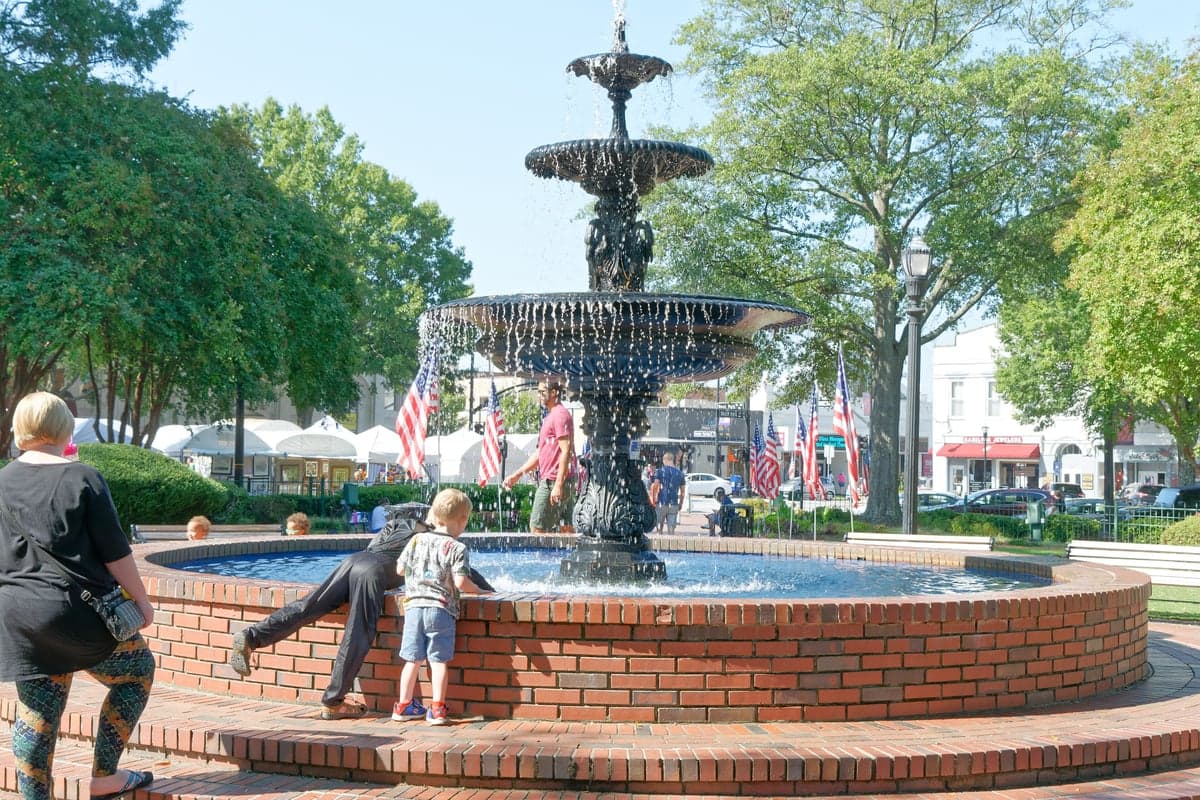
Marietta, Georgia, is a city of 61,773 residents that blends historic Southern roots with a growing diversity shaped by suburban expansion and immigration. Its population is 41.2% White, 30.2% Black, 19.8% Hispanic, 1.0% East/Southeast Asian, and 0.9% Indian, with 12.5% foreign-born and 46.8% college-educated. The city’s identity is defined by a strong sense of place—anchored by a walkable historic square—and a demographic trajectory that is becoming more Hispanic and more educated, while retaining a solid middle-class and professional character. For conservative-leaning movers, Marietta offers a stable, family-oriented environment with clear neighborhood distinctions that reflect its layered settlement history.
How the city was settled and grew
Marietta was founded in 1834 as a railroad and resort town for wealthy planters fleeing coastal heat, with its original population drawn from English, Scottish, and Irish settlers who received land grants in the 1832 Cherokee land lottery. The city’s early growth centered on the Marietta Square and surrounding blocks, where merchants, lawyers, and craftsmen built homes and businesses. After the Civil War, the city’s economy shifted to cotton and later textiles, attracting a wave of Black families who settled in the Franklin Gateway and Whitlock Avenue corridors, forming the core of Marietta’s historic African American community. By the early 20th century, the arrival of the Bell Bomber plant (later Lockheed Martin) during World War II brought a surge of White workers from the rural South and Appalachia into neighborhoods like West Cobb and Fair Oaks, transforming Marietta into a manufacturing and defense hub. These waves established a pattern of distinct enclaves: the Square remained White and commercial, Franklin Gateway became Black and working-class, and the western edges grew as White middle-class subdivisions.
Modern era (post-1965)
The 1965 Hart-Cellar Act and the 1970s-80s Sun Belt boom reshaped Marietta’s population dramatically. White flight from Atlanta proper accelerated suburbanization, pushing families into newer subdivisions like East Cobb (unincorporated but functionally part of Marietta’s metro area) and Mountain View, which became predominantly White and affluent. Meanwhile, the city’s Black population, which had been concentrated in Franklin Gateway and Whitlock, began spreading into neighborhoods like Bells Ferry and Lassiter as housing discrimination eased. The most significant post-1965 shift was Hispanic immigration: starting in the 1980s, Mexican and Central American workers arrived for construction, landscaping, and service jobs, settling heavily in Franklin Gateway and along South Marietta Parkway. Today, Franklin Gateway is a majority-Hispanic corridor with a dense concentration of Latino-owned businesses, while the Black population has dispersed across the city but remains strongest in the historic core. East/Southeast Asian and Indian communities are smaller but growing, with Indian families clustering in the East Cobb area near top-rated schools, and East/Southeast Asian residents scattered across the city’s newer subdivisions. The 12.5% foreign-born share is driven overwhelmingly by Hispanic immigrants, with smaller contributions from Indian and East/Southeast Asian professionals in tech and healthcare.
The future
Marietta’s population is trending toward greater Hispanic growth and continued White suburbanization on the edges, while the Black share is stabilizing. The Hispanic population, now at 19.8%, is likely to rise toward 25-30% over the next decade, driven by both immigration and higher birth rates, with Franklin Gateway becoming an even more distinct Latino enclave. The White population, while still the largest single group at 41.2%, is aging and being replaced in some neighborhoods by younger, more diverse families. The Black population is plateauing as younger Black families move to outer Cobb County suburbs like Powder Springs and Kennesaw. East/Southeast Asian and Indian communities are growing slowly but remain niche, concentrated in the East Cobb school zone. The city is not homogenizing—rather, it is tribalizing into clearer enclaves: White families in the west and north, Black families in the central and southern historic areas, and Hispanic families in the Franklin Gateway corridor. The 46.8% college-educated rate is rising as professionals from Atlanta’s tech and finance sectors move in, but this is mostly concentrated in the East Cobb and Mountain View areas, leaving the Franklin Gateway and Whitlock areas with lower educational attainment.
For someone moving to Marietta now, the city offers a choice of distinct neighborhoods with different demographics and feels. The historic Square area and western subdivisions remain predominantly White and conservative-leaning, with strong schools and low crime. Franklin Gateway is the most diverse and fastest-changing area, with a vibrant Hispanic community but higher poverty rates. The bottom line: Marietta is becoming a more Hispanic, more educated, and more neighborhood-differentiated city, where the character of your daily life depends heavily on which part you choose. It is not a melting pot but a mosaic of enclaves, each with its own history and trajectory.

* Values derived from national, state, county, city and local statistics and may differ in a specific area. Last updated: 2026-04-24T07:12:47.000Z
Narrative content on this page is AI-generated and may contain mistakes. Verify any details that matter before acting on them.
ReloMaps may earn a commission from affiliate links at no extra cost to you.

