
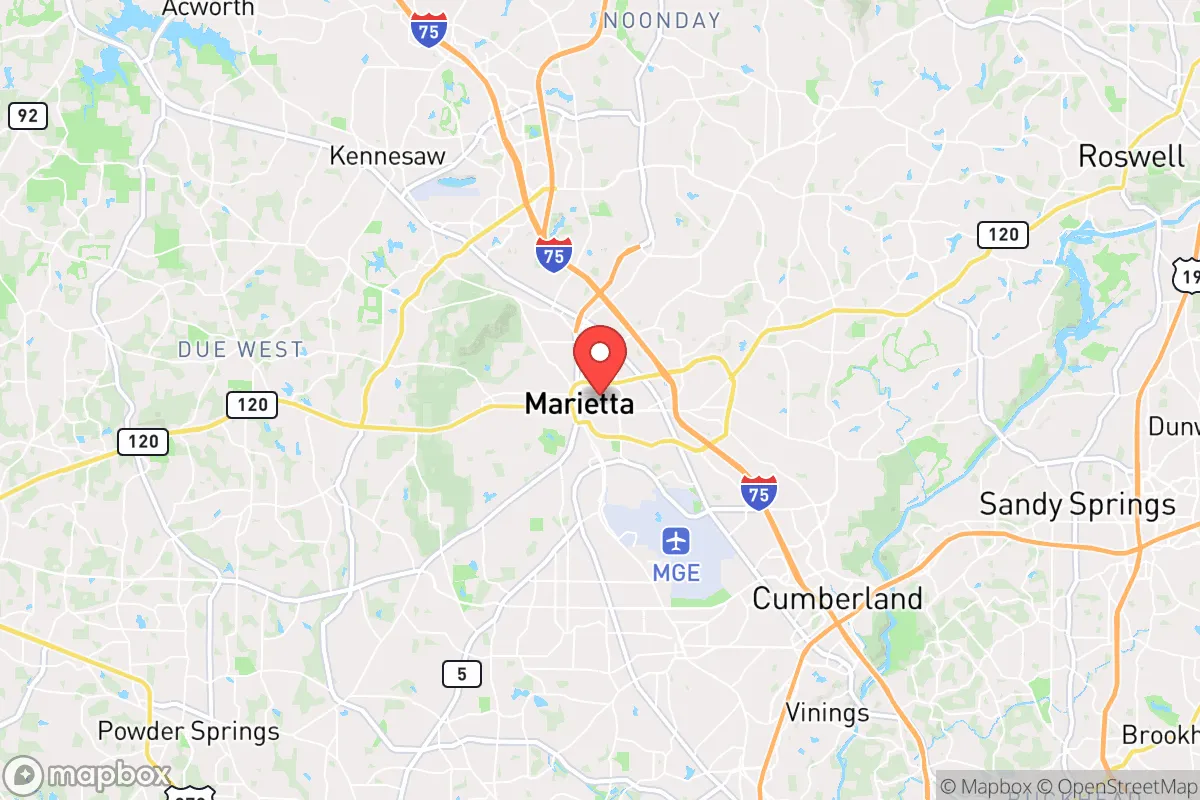
Photo: Wikipedia
Personal Sovereignty in Marietta, GA
Viable for self-reliance. Generally workable, though some barriers may limit total independence.
What does Personal Sovereignty tell us?
Personal Sovereignty measures your capacity for self-reliance and independence with minimal government friction. Higher scores mean fewer barriers between you and the way you want to live... but it assumes you have the space you need and good neighbors.
What does this tell us?
Personal Sovereignty measures your capacity for self-reliance and independence with minimal government friction. Higher scores mean fewer barriers between you and the way you want to live... but it assumes you have the space you need and good neighbors.
State Policy
Energy independence: Importer (12% of energy produced in-state)
Personal Liberty
Homesteading

Personal Liberty Analysis
For the individual who values personal sovereignty above all else, Marietta, Georgia offers a legal and cultural environment that is markedly more aligned with self-reliance than what you will find in most coastal or Midwestern jurisdictions. The city sits within Cobb County, a politically mixed area that leans center-right, but the real story is the state-level framework: Georgia is a "home rule" state with strong preemption laws that prevent local governments from enacting their own gun control, rent control, or many types of business regulation. This means that while Marietta itself may have a slightly more progressive city council than its rural neighbors, the state legislature in Atlanta has systematically stripped local governments of the ability to infringe on your Second Amendment rights, your property rights, and your ability to run a business without excessive red tape. For the prepper or survivalist, this is the critical distinction: your personal sovereignty in Marietta is largely protected by state law, not local goodwill.
Tax burden and regulatory posture: how Georgia compares to high-tax states
Georgia's tax structure is a significant advantage for anyone looking to maximize personal financial autonomy. The state levies a flat income tax rate of 5.49% as of 2026, with ongoing legislative pressure to reduce it further. There is no state-level estate tax or inheritance tax, which matters if you are building generational wealth or passing on land and supplies. Property taxes in Cobb County are moderate—typically around 0.8% to 1.0% of assessed value—and the county offers a homestead exemption that freezes the assessed value for homeowners over 65, but even for younger owners, the annual increase is capped. Sales tax in Marietta is 8.9% (state plus county and city), which is higher than rural Georgia but still below what you would pay in California or New York. More importantly, Georgia is a right-to-work state, meaning you cannot be forced to join a union as a condition of employment, and occupational licensing requirements are less burdensome than in many Northeastern states. For the self-employed prepper running a side business or a home-based trade, this regulatory posture means fewer inspections, lower fees, and less government intrusion into how you earn a living.
Self-defense and gun law specifics: what the Second Amendment actually looks like here
Georgia is a constitutional carry state, meaning that as of 2022, any legal resident 21 or older can carry a handgun openly or concealed without a permit. This is not a "may issue" or even a "shall issue" system—it is permitless carry, full stop. Marietta and Cobb County have not attempted to create their own gun registries or waiting periods, thanks to state preemption laws that explicitly forbid local governments from regulating firearms. The state also has a strong "stand your ground" law with no duty to retreat, and castle doctrine protections that extend to your vehicle and place of business. For the prepper, this means you can keep a firearm in your car while parked at work or at the grocery store without worrying about violating a "gun-free zone" ordinance. Magazine capacity is not restricted, and there is no state-level assault weapons ban. The only notable limitation is that you cannot carry in certain government buildings, courthouses, or schools without a permit (though a weapons carry license allows you to carry in many of those locations). If you are moving from a state like New York, Illinois, or California, the difference is night and day—your right to defend yourself is treated as a fundamental right, not a privilege to be negotiated with a bureaucrat.
Self-reliance and homesteading viability: lot sizes, zoning, and off-grid feasibility
Marietta itself is a suburban city with typical zoning that restricts livestock, heavy machinery, and non-standard structures in most residential neighborhoods. If you are looking for a five-acre homestead with chickens, goats, and a solar array, you will need to look outside the city limits—specifically into unincorporated Cobb County or neighboring Cherokee County. Within Marietta proper, standard residential lots range from 0.2 to 0.5 acres, and the city code requires that any dwelling be connected to municipal water and sewer. Off-grid living is effectively illegal inside city limits because the building code mandates grid-tied utilities. However, if you are willing to drive 15–20 minutes north or west, you can find properties with 1–5 acres in areas like West Cobb or near Kennesaw Mountain that allow backyard chickens, rainwater collection, and even small-scale agriculture. Cobb County does not have a countywide ban on solar panels, and net metering is available through Georgia Power, though the rates are not as favorable as in some other states. For the serious prepper, the best strategy is to buy a home in unincorporated Cobb County with a well and septic, then supplement with solar and battery storage. Marietta itself is not a homesteading paradise, but it is a 20-minute drive from one.
Personal liberties: parental rights, medical autonomy, speech, and property
Georgia has been a battleground for parental rights, and the current legal landscape is favorable for families who want to opt out of public school mandates or medical requirements. The state allows homeschooling with minimal oversight—you simply file a declaration of intent each year and provide a basic educational plan. There is no requirement for standardized testing or state-approved curriculum, and you are free to use religious or secular materials as you see fit. Medical autonomy is more complicated: Georgia does have a vaccine exemption for religious reasons, but the process requires a notarized affidavit, and some school districts have pushed back. The state also has a "Right to Try" law for experimental treatments, and there is no state-level mandate for COVID-19 vaccines or masks in schools as of 2026. Free speech is protected under the Georgia Constitution, which explicitly guarantees the right to assemble and petition the government, and there are no state-level "hate speech" laws that criminalize political or religious expression. Property rights are strong: Georgia is a "lien theory" state, meaning you hold the deed to your property even if you have a mortgage, and eminent domain abuse is limited by a 2006 constitutional amendment that restricts the government from taking private property for economic development. For the prepper worried about government overreach, these protections mean that your home, your children, and your medical decisions are largely yours to control—at least for now.
In the broader context of American personal sovereignty, Marietta sits in a sweet spot. It is not as free as rural Idaho or Montana, where you can buy 40 acres and disappear, but it is far freer than any major city on the West Coast or in the Northeast. The state-level preemption laws, constitutional carry, flat tax, and strong parental rights create a legal environment where the government is more of a background presence than an active manager of your daily life. The trade-off is that you are still in a metro area of 6 million people, which means traffic, HOA restrictions in many subdivisions, and the occasional progressive city council vote. But for the single individual or parent who wants a job in a major economy, access to healthcare, and the ability to keep a firearm in the truck while still living within an hour of the Appalachian foothills, Marietta is one of the better options in the Southeast. The sovereignty here is not absolute—nowhere in the United States is—but it is real, and it is protected by law, not by the goodwill of your neighbors.

* Values derived from national, state, county, city and local statistics and may differ in a specific area. Last updated: 2026-04-24T07:12:47.000Z
Narrative content on this page is AI-generated and may contain mistakes. Verify any details that matter before acting on them.
ReloMaps may earn a commission from affiliate links at no extra cost to you.

