

Photo: Wikipedia
Political ClimatePolitical Climate in Marietta, GA
District shown is the primary district for this city’s centroid. Cities may span multiple districts.
Local Political AnalysisPolitical Analysis of Marietta, GA
Marietta, Georgia, has long been a reliably conservative stronghold, with a Cook PVI of R+12 that reflects its solid Republican lean in both local and national elections. But if you’ve lived here as long as I have, you’ve seen the political winds start to shift—not enough to flip the district, but enough to make you pay attention. The city itself is still red, but the growing influence of metro Atlanta’s progressive suburbs is creeping in, and that’s something folks who value limited government and personal freedoms are watching closely.
How it compares
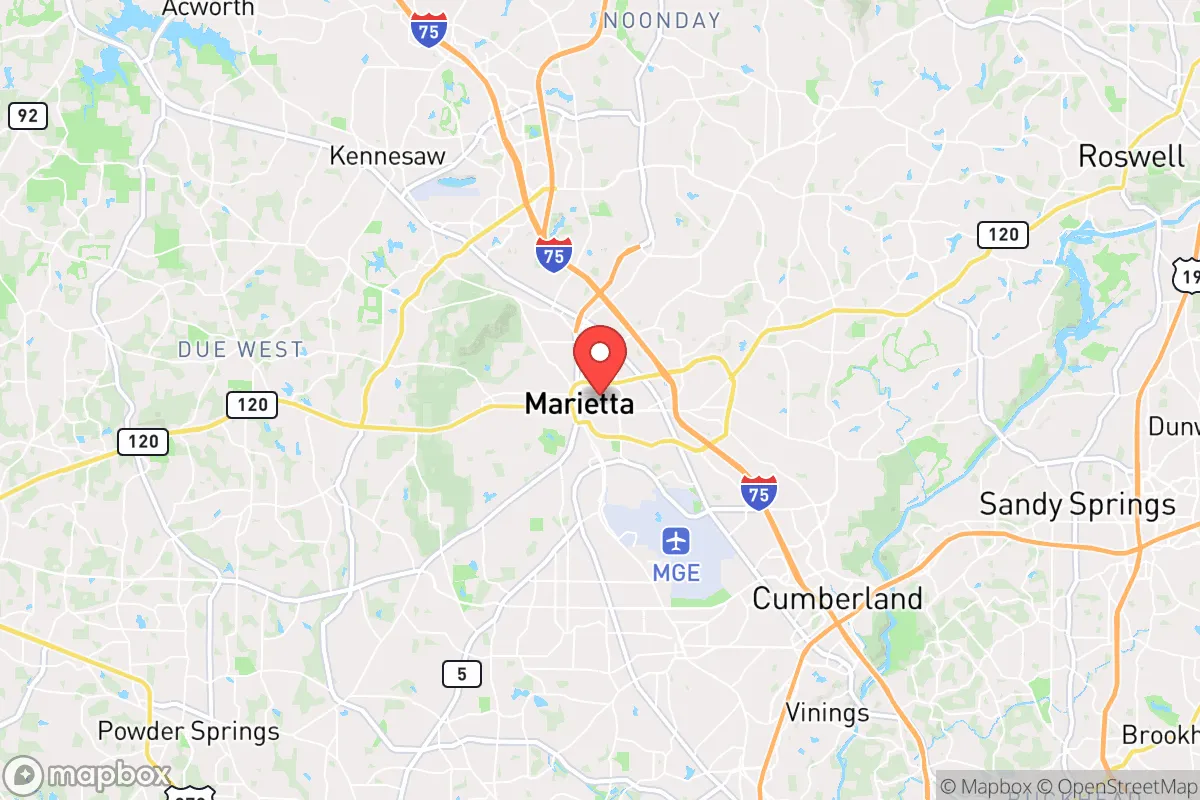
Marietta sits in Cobb County, which has been trending purple over the last decade—Hillary Clinton won it in 2016, and Joe Biden carried it in 2020. That’s a stark contrast to the city’s own R+12 rating, and it tells you a lot about the tension here. Head north to Kennesaw or Acworth, and you’ll find communities that still vote like Marietta used to: solidly conservative, with a strong emphasis on gun rights and local control. But drive east toward Sandy Springs or Buckhead, and you’re in deep-blue territory where government overreach into personal choices—like mask mandates or business closures—has become the norm. Marietta is the last line of defense for traditional values in this part of the metro, and that’s why the local elections matter more than ever.
What this means for residents
For those of us who moved here to escape the heavy hand of government, the recent shifts are concerning. You’re seeing more city council debates about zoning restrictions that could limit property rights, and school board meetings that get bogged down in progressive curriculum changes. The good news is that Marietta’s R+12 rating still gives conservatives a strong voice—local leaders know they can’t ignore the base. But if you value your Second Amendment rights or want to keep taxes low, you need to stay engaged. The long-term trend is clear: as Atlanta’s sprawl pushes north, more transplants bring their big-government ideas with them. It’s not a crisis yet, but it’s a slow erosion that demands vigilance.
One cultural distinction that sets Marietta apart is its deep-rooted sense of community independence. Unlike some neighboring towns that have embraced blanket mask mandates or vaccine passports, Marietta has generally pushed back on federal overreach, trusting residents to make their own choices. The annual Fourth of July parade and the local farmers market still feel like small-town America, not a government-run event. That said, the pressure is mounting—state-level debates over election integrity and school choice are front and center here, and Marietta’s future depends on keeping that conservative backbone strong. If you’re looking for a place where your freedoms aren’t just tolerated but defended, this is still it—but don’t take it for granted.

State Political ClimatePolitical Climate in Georgia
State Political AnalysisPolitical Environment in the State
Georgia has transformed from a reliably conservative stronghold into the nation’s premier political battleground, a shift that accelerated dramatically after 2020. The state now operates under a razor-thin partisan balance—Joe Biden won it by just 0.23% in 2020, and both Senate seats flipped Democratic in the 2020-2021 cycle—but Republicans still control the governorship, legislature, and all other statewide offices. Over the last 15 years, explosive growth in the Atlanta metro has diluted rural and exurban conservative votes, while the rest of the state—places like Dalton, Valdosta, and Augusta—has held firm or shifted rightward. The result is a state where your experience of freedom depends heavily on which county you call home.
Urban vs. rural divide
The political map of Georgia is a story of two Georgias. Metro Atlanta—specifically the urban core of Atlanta proper, plus close-in suburbs like Decatur and Sandy Springs—drives the state’s leftward trend. These areas are heavily Democratic, fueled by a coalition of young professionals, minority voters, and transplants from blue states. The “collar counties” that once voted Republican—Cobb, Gwinnett, Henry—have flipped blue in presidential races, a direct result of demographic change and corporate relocation. Meanwhile, the rest of the state is deeply red. Dalton in Whitfield County, the carpet capital of the world, remains conservative and working-class. Valdosta in Lowndes County anchors a solidly Republican south Georgia. Augusta, despite its urban core, votes reliably red in statewide races. The rural-urban divide is stark: drive 45 minutes outside the I-285 perimeter, and you’re in Trump country. The 2022 governor’s race saw Brian Kemp win by 7.5 points, powered by massive margins in exurban and rural counties that offset Atlanta’s turnout.
Policy environment
Georgia’s policy environment is a mixed bag for conservatives. On the plus side, the state has a flat income tax rate of 5.49% (down from 6% in 2022, with a path to 4.99% by 2029), and no estate or inheritance tax. The regulatory climate is business-friendly, with a right-to-work law and a tort reform package passed in 2005 that capped noneconomic damages. Education policy is a bright spot: Georgia has a robust charter school system, a school choice tax credit program (the Qualified Education Expense Tax Credit), and a new “Parents’ Bill of Rights” passed in 2022 that affirms parental authority over medical decisions and curriculum. However, the state’s healthcare landscape is concerning—Medicaid expansion has been rejected, which keeps premiums lower for private plans but leaves a coverage gap. Election integrity saw a major win with SB 202 (2021), which tightened voter ID requirements for absentee ballots, limited drop boxes, and banned mobile polling places. Critics call it “Jim Crow 2.0,” but supporters argue it restored confidence after the chaotic 2020 election. On the downside, Georgia has no statewide preemption on local gun ordinances, meaning Atlanta can (and does) pass its own restrictions—a sore point for gun owners.
Trajectory & freedom
Georgia’s trajectory on personal freedom is a tug-of-war. The good news: the state has expanded gun rights significantly. Constitutional carry (HB 218) was signed into law in 2022, allowing permitless carry of handguns for anyone 21 or older who can legally possess a firearm. The same year, the legislature passed a law prohibiting “vaccine passports” and banning government mandates for COVID-19 vaccines. Parental rights were strengthened with the aforementioned Parents’ Bill of Rights and a law requiring schools to notify parents of any “sexually explicit” instructional materials. Property rights got a boost with the passage of SB 9 (2022), which limited the ability of local governments to impose rent control. But there are worrying trends. Atlanta’s city council has passed ordinances restricting gun carry in city-owned buildings and parks, and the state’s “heartbeat” abortion law (HB 481, 2019) is currently tied up in court—if it falls, expect a rush of abortion tourism. The biggest threat to freedom is the influx of out-of-state voters. Roughly 100,000 people move to Georgia each year, many from California, New York, and Illinois. These newcomers tend to vote Democratic and support bigger government. If the trend continues, the state could flip blue at the state level within a decade, which would mean higher taxes, more regulation, and erosion of the conservative policy wins of the last decade.
Civil unrest & political movements
Georgia has been a flashpoint for political activism on both sides. The 2020 election cycle saw massive protests in Atlanta following the killing of George Floyd, with some devolving into property destruction and arson at the Wendy’s on University Avenue. The “Stop the Steal” movement was also active, with a rally at the state capitol in November 2020 and ongoing election integrity lawsuits. The most visible organized movement on the right is the Georgia Republican Assembly, which pushes for stricter election laws and anti-establishment candidates. On the left, groups like Fair Fight (founded by Stacey Abrams) and the New Georgia Project focus on voter registration and turnout, particularly in minority communities. Immigration politics are tense but not explosive—Georgia has no sanctuary cities, but Atlanta’s “Welcoming City” policy limits cooperation with ICE. The 2023 “Cop City” protests in DeKalb County, where activists opposed a police training facility, turned violent and resulted in a state of emergency. A new resident would notice the political polarization most in the suburbs: yard signs, bumper stickers, and heated Nextdoor debates are common. The 2024 election will be a stress test—expect heavy canvassing, legal challenges, and national media attention.
Projection
Over the next 5-10 years, Georgia is on a knife’s edge. Demographic trends favor Democrats: the Atlanta metro is growing faster than the rest of the state, and the white share of the population is declining. If current migration patterns hold, Georgia will likely become a blue state at the presidential level by 2032, and possibly at the state level by 2036. However, there are countervailing forces. The exurban counties—Forsyth, Cherokee, Paulding—are growing fast and remain deeply red. The 2020 census gave Georgia a 14th congressional seat, and the new map drawn by the Republican legislature packs Democratic voters into a few districts, preserving a 9-5 GOP advantage. The wild card is whether the state can hold the line on election integrity. If SB 202 survives legal challenges and is enforced strictly, it could suppress the Democratic turnout edge. But if the courts gut it, expect a blue wave. For a conservative moving in now, the smart play is to choose a county that matches your values—Dalton or Valdosta for a small-town feel, Forsyth County for a suburban stronghold, or Augusta for a mix of affordability and conservative politics. Avoid Atlanta proper and close-in suburbs unless you’re prepared for blue governance.
Bottom line: Georgia is still a good bet for conservatives who pick their location carefully. The state’s tax structure, gun laws, and parental rights are solid, and the rural/exurban areas are holding the line. But the clock is ticking. If you’re moving here, get involved in local politics, join a county GOP group, and vote in every primary. The state’s future depends on whether conservatives can turn out as reliably as the left’s new arrivals. Choose your county wisely, and you’ll find a place where freedom still has teeth—for now.
* Values derived from national, state, county, city and local statistics and may differ in a specific area. Last updated: 2026-04-24T07:12:47.000Z
Narrative content on this page is AI-generated and may contain mistakes. Verify any details that matter before acting on them.
ReloMaps may earn a commission from affiliate links at no extra cost to you.

