
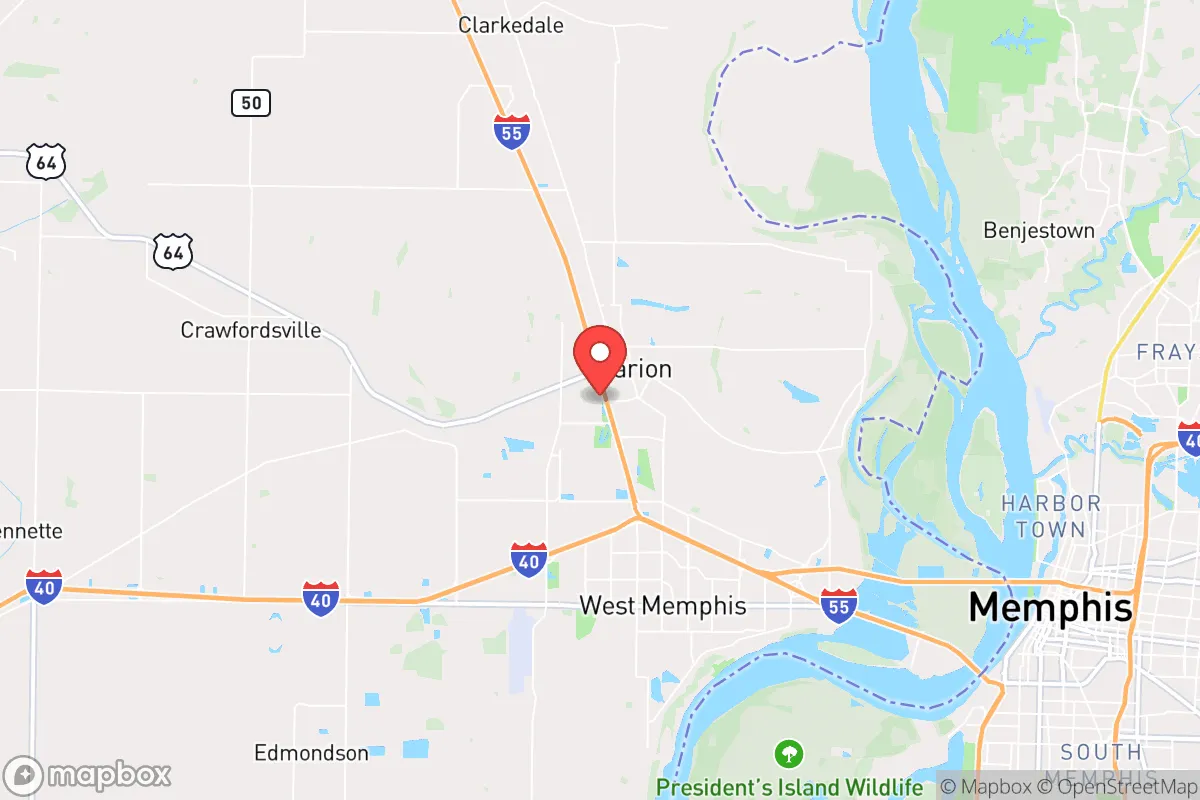
Photo: Wikipedia
Demographics of Marion, AR
Affluence Level in Marion, AR
A middle-class area roughly in line with national averages across income, home values, education, and employment.
People of Marion, AR
The people of Marion, Arkansas, today form a community of roughly 13,641 residents that is notably more diverse than the surrounding Crittenden County, with a distinctive Black-white balance of 36.2% Black and 51.8% white, alongside small but growing Hispanic (3.7%) and East/Southeast Asian (1.1%) populations. The city’s character is shaped by its role as a family-oriented, affordable suburb of Memphis, Tennessee, just across the Mississippi River, with a lower college attainment rate (24.5%) than the national average and a very small foreign-born share (1.7%). Marion’s identity is rooted in its historic role as a river town and railroad hub, but its modern population is increasingly defined by domestic migration from Memphis and other parts of the Mid-South, creating a community that is both racially integrated and economically modest.
How the city was settled and grew
Marion’s population history begins with its founding in 1836 as a river port and county seat of Crittenden County, drawing early settlers—mostly white farmers and merchants from Tennessee and Kentucky—who were attracted by the rich alluvial soil of the Mississippi Delta and the promise of cotton cultivation. The original settlement clustered around the courthouse square and along the riverfront, in what is now known as Historic Downtown Marion, where the first wave of families built homes and businesses. The arrival of the Memphis and Little Rock Railroad in the 1850s spurred a second wave of growth, bringing Irish and German laborers who settled in the Railroad District near the depot, working on track maintenance and in the cotton gins that lined the tracks. By the early 20th century, the population remained overwhelmingly white and native-born, with a small Black population of sharecroppers and domestic workers living in the South Marion area, a historically Black neighborhood that developed along the low-lying land south of the railroad. The Great Depression and the mechanization of cotton farming caused a population decline in the 1930s and 1940s, as many white and Black families left for industrial jobs in Memphis or the North, leaving Marion as a quiet, shrinking county seat of fewer than 2,000 residents by 1950.
Modern era (post-1965)
The modern transformation of Marion’s population began after 1965, driven by two forces: the construction of Interstate 55 and the expansion of Memphis’s suburban footprint. The I-55 bridge over the Mississippi River, completed in 1949, and the later development of the Marion exit at Highway 77 turned the city into a commuter suburb for Memphis, attracting white middle-class families from Tennessee seeking larger lots and lower taxes. These newcomers settled in the River Ridge subdivision, a planned development of ranch-style homes built in the 1970s and 1980s along the bluffs overlooking the river, and in the Fox Meadows neighborhood, a 1990s-era subdivision of brick homes popular with families. Simultaneously, the post-1965 relaxation of immigration laws had minimal direct impact on Marion—the foreign-born share remains just 1.7%—but the domestic migration of Black families from Memphis, driven by urban renewal and school desegregation pressures, accelerated after 1980. Black residents, many of whom had roots in the historic South Marion area, began moving into the West Marion neighborhoods west of the railroad tracks, including the Oakwood Hills subdivision, which became a predominantly Black middle-class enclave by the 2000s. The Hispanic population, now 3.7%, began arriving in the 1990s, primarily as laborers in the region’s poultry processing plants and construction industry, settling in the Marion Estates mobile home park and rental duplexes near the industrial corridor along Highway 77. The East/Southeast Asian population (1.1%) is a very recent addition, consisting mostly of Vietnamese and Filipino families who moved from Memphis for lower housing costs, with no single neighborhood concentration.
The future
Marion’s population is heading toward greater racial balance and slow, steady growth, but it is not homogenizing into a single melting pot. The Black share (36.2%) is likely to continue rising slowly as Memphis’s Black middle class seeks affordable suburban homes, while the white share (51.8%) is declining gradually as older white residents age in place and younger white families choose newer suburbs further east, like West Memphis or even Tennessee-side towns. The Hispanic and East/Southeast Asian communities are small and appear to be plateauing rather than surging, as the local economy—dominated by retail, logistics, and schools—does not offer the same pull as larger metro areas. The city is not tribalizing into distinct ethnic enclaves, but neighborhoods do show clear patterns: River Ridge and Fox Meadows remain overwhelmingly white, Oakwood Hills and West Marion are predominantly Black, and the newer subdivisions along Highway 77, such as Briarwood, are more mixed. Over the next 10-20 years, Marion will likely remain a modestly growing, majority-white suburb with a strong Black minority and very small immigrant communities, appealing primarily to families seeking a lower-cost, quieter alternative to Memphis proper.
For someone moving in now, Marion is becoming a stable, family-oriented suburb where racial integration is a lived reality rather than a political slogan, but where economic and educational opportunities remain limited compared to larger metro areas. The city’s future is one of slow, organic change, not rapid transformation, making it a predictable choice for conservative-leaning families who value affordability, community, and proximity to Memphis without its urban challenges.

* Values derived from national, state, county, city and local statistics and may differ in a specific area. Last updated: 2026-04-21T09:09:34.000Z
Narrative content on this page is AI-generated and may contain mistakes. Verify any details that matter before acting on them.
ReloMaps may earn a commission from affiliate links at no extra cost to you.

