
Photo: Wikipedia
Political ClimatePolitical Climate in Marion, AR
District shown is the primary district for this city’s centroid. Cities may span multiple districts.
Local Political AnalysisPolitical Analysis of Marion, AR
Marion, Arkansas, sits deep in reliably red territory, with a Cook PVI of R+23 that reflects a community where conservative values aren't just a preference—they're the baseline. This isn't a purple area that flips with the national mood; it's a place where the political culture has been steady for decades, anchored by a strong sense of personal responsibility and a wariness of government overreach. If you've lived here a while, you've seen the slow creep of progressive ideas in other parts of the country, but Marion has largely held the line, and most folks intend to keep it that way.
How it compares
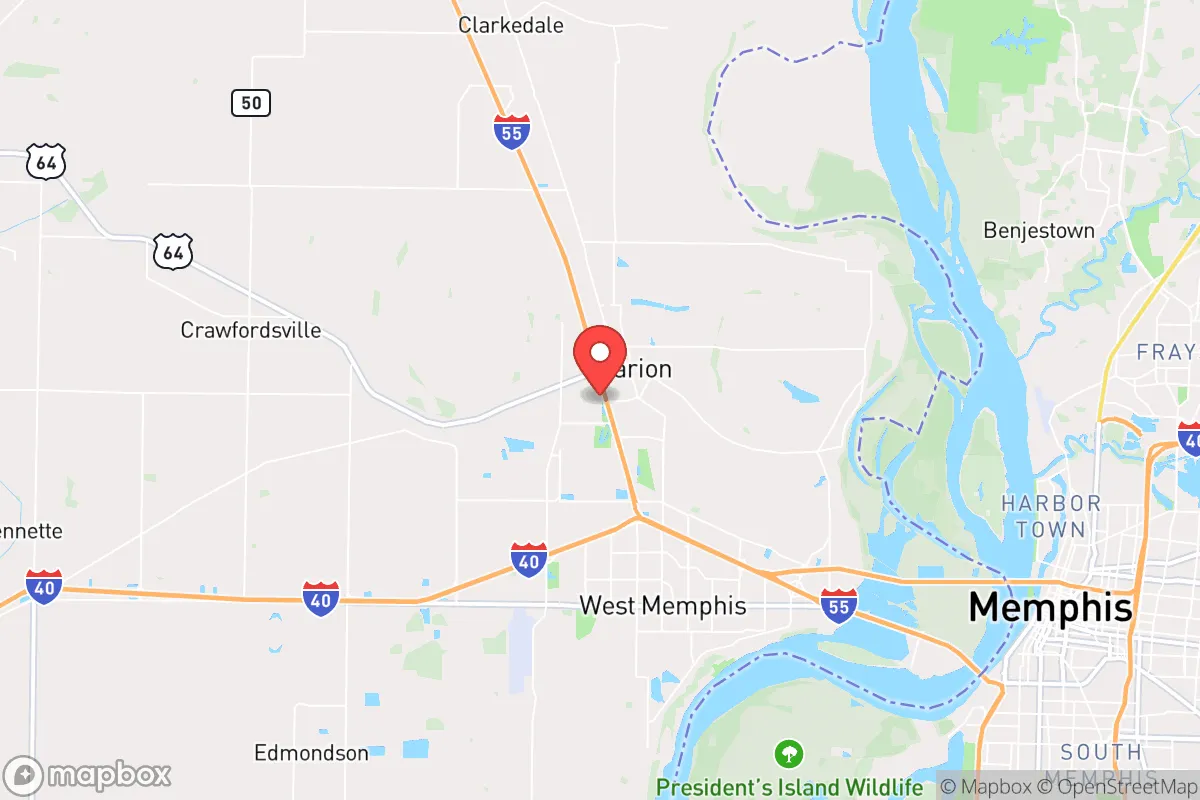
Drive just a few miles south into Memphis, Tennessee, and you're in a completely different political universe—a deep blue urban center where the local government is far more comfortable with expansive public programs and tighter regulations. That contrast is stark and immediate. Marion, by contrast, feels like a refuge for those who want to live under a lighter touch from the state. Surrounding Crittenden County votes solidly Republican, but even within the county, Marion tends to be more consistently conservative than some of the smaller, more transient communities along the Interstate 55 corridor. The nearby towns of West Memphis and Turrell have seen more political volatility, but Marion's electorate has stayed remarkably stable, voting for Republican candidates by wide margins in every recent presidential and statewide race. That consistency isn't an accident—it's a reflection of a population that values predictability and limited government.
What this means for residents
For the people who call Marion home, this political climate translates into a daily life with fewer surprises from the government. Local officials generally take a hands-off approach to business and property rights, which means you're less likely to see zoning fights or new mandates that complicate running a small shop or owning a home. The school board and city council tend to focus on core services—roads, public safety, basic infrastructure—rather than wading into social experiments or progressive policy pushes. That's a relief for families who just want to raise their kids without the school system becoming a battleground for ideological agendas. The tax burden here is modest compared to what you'd face across the state line in Tennessee's larger cities, and there's a general understanding that your paycheck and your personal choices are yours to manage. Any shift toward progressive ideology—whether it's in curriculum, local ordinances, or policing philosophy—is met with immediate skepticism. People here remember what happens when governments start thinking they know better than the people they serve.
One cultural distinction worth noting: Marion has a strong tradition of civic involvement that leans heavily on church and community organizations rather than government programs. If there's a need—helping a neighbor after a storm, funding a youth sports team, supporting a local family in crisis—the response comes from the community, not from a new city department. That self-reliance is a point of pride, and it's exactly the kind of thing that makes Marion feel like a place where conservative values aren't just talked about on election day but lived out every day. The long-term outlook here is cautious but optimistic: as long as the area can keep outside political pressures from reshaping local priorities, Marion will remain a solid, sensible place to put down roots.

State Political ClimatePolitical Climate in Arkansas
State Political AnalysisPolitical Environment in the State
Arkansas has been a reliably red state for decades, but it’s not the same Arkansas it was 20 years ago. The state leans solidly Republican at the presidential and state level — Donald Trump won it by 27 points in 2024 — but the real story is the slow, steady shift in its population centers and the quiet battle between traditional conservative values and the creeping influence of out-of-state transplants and federal money. The old Democratic machine that ran things up through the 1990s is dead, replaced by a GOP supermajority that’s been in control since 2012, but the fight now is about how far that control goes and whether it can hold off the progressive drift seen in neighboring states.
Urban vs. rural divide
The political map of Arkansas is a classic urban-rural split, but with a twist. The two biggest metros — Little Rock (Pulaski County) and Fayetteville (Washington County) — are the blue dots in a sea of red. Pulaski County voted for Joe Biden in 2020 and Kamala Harris in 2024, but by shrinking margins; it’s the only county in the state that consistently goes Democratic, driven by the capital city’s government workforce, the University of Arkansas for Medical Sciences, and a growing professional class. Washington County, home to the University of Arkansas, flipped from red to purple over the last decade — Trump won it by just 4 points in 2024, down from 15 in 2016 — as Fayetteville and Bentonville attract younger, more educated transplants from California and the Northeast. Meanwhile, the rural counties — places like Baxter County (Mountain Home), White County (Searcy), and Craighead County (Jonesboro) — vote 70-80% Republican, and they’re the backbone of the state’s conservative majority. The Arkansas River Valley and the Delta region (eastern Arkansas) are more mixed, with some old-line Democratic holdouts in majority-black areas like Jefferson County (Pine Bluff) and Phillips County (Helena-West Helena), but those populations are shrinking fast. The real battleground is the Northwest Arkansas corridor — if that area keeps trending left, the state’s overall lean could soften over time.
Policy environment
Arkansas’s policy environment is aggressively conservative, but with some notable wrinkles. The state has a flat income tax that was cut from 4.9% to 3.9% in 2025, with a goal of phasing it out entirely by 2030 — a major draw for people fleeing high-tax states. Sales tax is high (6.5% state rate, plus local add-ons that can push it over 10% in some cities), but property taxes are low, especially in rural areas. The Arkansas LEARNS Act, passed in 2023, created a universal school voucher program that lets parents use state funding for private or homeschool expenses — a huge win for school choice advocates. On healthcare, the state expanded Medicaid under the private option (Arkansas Works) in 2013, a pragmatic move that’s still controversial among conservatives, but there’s no talk of repealing it. Election integrity is a hot topic: the state passed voter ID laws in 2013 and tightened absentee ballot rules in 2021, but there’s no widespread fraud narrative here. The Second Amendment is fully protected — constitutional carry passed in 2021, and there are no red-flag laws. The regulatory environment is business-friendly, with no state-level minimum wage above the federal $7.25 (though cities like Fayetteville have tried to raise it locally). The biggest policy concern for conservatives is the slow creep of federal mandates — especially on environmental regulations affecting the timber and poultry industries — and the growing influence of Walmart and Tyson Foods in Northwest Arkansas, which push a more corporate, diversity-and-inclusion agenda that sometimes clashes with grassroots conservatism.
Trajectory & freedom
On the freedom front, Arkansas is moving in the right direction, but it’s a mixed bag. The Arkansas Sovereignty Act (2021) asserts the state’s right to nullify federal overreach, though it’s mostly symbolic. Parental rights were strengthened with the Arkansas Parental Rights Amendment (2023), which requires schools to get parental consent before teaching about sexuality or gender identity — a direct response to the progressive push in other states. Medical freedom took a hit with the state’s strict COVID-19 vaccine mandates for healthcare workers (later repealed in 2023), but overall, the legislature has resisted federal health mandates. Gun rights expanded with constitutional carry, and there’s no red-flag law on the books. Property rights are generally strong, though the state’s use of eminent domain for economic development projects (like the I-49 corridor expansion) has raised eyebrows. The biggest threat to freedom is the state’s reliance on federal funding — about 40% of the state budget comes from Washington, which gives the feds leverage. On the plus side, the Arkansas Freedom of Information Act is one of the strongest in the South, and the state has no income tax on military retirement pay. The trajectory is toward more individual liberty, but the battle is against the slow erosion of local control through federal grants and corporate influence.
Civil unrest & political movements
Arkansas is not a hotbed of civil unrest, but there have been flashpoints. The Black Lives Matter protests in Little Rock in 2020 were relatively small and peaceful compared to other cities, but they did lead to the removal of a Confederate monument at the state capitol. The Arkansas Patriot movement is active in rural areas, with groups like the Oath Keepers and Three Percenters having a presence, but they’re more focused on preparedness than confrontation. Immigration politics are a low-key issue — the state has a small but growing Hispanic population (mostly in Northwest Arkansas), and the legislature passed a law in 2023 requiring local law enforcement to cooperate with ICE. There’s no sanctuary city movement; even Fayetteville, the most liberal city, has avoided declaring itself a sanctuary. Election integrity controversies are minimal — the 2020 and 2022 elections were smooth, with no major fraud allegations. The most visible political movement is the school choice push, which has energized conservative parents and drawn opposition from teachers’ unions. The Arkansas Abortion Amendment (a proposed constitutional amendment to restore abortion access) failed to make the 2024 ballot, but the issue remains a rallying point for both sides. Overall, the state is politically stable, with no major unrest that would concern a new resident.
Projection
Over the next 5-10 years, Arkansas will likely stay red, but the shade of red could lighten. The Northwest Arkansas corridor — Bentonville, Rogers, Springdale, and Fayetteville — is growing fast, attracting young professionals and remote workers from blue states. That influx is already shifting Washington County from deep red to purple, and if it continues, the state could see a competitive Senate race by 2030. The rural counties are losing population, which means their electoral weight is shrinking. The Delta region is depopulating even faster, which hurts the Democratic base. The Little Rock metro is stagnant, with population growth flat. The wild card is in-migration — if the state continues to attract conservatives fleeing California and Illinois, the red lean could hold or even deepen. But if the newcomers are more moderate or libertarian, the state could see a shift toward a more pragmatic, less culturally conservative GOP. The income tax phase-out is a major draw, and if it succeeds, it could accelerate growth. The biggest risk is that the state’s education system — ranked near the bottom nationally — could deter families, but the LEARNS Act is an attempt to fix that. For a conservative moving in now, expect the state to remain a solid red anchor in the South for at least the next decade, but keep an eye on Northwest Arkansas — that’s where the future is being written.
For a new resident, the bottom line is this: Arkansas offers a high degree of personal freedom, low taxes, and a government that generally stays out of your life — as long as you’re not in the way of a federal grant or a corporate development project. The culture is welcoming to conservatives, with strong gun rights, school choice, and parental control. The downsides are the reliance on federal money, the slow growth of progressive influence in the northwest corner, and the state’s poor national rankings on education and health outcomes. If you’re looking for a place where your values are the norm and the government is on your side, Arkansas is a solid bet. Just don’t expect it to stay exactly the same — the newcomers are coming, and they’ll bring their politics with them.
* Values derived from national, state, county, city and local statistics and may differ in a specific area. Last updated: 2026-04-21T09:09:34.000Z
Narrative content on this page is AI-generated and may contain mistakes. Verify any details that matter before acting on them.
ReloMaps may earn a commission from affiliate links at no extra cost to you.

